
TL;DR
Abit rose to prominence in the 1990s by shipping enthusiast-friendly boards like the IT5H and BP6, but a string of hardware-quality issues, the loss of a key engineer, outsourcing, and accounting problems precipitated its decline. The company was sold to USI in 2006 and the Universal Abit brand folded at the end of 2008.
What happened
Abit, founded in 1989, became a favorite among PC enthusiasts in the 1990s thanks to boards that made overclocking and unusual builds accessible. Products such as the jumperless IT5H (Socket 7, Intel 430HX) with its CPU Softmenu and the BP6 (Socket 370) that enabled inexpensive dual‑CPU setups earned Abit a devoted following. Over time the company cut costs on components, notably using capacitors of lower endurance than competitors, leaving many boards vulnerable when the broader capacitor problems emerged. In 2002 Abit began outsourcing some low‑end models to Elite Computer Systems. In March 2003 the company lost Oscar Wu, the engineer behind several hallmark features. Then in December 2004 Abit faced delisting after questions about its accounting and inflated counts. Abit was sold to Universal Scientific Industrial in January 2006 and the Universal Abit venture was shuttered on December 31, 2008.
Why it matters
- Hardware design and component choices can determine a platform’s long‑term reliability and reputation.
- Key technical leaders can be central to a hardware maker’s competitive edge; their departure can affect product direction.
- Corporate governance and accounting issues can destroy customer trust and investor support even for well‑known brands.
- Legacy hardware still has value to collectors and restorers, but long‑term usability often requires component replacement.
Key facts
- Abit was founded in 1989 and built early 386 and 486 motherboards.
- The Abit IT5H (Socket 7, Intel 430HX chipset) offered jumperless configuration and a CPU Softmenu for voltage and bus changes.
- The Abit BP6 allowed inexpensive dual‑CPU systems using Socket 370 Celeron chips by wiring the board to enable multiprocessor use.
- Abit used capacitors of lower longevity than some competitors, making many boards susceptible during the industry capacitor failures.
- From 2002 Abit outsourced some low‑end motherboard production to Elite Computer Systems (ECS).
- Oscar Wu, the engineer behind the Softmenu and key designs, left Abit for rival maker DFI in March 2003.
- In December 2004 Abit was delisted after reports of inflated counts and potentially improper accounting practices.
- Abit was acquired by Universal Scientific Industrial on January 25, 2006; Universal Abit closed December 31, 2008 and ceased January 1, 2009.
- Collectors prize classic Abit boards today, but practical reuse typically requires replacing electrolytic capacitors with higher‑quality parts.
What to watch next
- Collector markets and restoration activity around Abit boards, including capacitor replacement and repaired examples.
- Not confirmed in the source: any attempt to revive the Abit brand or relaunch its designs under a new ownership.
Quick glossary
- Motherboard: The main printed circuit board in a computer that houses the CPU, memory, chipset, and expansion slots.
- Capacitor plague: A period when many electrolytic capacitors failed prematurely across the electronics industry, causing reliability problems.
- Front side bus (FSB): A communications pathway between the CPU and the system chipset used in many older PC architectures.
- CPU multiplier: A factor that multiplies the base bus frequency to determine a processor’s operating clock speed.
- Overclocking: Running hardware at higher speeds than the manufacturer’s specified operating frequency to increase performance.
Reader FAQ
Is Abit still an active company?
No. Abit was sold to Universal Scientific Industrial in 2006 and Universal Abit closed on December 31, 2008.
Why did Abit fail?
A combination of lower‑end component choices (notably capacitors), outsourcing, the departure of a key engineer, and questionable accounting led to loss of trust and eventual sale.
Can Abit motherboards still be used?
Many are usable after replacing aging electrolytic capacitors with higher‑quality parts; collectors prize certain models for restoration.
Who designed Abit’s famous features like the Softmenu?
Oscar Wu was the engineer credited with the CPU Softmenu and much of the hardware design; he left Abit for DFI in March 2003.
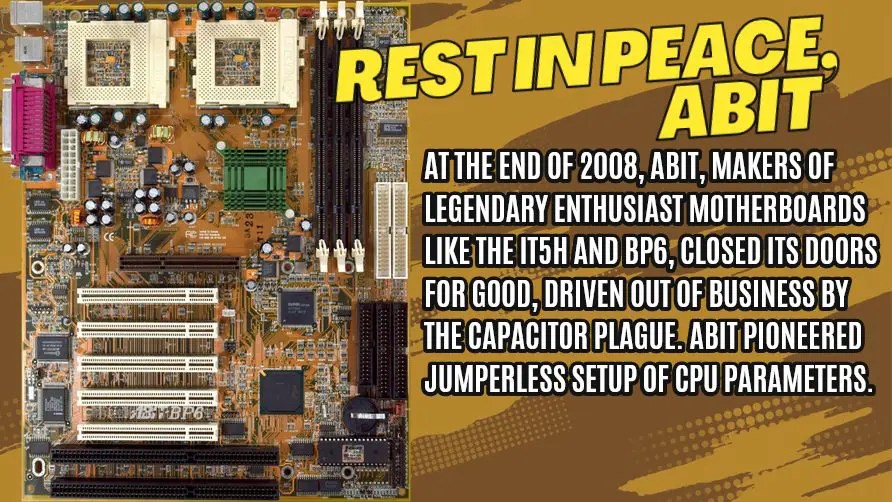
What happened to Abit motherboards Dave Farquhar Retro Computing December 30, 2025 1 Comment At the end of the year in 2008, one of the most legendary motherboard manufacturers of…
Sources
- What Happened to Abit Motherboards
- Abit reportedly leaving motherboard business
- Motherboard Manufacturer Abit Dead (Sort-of) – ABC News
- Universal abit Denies Claims That it is Leaving …
Related posts
- GameSir adds tiny force-feedback steering wheel to Swift Drive controller
- Leaked Galaxy S26 video suggests Fold-style unified camera island
- Anker’s 521 PowerHouse portable backup battery drops to about half price