
TL;DR
A short anecdote from Yakov Perelman's 1927 collection recounts a man who circles a glade trying to glimpse a squirrel that keeps showing only its face. Observers debate whether walking around the tree in the center counts as 'circling the squirrel' when the animal never exposes its back.
What happened
In a brief dialogue drawn from Yakov Perelman's Mathematics Can Be Fun (1927), a narrator describes playing hide-and-seek with a squirrel perched on a birch in the middle of a small round glade. The narrator walks around the glade's edge four times, keeping his distance to avoid startling the animal; each time the squirrel retreats on the trunk and only its snout and eyes are visible. Other participants in the conversation insist that by circling the central tree the narrator has, by definition, circled the squirrel as well. The narrator objects, arguing that he never saw the squirrel's back and therefore cannot truthfully claim to have circled it. The exchange ends with a dispute over whether the physical act of going around the tree equates to going around the animal when the animal continually faces the same direction.
Why it matters
- Illustrates how everyday language can hide ambiguous assumptions about what actions mean.
- Highlights a distinction between geometric or spatial descriptions and an observer's perception of an object.
- Serves as a concise example of logical or semantic puzzles that can arise from simple scenarios.
- Shows how a small anecdote can provoke an argument about definitions and evidence.
Key facts
- The anecdote appears in Yakov Perelman's Mathematics Can Be Fun, published in 1927.
- The scene is set in a small round glade with a lone birch at its centre.
- The narrator reports making four circuits along the glade's edge while trying to see the squirrel.
- Each time the narrator approached, the squirrel retreated on the trunk and only its face was visible.
- Listeners argue that circling the tree should be taken as circling the squirrel; the narrator disagrees because he never saw its back.
- The exchange is presented as a short dialogue that probes the meaning of 'circling' in this context.
- The excerpt was republished on Futility Closet on January 2, 2026 under the 'Oddities' category.
What to watch next
- not confirmed in the source
- not confirmed in the source
Quick glossary
- Glade: An open space in a forest, typically grassy and surrounded by trees.
- Perimeter: The continuous boundary or outer edge of a two-dimensional shape or area.
- Semantics: The study of meaning in language, including how words and phrases are interpreted.
- Paradox: A statement or situation that appears contradictory or defies intuition, often prompting closer analysis.
- Yakov Perelman: An author known for writing accessible popular-science and mathematics books in the early 20th century.
Reader FAQ
Who wrote this anecdote?
Yakov Perelman; it appears in his book Mathematics Can Be Fun (1927).
Was the story republished recently?
Yes — the excerpt was posted on Futility Closet on January 2, 2026 under the 'Oddities' section.
Did the narrator actually see the squirrel's back?
No; the narrator states he never saw the back because the squirrel kept showing only its face.
Is there a definitive resolution to the argument in the excerpt?
Not confirmed in the source.
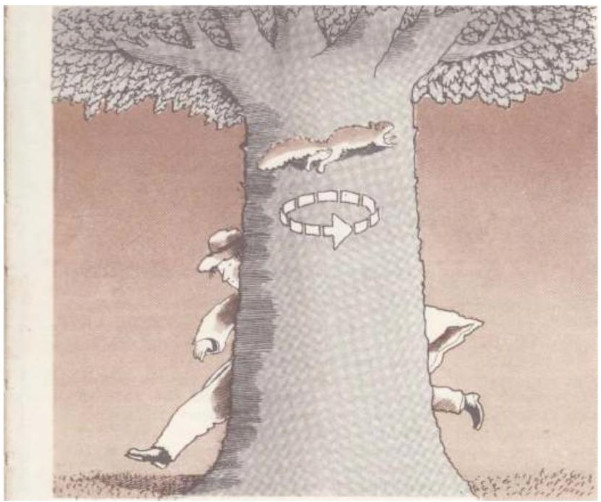
Round and Round ‘I had quite a bit of fun playing hide-and-seek with a squirrel,’ he said. ‘You know that little round glade with a lone birch in the centre?…
Sources
- Round the tree, yes, but not round the squirrel
- The squirrel problem | Just Thomism – WordPress.com
- Lecture II. What Pragmatism Means (by William James)
- James' What Pragmatism Means
Related posts
- Y2K duty postponed one honeymoon by 17 years — more millennial IT tales
- Your Real Biological Clock: Mortality Shapes When People Become Parents
- Lenovo Coupons and Promotions: Big Savings, Rewards, Financing Options