
TL;DR
The US has told all 43 Visa Waiver Programme (VWP) countries to sign an 'Enhanced Border Security Partnership' that would give US authorities direct access to partner police databases containing fingerprints, facial images and other personal data. Refusal risks losing visa-free travel status; the plan raises legal and privacy questions in Europe and conflicts with current data-exchange norms.
What happened
The United States has asked every country in the Visa Waiver Programme—43 states, mostly in Europe—to enter an Enhanced Border Security Partnership (EBSP). The proposal would allow US authorities direct access to police databases in partner countries, including biometric records such as fingerprints and facial images as well as other personal data. Countries that do not accept the partnership could be excluded from visa-free travel. The demand departs from existing practice within Europe, where data exchange usually follows a hit/no-hit model and further information is shared only after a specific request. The Prüm framework among Schengen states has mainly covered fingerprints and DNA and is being extended to facial images. The US push also rekindles debates about compatibility with EU data-protection rules and the role of US immigration bodies that already use multiple data sources in enforcement.
Why it matters
- Direct database access would significantly broaden the range of personal and biometric data available to US authorities.
- Countries in the VWP face a choice between maintaining visa-free travel arrangements and rejecting expanded data sharing.
- The proposal departs from established intra-European data-exchange practices, which generally limit automatic direct access.
- Legal and privacy questions arise about how such transfers would comply with EU data-protection rules like the GDPR.
- Expanded access could strengthen US immigration enforcement operations that already make use of varied data sources.
Key facts
- The US has set a deadline of 31 December 2026 for VWP states to conclude the EBSP.
- The Visa Waiver Programme includes 43 countries, most of them in Europe.
- The EBSP aims to grant US authorities direct access to police databases containing fingerprints, facial images and other personal data.
- Countries that refuse the partnership risk exclusion from the visa-free travel programme.
- Existing intra-EU exchange typically uses a 'hit/no-hit' principle with follow-up requests, not broad direct access.
- The Prüm Treaty among Schengen states has covered fingerprints and DNA and is being expanded to include facial images.
- Germany alone might make available around 5.5 million facial images and a similar number of fingerprints, according to the source.
- The US previously tightened VWP rules in 2006 (biometric passports) and 2008 (ESTA pre-registration); bilateral exchanges of fingerprints and DNA have been limited to serious-crime cases.
- The EU–US Police Framework Agreement does not apply to the proposed EBSP, which would be for law enforcement purposes.
- The EU Commission intends to seek a single framework agreement to apply across member states; some countries have already concluded bilateral arrangements.
What to watch next
- Whether the EU Commission can negotiate a common framework agreement with the US — not confirmed in the source.
- Which VWP states will accept the EBSP and which will face exclusion by the US — not confirmed in the source.
- Legal challenges or rulings on compatibility with GDPR and other EU data-protection standards — not confirmed in the source.
- Uptake and scope of bilateral deals already agreed between some countries and the US.
Quick glossary
- Visa Waiver Programme (VWP): A US programme that allows citizens of designated countries to travel to the United States for short stays without a visa.
- Enhanced Border Security Partnership (EBSP): A proposed arrangement by the US to obtain direct access to partner countries' police databases, including biometric records.
- Hit/no-hit principle: A data-exchange method where systems report whether a match exists and further information is requested only after a hit.
- Prüm Treaty: An agreement among Schengen states facilitating cross-border cooperation, historically covering fingerprints and DNA and being extended to facial images.
- GDPR: The European Union's General Data Protection Regulation, a legal framework for personal data protection and processing.
Reader FAQ
Who would be affected by the US demand?
All 43 countries in the Visa Waiver Programme and people whose data are held in partner police databases; anyone under border authority jurisdiction could be affected.
What data would the US seek access to?
The proposal would cover fingerprints, facial images and other personal data in police databases.
Is this kind of direct access already standard among EU states?
No. The source says intra-EU exchange typically uses a hit/no-hit approach; the proposed direct access is unprecedented among EU members.
Does the EU consider the EBSP compatible with its data-protection rules?
The source says compatibility with GDPR is questionable and the EU Commission wants to negotiate a framework — further outcomes are not confirmed in the source.
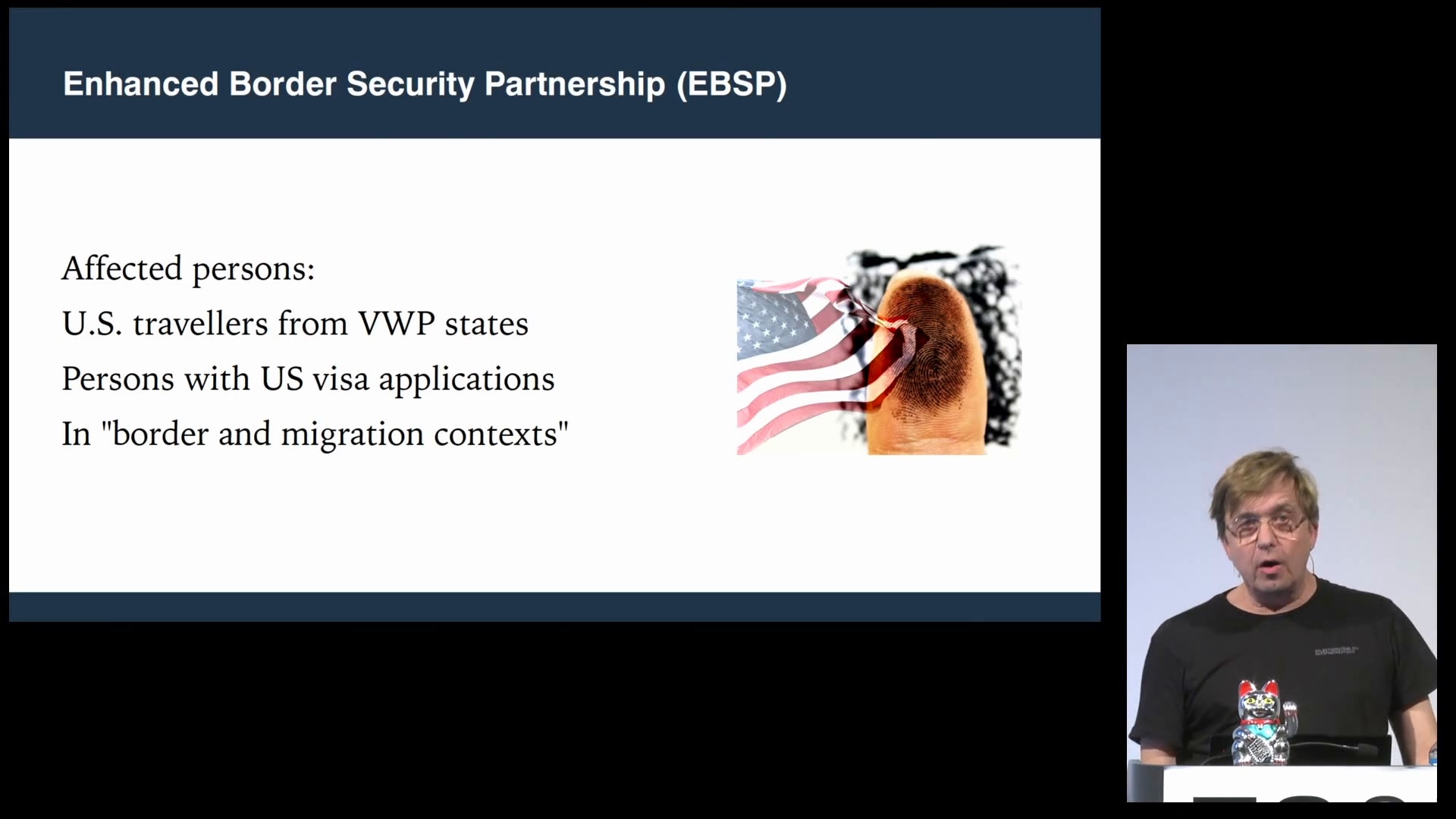
Trump government demands access to European police databases and biometrics Matthias Monroy Video Player 15 30 00:00 | 40:07 1.00x eng 1080p h264-hd (mp4) fra 1080p h264-hd (mp4) deu 1080p…
Sources
- US Government demands access to European police databases and biometrics
- US access to EU citizens' biometric data: ministers approve …
- Trump government demands access to European police …
- US Demands Direct Access to EU Databases for Traveler …
Related posts
- Finnish police detain crew of cargo ship after Baltic undersea cable damage
- Ukrainian Soldier’s M1 MacBook Air Blocks Artillery Fragment and Still Works
- British security researcher gets invite-only Australian visa after reporting DFAT flaw