
TL;DR
A short dialogue from Yakov Perelman's 1927 book describes a man who walks around a circular glade while a squirrel hides on a birch at the center. Listeners dispute whether circling the tree counts as circling the squirrel when the animal continually faces the walker.
What happened
The excerpt recounts a conversational vignette in which a narrator describes playing hide-and-seek with a squirrel perched on a lone birch at the center of a round glade. To avoid frightening it, he keeps to the glade's rim and completes four circuits, but the squirrel retreats behind the trunk so its back is never visible. A listener points out that circling the tree amounts to circling the squirrel, since the animal occupies the tree. The narrator objects, arguing that because he never saw the squirrel's back—because the animal kept facing him—he did not, in his view, circle the squirrel. The exchange hinges on whether 'circling' should be judged by the path taken around a fixed point (the tree) or by relative orientation to the creature itself. The passage is credited to Yakov Perelman from Mathematics Can Be Fun (1927) and appears on futilitycloset.com in a January 2, 2026 post.
Why it matters
- It highlights how everyday language can conceal subtle logical and semantic questions about reference and perspective.
- The short scene illustrates a common distinction between objective position (an object's location) and subjective orientation (what is visible to an observer).
- Such puzzles are useful for teaching critical thinking about definitions, assumptions, and how problems are framed.
- The anecdote is part of a tradition of popular mathematics and recreational logic that seeks to make abstract ideas accessible.
Key facts
- The passage is an excerpt from Yakov Perelman's Mathematics Can Be Fun, published in 1927.
- The setting is a circular glade with a single birch standing at its center.
- A narrator walked around the edge of the glade four times to try to see a squirrel hiding on the birch.
- The squirrel repeatedly backed away behind the tree so that its back was never seen by the narrator.
- A listener argues that circling the tree is equivalent to circling the squirrel because the animal is on the tree.
- The narrator maintains that because he never saw the squirrel's back, he did not, in his sense, circle the animal.
- The dialogue focuses on whether 'circling' should be defined by the path around a point or by the relative orientation to a living subject.
- This excerpt was reposted on futilitycloset.com on January 2, 2026 under the 'Oddities' category.
What to watch next
- How you choose to define 'circling'—by spatial path or by an observer-relative relation—determines which interpretation you accept.
- Not confirmed in the source: whether Perelman intended this exchange as a formal logical paradox, a pedagogical example, or simply a witty anecdote.
- Not confirmed in the source: any further commentary or resolution provided by Perelman in the original book beyond this short dialogue.
Quick glossary
- Semantic ambiguity: A situation in which a word, phrase, or sentence can be interpreted in more than one way due to multiple possible meanings.
- Perspective (in observation): The viewpoint or orientation of an observer that affects what aspects of a scene are visible or salient.
- Reference: The relation between a word or expression and the object or concept it denotes.
- Logical puzzle: A problem or anecdote posed to provoke reasoning, uncover implicit assumptions, or illustrate a conceptual point.
Reader FAQ
Who wrote the passage?
The passage is attributed to Yakov Perelman and comes from his 1927 book Mathematics Can Be Fun.
What is the central question in the dialogue?
Whether walking around a tree should be considered 'circling' the animal on that tree, given that the animal continually faces the walker.
Where was this excerpt reposted online?
It appears on futilitycloset.com in a post dated January 2, 2026.
Does the source provide a definitive answer to the dispute?
Not confirmed in the source.
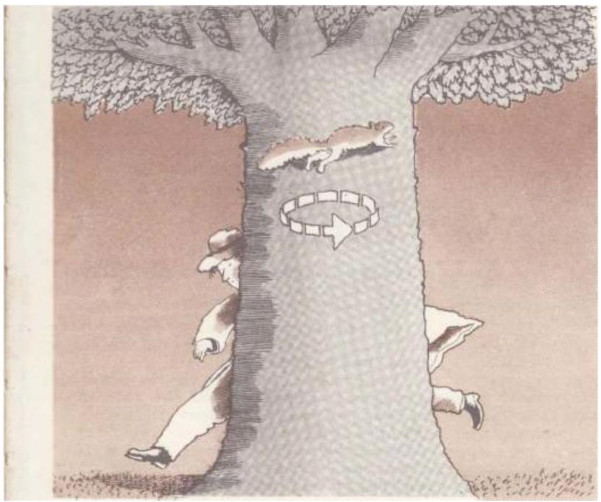
Round and Round ‘I had quite a bit of fun playing hide-and-seek with a squirrel,’ he said. ‘You know that little round glade with a lone birch in the centre?…
Sources
- Round and Round
- Explain the answer to this logic puzzle
- The Circular Logic of Uniqueness
- Numberplay: Circular Logic
Related posts
- IPv6 turns 30: hasn’t dominated the internet but isn’t a failure
- Why Many Americans Distrust Artificial Intelligence — A Briefing
- Assorted less(1) tips: Practical shortcuts for using the less pager