
TL;DR
Analysis of UC San Diego admissions from 2022–24 shows admission rates vary strongly by the high school a student attends, with a clear boost for schools designated LCFF+. High-achieving schools that produce many applicants can see lower acceptance rates, while some lower-proficiency LCFF+ schools have higher-than-expected admit rates.
What happened
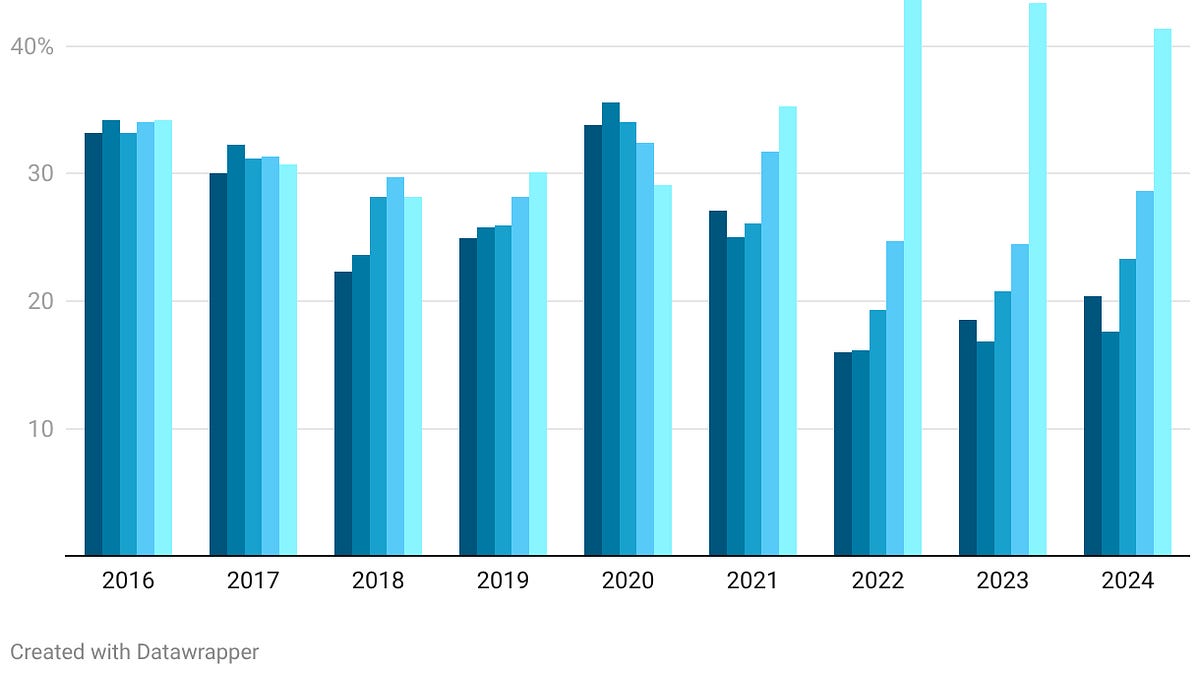
Reporting on UC San Diego admissions between 2022 and 2024 finds that the chance a student is admitted depends heavily on their high school. UCSD admitted roughly 26% of public-school applicants overall, but rates varied widely by school: small programs sending fewer than 25 applicants a year averaged admission rates above 40%, while the 63 schools that sent more than 200 applicants averaged only 18% admitted. The analysis contrasts schools such as Lynbrook High (high levels of Math and English proficiency among seniors but few admits) with Crawford High (lower measured proficiency yet substantially more admits). Selective schools also show inconsistent outcomes: some selective campuses had high admit shares while others with similar proficiency levels had much lower shares. A major driver is the Unduplicated Pupil Percentage (UPP) under California’s LCFF policy: UCSD has been giving a substantial boost to students from schools with UPP above 75% (so-called LCFF+ schools), producing a visible discontinuity in admission rates between high-UPP and lower-UPP schools. Other patterns include lower average admission rates for private-school applicants despite evidence they are often objectively stronger, and a large rise in California applications—a 57% increase to UCSD from 2016 to 2024—exacerbating competition.
Why it matters
- School-level factors, not only individual credentials, are shaping UCSD admissions outcomes.
- Students at high-performing schools that send many applicants face intensified internal competition for limited spots.
- The LCFF+ preference shifts admission advantages toward schools with high shares of high-needs students, affecting which applicants benefit.
- Private-school applicants as a group have had lower admission rates at UCSD despite data suggesting greater objective strength.
Key facts
- UC San Diego enrolled freshmen in 2024 with 8.5% needing remedial math classes.
- Across 2022–24 UCSD admitted about 26% of all public school applicants.
- Schools sending fewer than 25 applicants per year averaged admission rates over 40%; 63 schools sending more than 200 applicants averaged an 18% admission rate.
- Lynbrook High (San Jose): 375 seniors proficient in both Math and English; 37 admitted to UCSD. Crawford High (San Diego): 23 seniors proficient in both (8.6% of 266 seniors) yet 38 admitted.
- Selective schools varied: CAMS had over 90% proficiency and nearly 40% admitted; Gretchen Whitney and Oxford Academy had similar proficiency but under 20% admitted.
- Private school applicants had an average 18.3% chance of admission versus 25.8% for public school applicants.
- Nearly 50% (440 of 906) of public schools had admission rates over 30%, compared with 2% (3 of 142) of private schools.
- The UPP (share of students eligible for free/reduced meals, English learners, or in foster care) rose statewide to about 65% in 2024; share of students in LCFF+ schools rose from 35% in 2021 to 45% in 2025.
- California law has required UCs to report applications/admissions from LCFF+ schools since 2017; UCSD has been giving a substantial admissions boost to LCFF+ schools.
What to watch next
- Whether UC San Diego alters how it applies school-level preferences or clarifies how LCFF+ status is weighted — not confirmed in the source.
- If other UC campuses adopt similar school-level boosts or change reporting and selection practices — not confirmed in the source.
- The impact on individual high-needs students: the analysis shows non-high-needs students within LCFF+ schools may benefit most, while many high-needs students remain in non-LCFF+ schools and appear less likely to gain admission.
Quick glossary
- UCSD: University of California, San Diego — one campus in the University of California system referenced for its recent admissions patterns.
- LCFF: Local Control Funding Formula — California’s funding policy that directs extra resources to schools with higher shares of high-needs students.
- UPP: Unduplicated Pupil Percentage — the share of a school's enrollment that is eligible for free or reduced-price meals, English learners, or in foster care; used to identify LCFF+ schools.
- LCFF+ school: A school with a UPP of 75% or higher; identified in reporting and in UCSD’s analysis as receiving an admissions boost.
- Proficiency in Math and English: A measure used in the analysis indicating the share of seniors meeting or exceeding state standards in both subjects.
Reader FAQ
Does attending a high-achieving high school hurt my UCSD chances?
The data show students from schools with many strong applicants can face lower admission rates at UCSD because they effectively compete with numerous classmates; this has been observed in the 2022–24 data.
Are applicants from private schools disadvantaged?
On average private school applicants had a lower admission rate (18.3%) than public school applicants (25.8%) over the period analyzed.
What is an LCFF+ school and why does it matter for admission?
An LCFF+ school has a UPP of 75% or higher; UCSD’s reported admissions data show these schools received notably higher admission rates.
Will the UC evaluate applicants only by their individual merits?
The source indicates UCSD’s admissions outcomes have varied by school and that applicants appear to be competing with their classmates, suggesting school-level effects are significant.
Discover more from SFEDup Data about Education in San Francisco Over 1,000 subscribers Subscribe By subscribing, I agree to Substack's Terms of Use, and acknowledge its Information Collection Notice and…
Sources
- How your high school affects your chances of UC Admission
- Do I still have a chance of getting into any UC school? I am a sophomore …
- How applications are reviewed | UC Admissions
- 10 Tips for Improving Your Chances of Getting Into the UC's
Related posts
- ASCII-Driven Development: A Practical Look at Text-First Tools and Workflows
- Good Judgment Open — Crowd Forecasting Platform and Superforecaster Training
- Timeline: Minnesota’s Standoff With Federal Government Over Fraud and Immigration