
TL;DR
The Sinclair C5 was a one-person, battery-assisted recumbent tricycle launched by Sir Clive Sinclair in 1985 that failed to find a market. Limited range, low top speed, safety concerns and poor press response led to steep production cuts and the manufacturer's collapse within months.
What happened
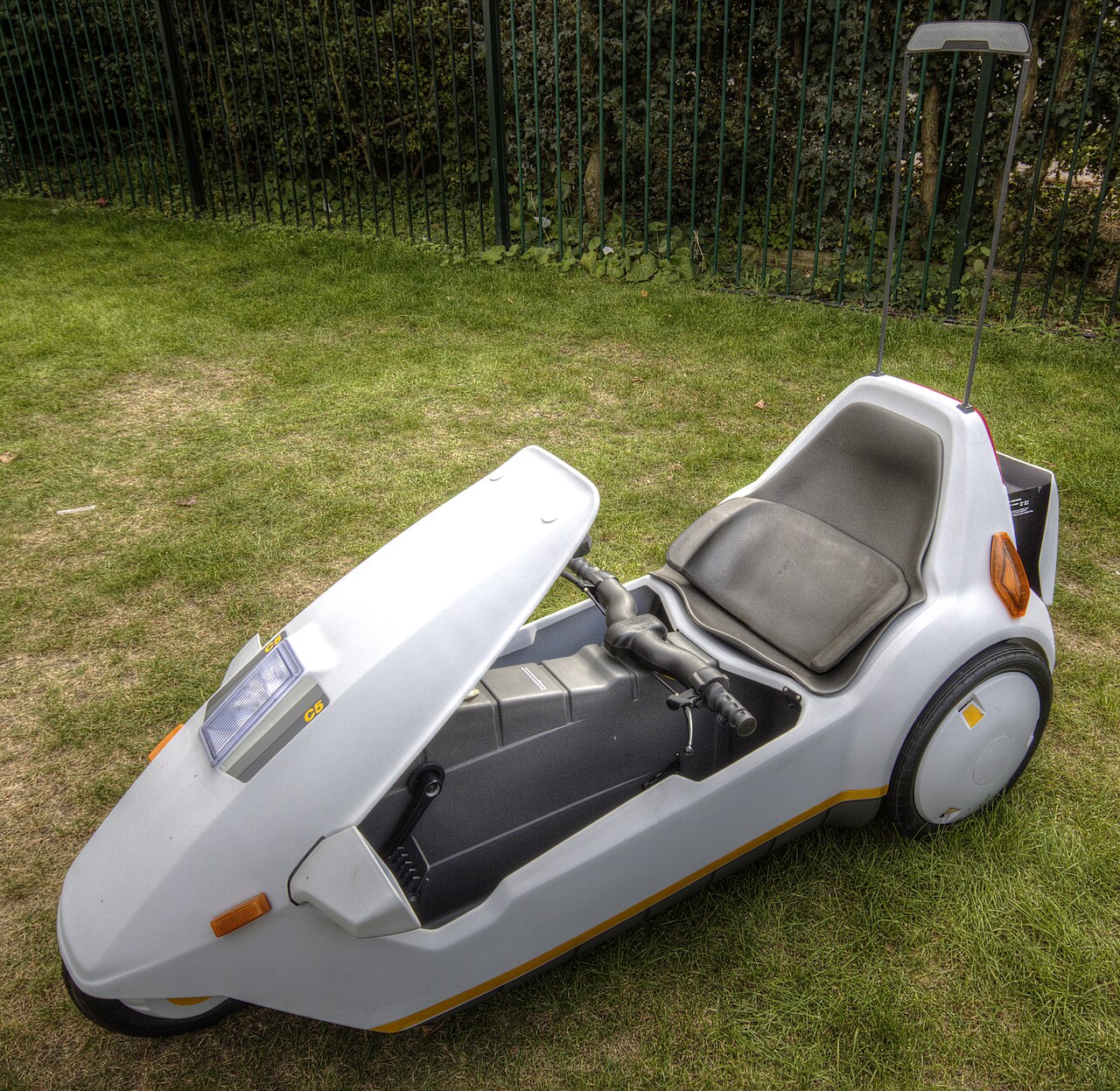
The Sinclair C5 was introduced in January 1985 as a single-seat, electrically assisted pedal tricycle designed by Sinclair Vehicles with a chassis by Lotus Cars. Built largely from polypropylene and powered by a 12 V lead–acid battery driving a 250 W motor, the C5 offered a claimed range of about 20 miles and a top speed of 15 mph. Positioned as an alternative to cars and bicycles, it faced negative media reviews, consumer and motoring-group safety worries, and practical limitations such as limited weather protection and a battery that drained quickly. The vehicle did not reach retail outlets until months after its launch; within three months production was cut by 90%. Manufacturing ceased by August 1985, with about 14,000 produced and only some 5,000 sold before Sinclair Vehicles went into receivership. Despite commercial failure, the C5 later became a collector item and the basis for enthusiast modifications.
Why it matters
- The C5 represented a high-profile attempt to rethink personal electric transport rather than retrofit existing cars with electric drives.
- Its legal classification as an electrically assisted pedal cycle followed a change in law influenced by bicycle industry lobbying, illustrating the impact of regulation on vehicle design.
- The project is often cited as a cautionary example of product-market mismatch and the limits of consumer acceptance for unconventional microcars.
- Although unsuccessful commercially, the C5 achieved a second life as a cult collectible, showing how market failure can coexist with enduring cultural interest.
Key facts
- Manufacturer: Sinclair Vehicles; launched 10 January 1985; assembled in Merthyr Tydfil, Wales.
- Vehicle class: battery electric, recumbent three-wheeler (described legally as an electrically assisted pedal cycle).
- Powertrain: 12 V lead–acid battery and a 250 W electric motor with a two-stage gear drive; battery capacity claimed to give about 20 miles range.
- Performance: maximum speed of 15 miles per hour (24 km/h); motor continuous rating 250 W, with safety shutdowns for overload and overheating.
- Dimensions & weight: approximately 1,744 mm long, 744 mm wide, 795 mm high; kerb weight around 30 kg without battery and 45 kg with battery.
- Production & sales: about 14,000 C5s produced; roughly 5,000 sold before production ended and the company entered receivership.
- Price & options: initial retail price £399; several items such as indicators, mirrors, a horn and a high-visibility mast were sold as optional accessories to stay under the £400 threshold.
- Afterlife: unsold units were later bought by investors and the model became a collector's item; some enthusiasts have substantially modified C5s.
What to watch next
- Whether preserved C5 examples and modified vehicles continue to appear in collector markets and events—collector interest persisted after the initial failure.
- Not confirmed in the source: any modern legal or commercial attempts to revive the C5 design or brand.
- Development of planned follow-up models (C10 and C15) did not progress beyond the drawing board due to the C5's poor reception.
Quick glossary
- Recumbent tricycle: A three-wheeled vehicle where the rider sits in a reclined or laid-back position, often used to reduce frontal area and improve aerodynamics.
- Lead–acid battery: A common rechargeable battery type using lead plates and sulfuric acid; historically used in automotive and low-cost electric vehicles for energy storage.
- Kerb weight: The weight of a vehicle including standard equipment and fluids, but typically without passengers or cargo.
- Electrically assisted pedal cycle: A vehicle classification for bicycles or similar vehicles that provide electric motor assistance in addition to human pedaling, often subject to different regulations than motor vehicles.
Reader FAQ
Was the C5 an electric car?
The C5 was commonly called an 'electric car' in media, but it was engineered and marketed as an electrically assisted pedal vehicle; Sinclair described it as a 'vehicle, not a car.'
How fast and how far could a C5 go?
The standard C5 had a top speed of about 15 mph (24 km/h) and a claimed range around 20 miles (32 km) on a full charge.
Did the C5 sell well?
No. About 14,000 units were produced but only around 5,000 were sold before production ended and Sinclair Vehicles entered receivership.
Are there still C5s around today?
Yes. The C5 became a cult collectible and some owners and clubs have modified examples, including substantial performance upgrades.
Toggle the table of contents Sinclair C5 15 languages Article Talk Read Edit View history Tools From Wikipedia, the free encyclopedia Sinclair C5 Overview Manufacturer Sinclair Vehicles Production 1985; 41 years…
Sources
- Sinclair C5
- Sinclair C5 – the Personal Electric Vehicle
- Sinclair C5 electric trike goes on sale – archive, 1985
- Ever the Third Wheel: The Electric Tricycle that Failed to …
Related posts
- Bichon: Lightweight Rust email archiver with WebUI and REST API
- Voltair’s drones perch on power lines to recharge and extend range
- Amazfit Active 2 tracker, 4K Blu-rays and more lead this week’s deals