
TL;DR
A 2021 analysis revisits Max Payne’s visuals two decades after its 2001 release, focusing on how technical constraints shaped its look. The piece highlights smart workarounds—prebaked lightmaps, flipbook particle textures, detail maps and painted 'fake' geometry—while calling out artifacts and limitations still visible today.
What happened
The source is a graphics-focused retrospective published on the game’s 20th anniversary that isolates rendering techniques used in Max Payne (released July 23, 2001). It frames the title against the PC hardware of the era—DirectX 8.0, a ~450 MHz CPU and ~16 MB GPU memory—and explains how those constraints forced developers to favor precomputed and illusion-based methods over real-time simulation. The article catalogs standout effects (bullet impacts, sparks, steam, exploding monitors, shattering glass, candle flames, grenade dust) and explains they were achieved largely with quads and animated flipbook textures rather than complex geometry or fluid simulation. Lighting relied on low-resolution prebaked lightmaps; surface detail used single-channel detail textures; many three‑dimensional impressions were baked into albedo textures rather than modeled. The author also lists visual shortcomings tied to these choices, including particle clipping, lack of particle-environment interaction, decal timing issues, and soft or leaking shadows from low lightmap density.
Why it matters
- Shows how developers delivered convincing visuals despite severe hardware and API limits by prioritizing perceptual tricks.
- Highlights the trade-offs between precomputed assets and real‑time simulation that shaped early 2000s game aesthetics.
- Provides context for preservation, remastering and modding efforts that must balance authenticity with modern rendering features.
- Offers lessons for optimization: targeted use of baked data, texture bandwidth management and particle system design remain relevant.
Key facts
- Max Payne released on July 23, 2001 (anniversary noted in the piece).
- The game targeted DirectX 8.0 and machine specs cited include a ~450 MHz CPU and a 16 MB graphics card.
- Developers used forward-only rendering with no render-to-texture and no dynamic shadow maps.
- Particle effects were implemented primarily with quads and animated flipbook textures rather than detailed geometry or real fluid simulation.
- Lighting for static geometry was provided via prebaked lightmaps rather than real-time global illumination or radiosity.
- Detail textures were used to simulate micro-surface features; these detail maps were single-channel (8-bit) and lacked color.
- Many apparent 3D details were painted into albedo textures (fake geometry) and relied on perspective limitations to remain convincing.
- Documented visual issues include large particle quads clipping the ground, particles not interacting with static geometry, decal timing offsets, and soft/light-leaking shadows from low lightmap texel density.
What to watch next
- Whether any official remaster or community mods explicitly address the cited issues (particle clipping, decal timing, lightmap resolution): not confirmed in the source.
- Experiments that replace flipbook particles with higher-fidelity particles or add simple path tracing for particle-environment interaction: not confirmed in the source.
Quick glossary
- DirectX 8.0: A graphics and multimedia API used in the late 1990s and early 2000s that introduced programmable vertex and pixel shaders but had strict instruction and capability limits.
- Lightmap: A precomputed texture storing lighting information for static geometry so scenes can show baked illumination without per-frame global lighting calculations.
- Flipbook texture: An animated sprite technique where sequential images are arranged in a single texture and played back over a quad to simulate motion for particles or effects.
- Detail texture: A small-scale texture blended with an object's base color to suggest fine surface detail without increasing base texture resolution or polygon count.
- Albedo (baked detail): The base color texture of a surface; baking geometry or shadow details into albedo means painting those cues into the texture itself rather than deriving them from real geometry or dynamic lighting.
Reader FAQ
Was Max Payne's rendering considered advanced for its time?
Yes; the source describes its rendering as phenomenal for the era and notes it won multiple graphics awards.
Did the game use dynamic shadowing or full real‑time lighting?
No—the game relied on prebaked lightmaps for static geometry and did not employ dynamic shadow maps according to the analysis.
Are the particle and fluid effects simulated physically?
No; many effects are created with animated quads and textures rather than fluid or rigid-body simulations.
Were detail textures full-color?
Typically not; detail textures in the game are described as single-channel (8-bit) masks without color information.
Does the source discuss any official remaster or fixes for these graphics issues?
Not confirmed in the source.
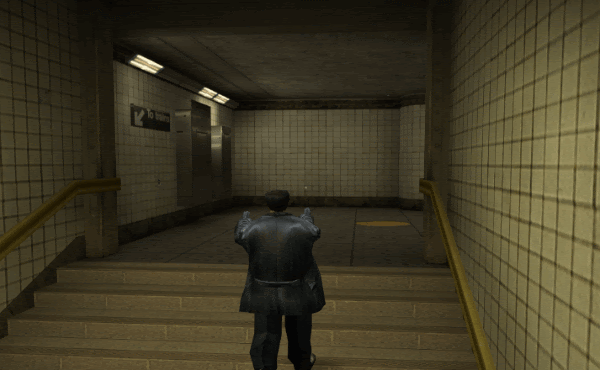
Mechanism and Its Consequences Friday, 23 July 2021 Max Payne – two decades later – Graphics Critique It has been two decades since the video game Max Payne was…
Sources
Related posts
- How Google Keep in Gmail’s Sidebar Became a Daily Note Habit for One Writer
- The Risk of Reducing America’s Venezuela Invasion to a 60‑Second Clip
- Max Payne, 20 Years On: A Technical Critique of Its Graphics