
TL;DR
A short essay argues that most social and workplace exchanges are repeat interactions that shape how others behave toward you. Treating each encounter as a conditioning event—like Pavlov’s bell—helps explain why tone, timing and consistency matter for reputation and long-term progress.
What happened
An essay published Jan. 5, 2026 uses the Pavlovian-conditioning metaphor to argue that routine conversations and interactions function as training moments for the people around you. Rather than treating encounters as one-off fights to be won, the piece suggests viewing them as repeat games: every exchange nudges colleagues, friends and observers toward particular behaviors. Examples in the text include people stopping questions after feeling belittled, greater willingness to bring harder problems when met with curiosity, outsourcing of judgment when others are always given answers, and concealment of work when feedback is mostly critique. The author notes that firm feedback can be effective if delivered well, and emphasizes that tone, timing and consistency create the feedback loop that ultimately defines someone’s reputation and capacity to make progress. The piece is available at the source URL; author attribution is not confirmed in the source.
Why it matters
- Interactions shape future behavior: how you respond now affects what people bring to you later.
- Reputation and influence depend on consistent signals—tone, timing and delivery matter.
- Misaligned responses can reduce learning: constant solving or constant criticism creates undesirable habits.
- Small patterns compound over time, affecting referrals, collaboration and organizational progress.
Key facts
- The essay frames everyday exchanges as conditioning events, likening them to Pavlov’s bell.
- It argues most life and work interactions are repeat games, not isolated incidents.
- Negative short-term reactions (e.g., making someone feel small) can deter future questions.
- Responding with curiosity encourages people to bring harder problems.
- Always solving problems for others can lead them to outsource judgment.
- Always critiquing work can prompt people to hide their output.
- Hard feedback can be motivating if delivered well; the piece stresses tone, timing and consistency.
- Published on Jan. 5, 2026. Author attribution is not confirmed in the source.
What to watch next
- A decline in questions or requests from colleagues, which may signal they feel discouraged.
- An increase in low-effort or routine asks instead of hard problems, indicating people are avoiding higher-stakes input.
- More hidden or late-stage work submissions, which could mean feedback is perceived as unsafe.
- Changes in referrals or collaboration patterns as people update their expectations of you.
Quick glossary
- Pavlovian conditioning: A behavioral concept where a neutral stimulus becomes associated with a response after repeated pairings; used here as a metaphor for how interactions shape behavior.
- Repeat game: A situation in which the same actors interact multiple times, so current choices influence future behavior and reputation.
- Feedback loop: A cycle in which actions produce reactions that then alter subsequent actions and expectations.
- Tone, timing and consistency: Three dimensions of interpersonal behavior that affect how messages are received and how patterns are reinforced over time.
Reader FAQ
What does 'Think of Pavlov' refer to in this context?
It uses the Pavlovian-conditioning metaphor to describe how repeated interactions train others’ expectations and behavior.
Does the essay say you should always be soft or avoid hard feedback?
No. It states that hard feedback can be motivating if delivered well, while emphasizing the importance of tone, timing and consistency.
Who wrote the piece?
Not confirmed in the source.
When was the essay published?
It was published on Jan. 5, 2026.
Does the essay offer concrete steps for changing behavior?
Not confirmed in the source.
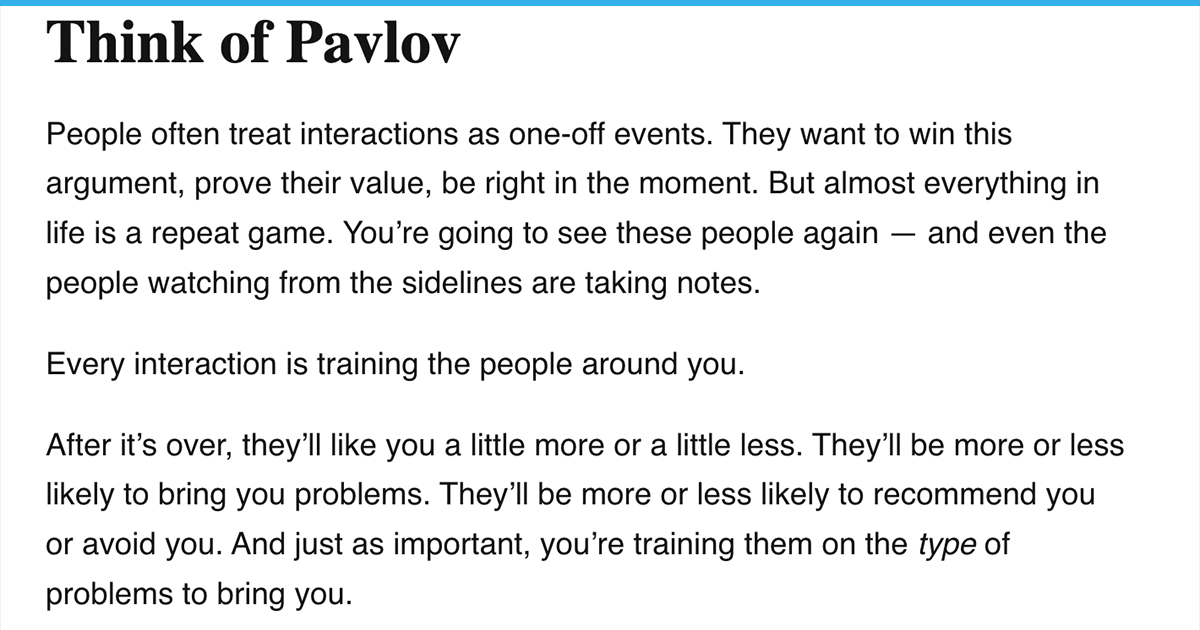
Think of Pavlov People often treat interactions as one-off events. They want to win this argument, prove their value, be right in the moment. But almost everything in life is…
Sources
Related posts
- Why I removed Windows 11 and switched my main computers to Linux
- Want to Stop Doomscrolling? A Sleep Coach Might Help Adults Reclaim Rest
- Max Payne — Twenty Years On: A Graphics Critique of Its Visual Tricks