
TL;DR
A convergence of low-cost mini PCs, mesh VPN tools like Tailscale, and terminal AI agents such as Claude Code has made running personal services at home far easier. One user reports installing Ubuntu, running Claude Code on a Beelink Mini N150, and deploying a suite of containers (passwords, photos, media, home automation) with minimal manual configuration.
What happened
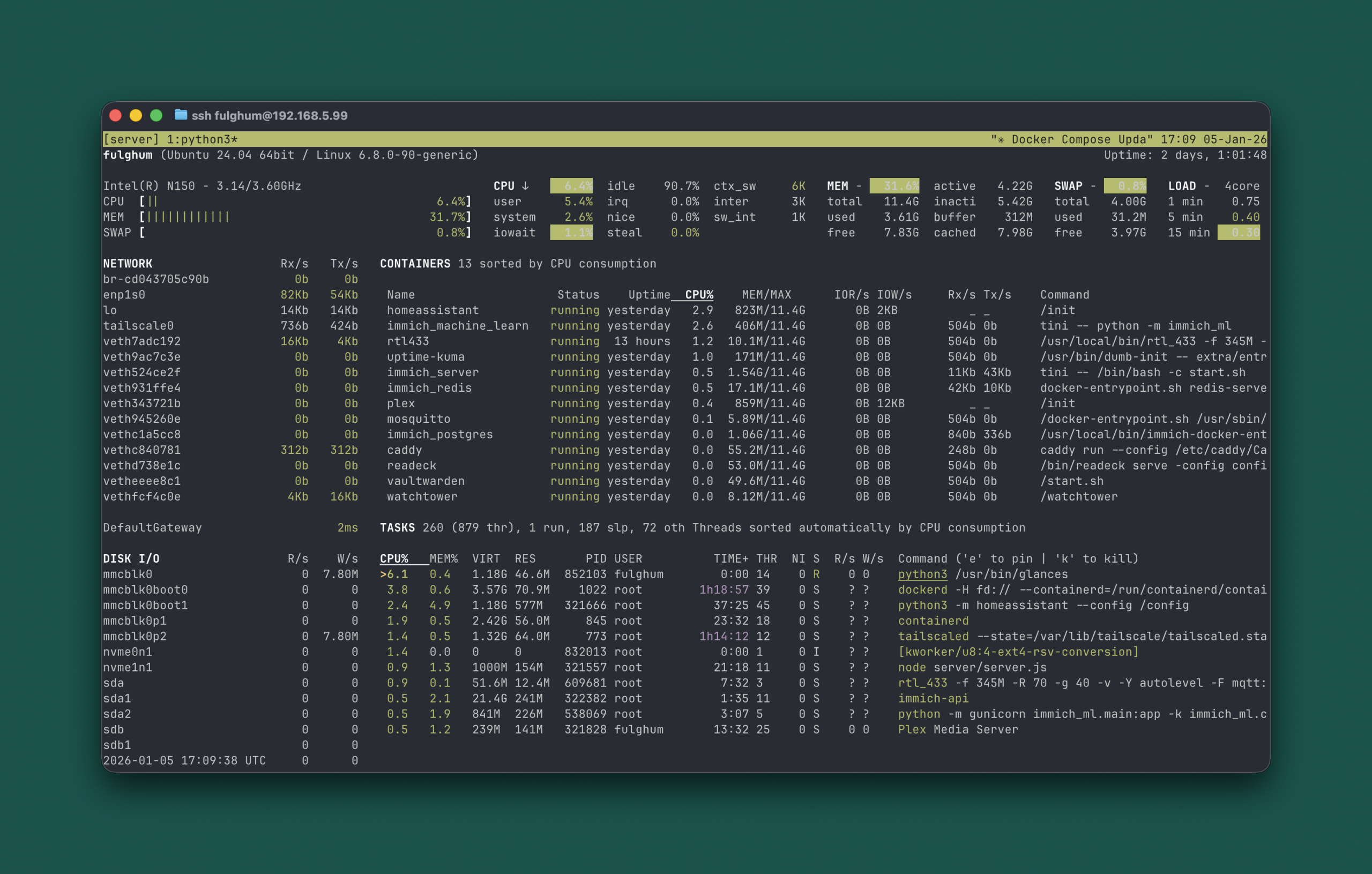
An author who had long tried and abandoned home self-hosting describes a recent turnaround: installing a compact Linux mini PC and using a terminal AI agent to automate setup and maintenance. The device used was a Beelink Mini N150, bought for about $379 plus roughly a few hundred dollars for an 8TB NVMe SSD. The author installed Ubuntu Server 22.04 LTS, joined the machine to a private network via Tailscale, SSHed in remotely, and installed Claude Code directly on the server. They then instructed the agent to set up Docker, generate Docker Compose files, deploy services, configure Caddy as a reverse proxy with automatic TLS, persist data, enable updates, and ensure services restart on boot. The resulting stack runs about 13 containers and includes Vaultwarden, Immich, Plex, Home Assistant, ReadDeck, Uptime Kuma and utilities like Lazydocker and Glances for monitoring.
Why it matters
- Terminal AI agents can lower the barrier to self-hosting by translating plain-English requests into system tasks, reducing the need to memorize tooling and config formats.
- Affordable, low-power mini PCs make always-on hardware more accessible than relying on bigger desktop or cloud instances.
- Tailscale-like networking avoids complex router configuration, making remote access simpler and safer for home servers.
- A working self-hosted password manager, photos service, and read-it-later tool demonstrate that common consumer services can be reclaimed from cloud vendors.
Key facts
- The author purchased a Beelink Mini N150 for about $379 and added roughly a few hundred dollars more for an 8TB NVMe SSD.
- Ubuntu Server 22.04 LTS was the chosen OS; Tailscale was used to place the device on the private network.
- Claude Code, a CLI agent, was installed on the server and used to create Docker Compose setups, deploy services, configure reverse proxying with Caddy, and handle update and restart policies.
- The deployed services run in separate containers and include Vaultwarden (Bitwarden-compatible), Immich (photo storage), Plex (media server), Home Assistant, ReadDeck (read-it-later), and Uptime Kuma (service monitoring).
- Monitoring tools cited include Lazydocker for container management and Glances for overall utilization; the system reportedly ran 13 containers at low CPU and modest memory on the mini PC.
- Uptime Kuma was configured to send simple email alerts when services go down and when they recover.
- Vaultwarden was the moment that convinced the author self-hosting was practical, replacing iCloud/Keychain exports into a self-hosted password store.
- Immich is described as a viable Google Photos replacement with mobile apps, timeline and map views, and local face-recognition capabilities (noted as slow on the author’s hardware).
What to watch next
- Whether more non-expert users adopt self-hosting in 2026 and beyond — not confirmed in the source
- How agent-managed servers perform over time in terms of security and reliability — not confirmed in the source
- Broader integration of agentic CLIs into standard server workflows and distributions — not confirmed in the source
Quick glossary
- Self-hosting: Running software and services on hardware you control rather than relying on third-party cloud providers.
- Docker Compose: A tool for defining and running multi-container Docker applications using a YAML file that describes services, networks, and volumes.
- Reverse proxy (Caddy): A server that routes incoming requests to backend services; Caddy is a web server that automates TLS provisioning and can act as a reverse proxy.
- Tailscale: A VPN-like mesh networking tool that creates secure private networks between devices without manual port forwarding or complex firewall rules.
- CLI agent (e.g., Claude Code): A command-line–based artificial intelligence assistant that can perform system administration tasks when installed and instructed on a host.
Reader FAQ
Is self-hosting now easy enough for non-experts?
The author says the combination of mini PCs, Tailscale, and Claude Code made self-hosting approachable for "normie/software-literate" people who are comfortable with a terminal.
Do you need Claude Code to replicate this setup?
Not confirmed in the source.
What hardware and costs are involved?
The example used a Beelink Mini N150 (~$379) plus roughly a few hundred dollars more for an 8TB NVMe SSD; exact prices and models will vary.
How does the author handle uptime and alerts?
They run Uptime Kuma to monitor services and receive simple email alerts when services go down and when they return.
Is data safety and backup covered?
Not confirmed in the source.
2026 is the Year of Self-hosting by Jordan Fulghum, January 2026 Your home server's new sysadmin: Claude Code I have flirted with self-hosting at home for years. I always bounced…
Sources
- 2026 is the Year of Self-hosting
- Why Self-host?
- Every Developer Needs to Self-Host
- I don't self-host everything, and these are the tools I still pay …
Related posts
- iCloud Photos Downloader: Open-source CLI for exporting iCloud photos
- Sampling Language Models at Negative Temperature: Experiments with LLaMA
- User asks why Armenian reportedly ‘breaks’ Claude in social media post