
TL;DR
Author Alex Wellerstein removed NUKEMAP from Google Maps after API feature deprecations and a sharp shift in Google’s pricing that made running the site prohibitively expensive. He migrated the site to Mapbox + Leaflet, where he found friendlier support and more manageable costs, though a few Google-dependent functions remain to be rebuilt.
What happened
NUKEMAP, first rebuilt in 2012 using the Google Maps JavaScript API, was moved off Google’s platform after a series of product and pricing changes. Over the years Google deprecated features the project relied on (including the Google Earth Plugin that underpinned a 3-D version), and in 2018 a new pricing scheme pushed the site’s monthly bill from a few hundred dollars to roughly $1,800 a month. The author says Google’s nonprofit/education credit paths excluded individual academics and proved difficult to navigate. After attempts to get help from Google led to a third-party partner and slow responses, the developer replaced Google Maps with Mapbox for map tiles and Leaflet for the front-end. Mapbox provided credits and direct human support, and the migration required writing a Leaflet plugin to reproduce some mapping functions. One Google-dependent feature (the ‘Humanitarian consequences’ functionality that used Google’s Places library) still needs a replacement.
Why it matters
- Changes to API pricing can make popular but modest academic projects financially unsustainable.
- Vendor decisions to deprecate features can force developers to rewrite or abandon functionality.
- Platform support and direct contact with vendors can matter as much as raw pricing for small projects.
- Open-source and alternative mapping stacks provide viable paths for education and independent developers.
Key facts
- NUKEMAP was rebuilt using the Google Maps JavaScript API in 2012.
- The site typically receives thousands of visits daily and has experienced large viral spikes.
- Google began charging for API usage in 2016; initial bills were manageable (about $200/month).
- A 2018 pricing change increased the author’s monthly Google bill to about $1,800 (~$20,000/year).
- Google deprecated the Google Earth Plugin, which contributed to the end of NUKEMAP3D.
- Google for Nonprofits / education pathways did not provide usable credits for the author’s academic setup, per the source.
- After surveying alternatives, the author migrated NUKEMAP and MISSILEMAP to Mapbox for tiles and Leaflet for mapping.
- Mapbox provided credits and responsive, human support; the author wrote a Leaflet plugin to restore certain features.
- One function that relied on Google’s Places library (‘Humanitarian consequences’) has not yet been fully ported.
What to watch next
- Whether Google revises its Maps API pricing or support for small developers — not confirmed in the source.
- How sustainable Mapbox credits and pricing will be for NUKEMAP’s traffic levels over time — not confirmed in the source.
- When or how the site’s Google-dependent ‘Humanitarian consequences’ feature will be reimplemented (timeline not given in the source).
- Whether Google restores API features such as a replacement for the Earth Plugin or ports website features into the API — not confirmed in the source.
Quick glossary
- Google Maps API: A set of interfaces provided by Google that let developers embed and control Google Maps features in websites and applications.
- Mapbox: A commercial provider of customizable map tiles and mapping services used as an alternative to other map platforms.
- Leaflet: An open-source JavaScript library for interactive maps that can use various tile providers and plugins.
- Google Earth Plugin: A deprecated browser plugin that once enabled 3-D Earth visualization in web apps; it has been discontinued.
- API pricing: The billing structure set by a service provider for usage of its application programming interfaces, often based on requests, map loads, or other metrics.
Reader FAQ
Why did NUKEMAP leave Google Maps?
According to the developer, a combination of feature deprecations and a sharp increase in API pricing made Google’s platform untenable for the project.
Is NUKEMAP still online?
Yes—the project was migrated to Mapbox for map tiles and Leaflet for the front-end, per the source.
Did Google offer nonprofit or academic credits to cover costs?
The source reports that Google’s nonprofit/education programs did not provide a usable path for the author, and that academics were effectively disqualified.
Are any features missing after the migration?
A feature relying on Google’s Places library for ‘Humanitarian consequences’ has not yet been fully ported; timing for that work was not provided.
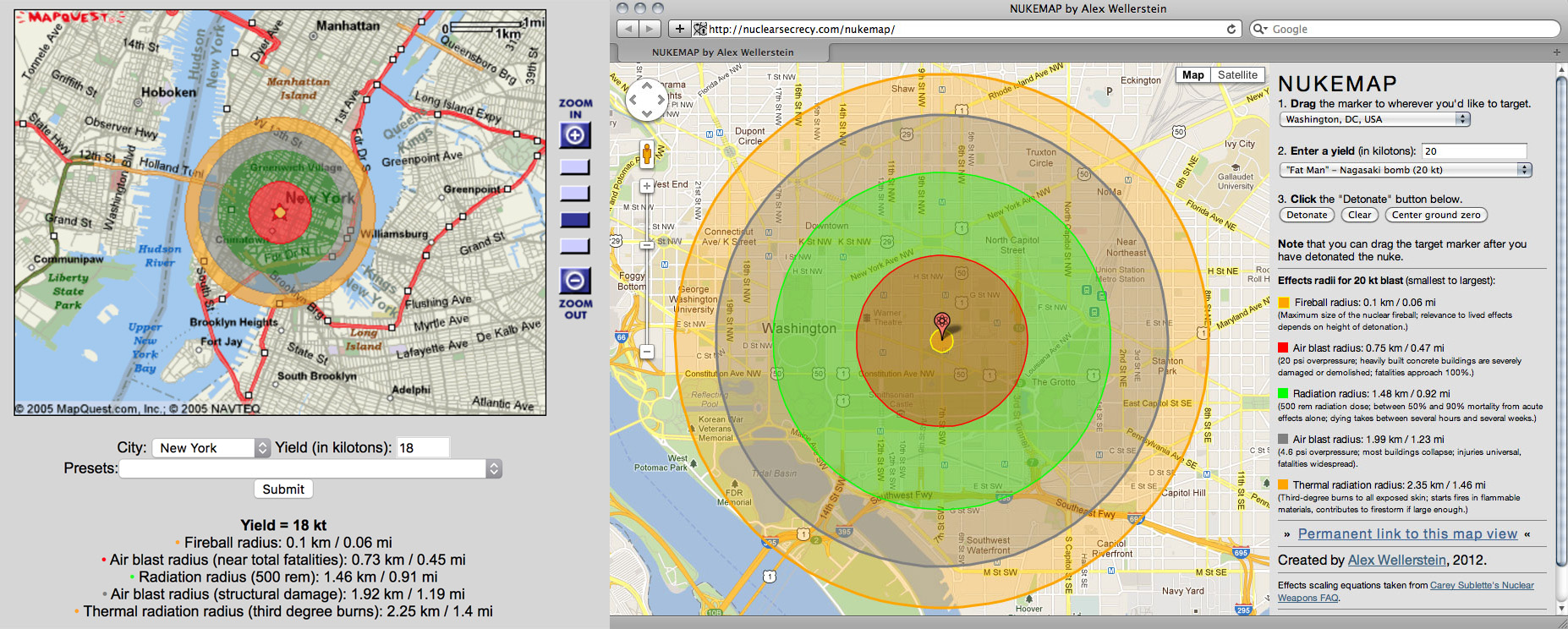
RESTRICTED DATA A Nuclear History Blog by Alex Wellerstein NEWS AND NOTES | VISIONS Why NUKEMAP isn’t on Google Maps anymore by Alex Wellerstein, published December 13th, 2019 When I…
Sources
- Why NUKEMAP isn't on Google Maps anymore (2019)
- Why Nukemap Isn't on Google Maps Anymore
- Google Maps API Changes 2025: Migration Guide for …
- Google Maps Restricts Its API, Government Collectively …
Related posts
- Demo Programs Repository for System Programming in Linux (book code)
- Developer Frustrated with GitHub Actions After ARM Build Fails in CI
- Servo 2025 community and project metrics: contributions, WPT, and growth