
TL;DR
A developer adapted an inexpensive PTZ streaming camera into a ground-based aircraft tracker by shifting stabilization and tracking tasks into software. The system combines visual tracking, predictive filtering, PID plus feed‑forward control and a digital 'virtual gimbal' while correlating locks with local ADS‑B telemetry; the project is published on GitHub under an MIT license.
What happened
On January 13, 2026, developer Ian Servin published Project SkyWatch, an experiment to reproduce some capabilities of professional EO/IR gimbal turrets using consumer hardware. The build uses a budget 20x PTZ camera (an AVKANS LV20N that mimics a PTZOptics unit) and replaces much of the mechanical performance with software. The backend initializes a CSRT visual tracker to lock onto an aircraft, measures pixel error, and feeds that to a control loop. A Kalman filter smooths the noisy visual output and predicts the aircraft’s state roughly 200 ms ahead to counter system latency. That predicted velocity is combined with a PID controller in a feed‑forward arrangement and a dynamic speed limiter to drive the camera motors. A digital stabilization layer crops and shifts the sensor image to counter gear play, emulating a gimbal. The system also cross-references camera azimuth/elevation with local ADS‑B feeds via a tar1090-monitoring script. The code is available on GitHub under an MIT license.
Why it matters
- Shows how software can compensate for cheap PTZ hardware to approximate professional EO/IR behaviors.
- Makes ground-based tracking of aircraft more accessible to hobbyists and researchers without defense‑contractor budgets.
- Combining visual locks with ADS‑B provides richer context for observed targets.
- Demonstrates a civilian approach to technologies usually associated with ISR, framed as sousveillance.
Key facts
- Core camera used: AVKANS LV20N, a cost‑effective knockoff of a 20x PTZOptics unit.
- Visual tracking uses OpenCV with a CSRT (Discriminative Correlation Filter) tracker to follow texture/features rather than simple contrast.
- A Kalman filter smooths tracker jitter and predicts the aircraft’s position about 200 ms into the future to offset system latency.
- Control loop mixes a PID controller with a feed‑forward velocity vector derived from the Kalman prediction.
- A dynamic velocity clamp scales motor aggressiveness based on target distance for fast acquisition and fine centering.
- A software 'virtual gimbal' crops and shifts the image frame‑by‑frame to digitally stabilize residual mechanical jitter.
- ADS‑B telemetry is polled from a local receiver and correlated to camera azimuth/elevation using a tar1090 monitoring script.
- Project is posted on GitHub under an MIT license; original post date January 13, 2026.
What to watch next
- Updates and code changes to the GitHub repository (confirmed in the source).
- Regulatory or privacy discussions prompted by civilian use of ISR-derived tracking techniques: not confirmed in the source.
- Community forks, hardware adaptations or performance benchmarks from other users: not confirmed in the source.
Quick glossary
- EO/IR gimbal: A gyro-stabilized turret combining electro-optical and infrared sensors to keep imagery steady while an aircraft maneuvers.
- PTZ camera: A pan-tilt-zoom camera whose motors can reposition and zoom the lens under programmatic control, commonly used for streaming and surveillance.
- CSRT tracker: A visual tracking algorithm (Discriminative Correlation Filter with Channel and Spatial Reliability) that follows object features across frames.
- Kalman filter: A mathematical algorithm that fuses noisy measurements over time to estimate and predict a system’s state, like position and velocity.
- PID controller: A control loop mechanism using proportional, integral and derivative terms to reduce error and stabilize a system’s response.
Reader FAQ
Is the project code available?
Yes — the post states the project is available on GitHub under an MIT license.
Which camera does the build use?
The developer used an AVKANS LV20N, described as a knockoff of a 20x PTZOptics unit.
Does the system use external flight telemetry?
Yes — it queries local ADS‑B traffic from a receiver and uses a tar1090 monitoring script to correlate aircraft to visual locks.
Can it reliably track jets at high speed?
The source describes design choices to handle high-speed targets and mentions predicting 200 ms ahead, but does not provide verified performance metrics or reliability figures.
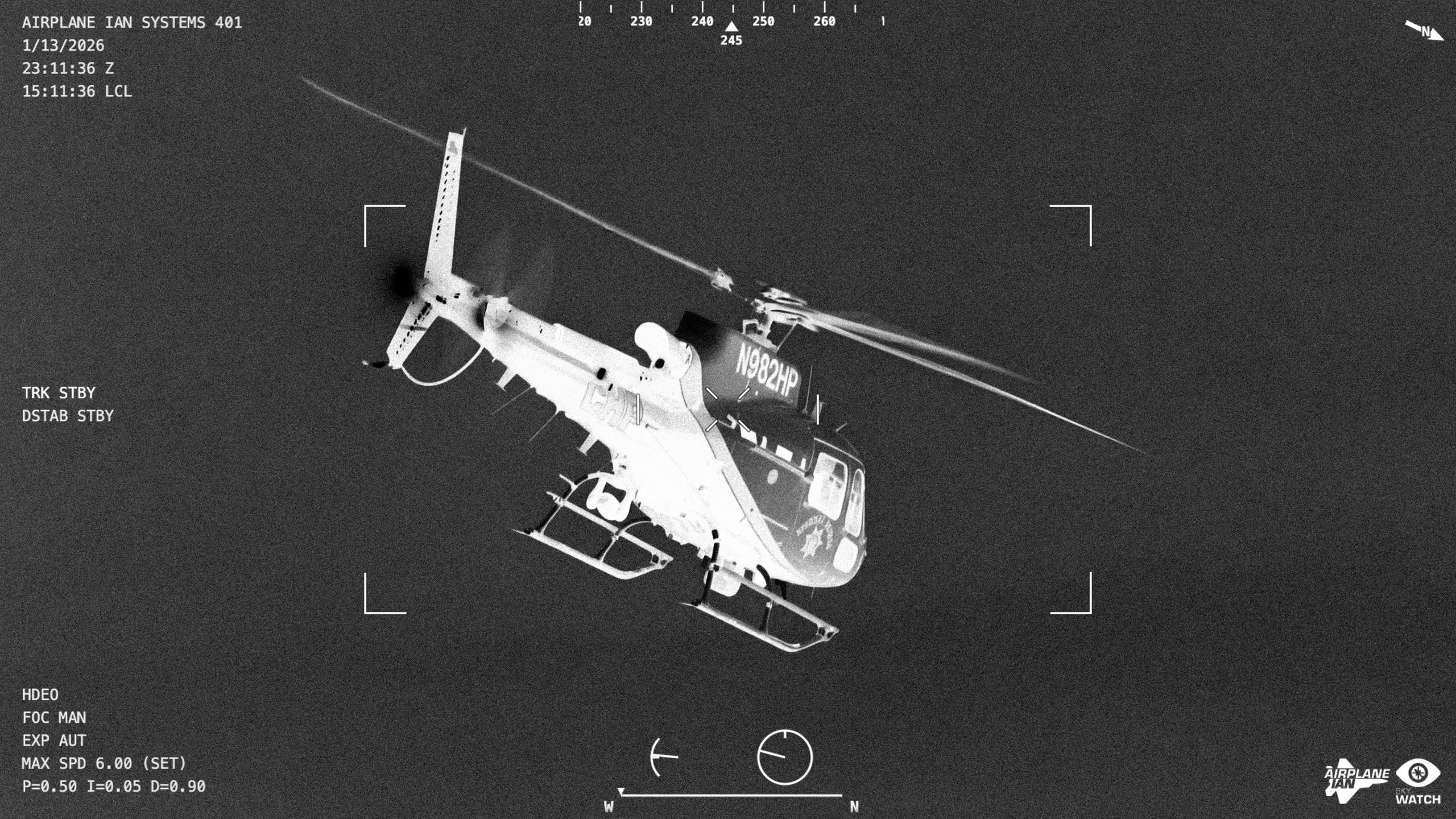
Project SkyWatch (AKA Wescam at home) Professional aviation surveillance relies on a specific piece of hardware: the EO/IR (Electro-Optical/Infra-Red) gimbal. These are the gyro-stabilized turrets you see on the nose…
Sources
- Project SkyWatch (a.k.a. Wescam at Home)
- Next-Generation EO/IR Uncrewed and Autonomous …
- baroni.rows
- slugs.txt – Welcome Visitors – Wiki.org
Related posts
- Claude Cowork Vulnerable to File Exfiltration via Prompt Injection
- Google separates Gemini 3 limits, raising daily prompts for Pro and Thinking
- Eigent: Open-source Cowork Desktop for Multi-Agent AI Workforces