
TL;DR
An extended essay by Henry argues the Web has shifted from a diverse commons of learning and community into an industrialized, attention-extracting system dominated by a few platforms. Drawing on Ivan Illich’s critique of technology and historical examples—from cars to antibiotics—the piece frames the current web as a tool that now shapes society rather than serving it.
What happened
In a roughly 3,100-word essay, Henry argues that the internet has diverged from its early promise as an open, creative public sphere and now functions largely as an attention economy dominated by a small number of platforms. The author traces a pattern found in other technologies: an initial liberatory phase followed by industrialization and extraction. Using examples such as the automobile’s infrastructure demands, the textile industry’s labor and waste problems, antibiotic overuse and resulting resistance, and space commercialization producing orbital debris, Henry borrows Ivan Illich’s concept of radical monopoly to explain how tools can reshape societies. He contends that social networks and a compressed set of dominant sites have displaced hand-built forums, blogs, and wikis; learning and friendship have been hollowed out by feeds, short-form video and algorithmic incentives. The essay explicitly rejects simple nostalgia while asking readers to consider what has been lost and how tools might be made more convivial.
Why it matters
- Concentration of platforms shifts cultural production toward attention extraction and commodified content, reducing meaningful learning and community.
- The industrialization of tools can create dependencies—what Illich calls radical monopoly—where society reorganizes around technologies rather than the other way around.
- Historical parallels (automobiles, textiles, antibiotics, space commercialization) illustrate how beneficial innovations can produce long-term harms when commercial incentives dominate.
- Changes to web architecture and formats risk severing users from ownership of their work and increasing surveillance and commercial manipulation.
Key facts
- The essay is presented as roughly 3,100 words and described as about a 15-minute read.
- Henry invokes Ivan Illich’s Tools for Conviviality and the concept of radical monopoly to analyze tech adoption.
- The World Wide Web was first conceived at CERN in 1989 as a way to link and share documents and media.
- The author claims the web has compressed from many independent sites to a tiny set of dominant platforms, summarizing it as a shift “from a thousand and one websites to three.”
- The piece cites several historical examples of technological harms: automobile infrastructure demands, the textile industry’s labor and waste problems, antibiotic overuse and resistance, and orbital debris from space commercialization.
- Specific textile-sector figures given: about 60 million factory workers globally (2022) and under 2% earning a living wage; global textile consumption rose roughly 400% over the past 20 years according to the essay.
- The essay lists harms associated with the industrialized web: cyberstalking, bullying, circulation of CSAM, violent imagery, misinformation, identity theft and addiction.
- Henry qualifies his critique by saying he does not mean to simply romanticize the past—wider access to the web is a marked improvement—but he urges reflection on what the web used to feel like and what has been lost.
What to watch next
- Whether movements or projects emerge that explicitly adopt Illich-style convivial tooling to rebuild interoperable, user-owned web spaces (not confirmed in the source).
- Regulatory or market responses that might address platform concentration, attention-extracting business models, or restore interoperability (not confirmed in the source).
- Trends in content formats and platform design that further centralize attention or, conversely, enable more distributed, long-form, and archival publishing (not confirmed in the source).
Quick glossary
- Radical monopoly: A concept from Ivan Illich describing a state in which a technology has become so dominant that participation in society effectively requires its use.
- Convivial tools: Tools that are designed to enhance individual autonomy and community well-being rather than to concentrate power or extract value from users.
- Attention economy: An economic model where human attention is treated as a scarce resource that platforms monetize through algorithms, advertising, and engagement-focused design.
- World Wide Web: A system of interlinked documents and media, originally conceived at CERN in 1989 to enable flexible sharing of information across networks.
Reader FAQ
Who wrote the essay?
The piece is by Henry (from Online), presented as a standalone essay.
Is the author calling for a return to the old internet?
Henry explicitly says he is not trying to indulge in nostalgia; he notes wider access is a clear improvement while asking readers to consider what was lost.
Does the essay offer concrete technical proposals to fix the web?
Not confirmed in the source.
What frameworks does the essay use to analyze the problem?
It draws on Ivan Illich’s Tools for Conviviality and historical examples of technological industrialization to frame the argument.
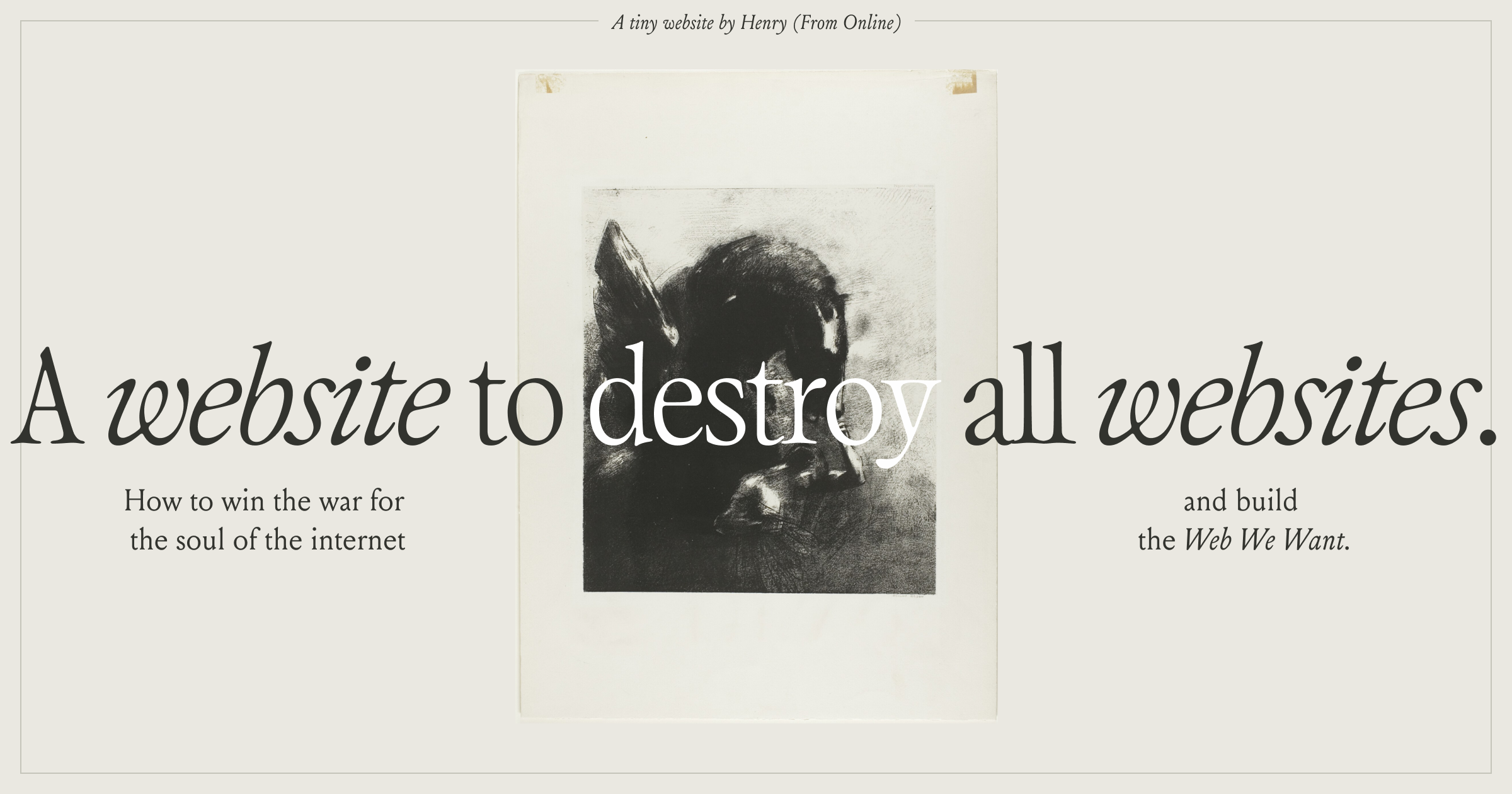
A website to destroy all websites. How to win the war for the soul of the internet and build the Web We Want. Captive Pegasus, Odilon Redon (1889) A tiny…
Sources
- A website to destroy all websites
- Kick Ass – Destroy the web
- Battle for the Soul of the Internet
- Destroy the Web | HTML & CSS Wiki – Fandom
Related posts
- Beginner’s guide to Mastodon: the open-source alternative to Twitter
- Mythic Discovery: Joseph Campbell Meets George Lucas — Part I (2015)
- Starlink to lower roughly 4,400 satellites from ~550 km to ~480 km across 2026