
TL;DR
Photographer Weimin Chu used drones over three years to document China's rapid expansion of wind and solar power, producing aerial images that highlight the geometric scale of installations. Last year China accounted for more than half of global wind and solar additions; in May alone it installed solar capacity at a pace described as roughly 100 panels per second, enough that month to power Poland.
What happened
China expanded its wind and solar capacity at a pace that outstripped the rest of the world last year, adding more than half of all new global wind and solar. In May alone, the country installed enough solar capacity to power Poland, and panels were being sited at an estimated rate of about 100 per second. Photographer Weimin Chu spent three years documenting this transformation with drone imagery, capturing rooftop arrays in crowded eastern cities and large-scale wind and solar farms across western deserts and mountain regions. His aerial photographs, which the photographer says borrow compositional cues from traditional Chinese ink painting, reveal recurring geometric patterns and the installations’ relationships to terrain — mountains, tidal flats, wetlands and historic sites. A selection of Chu’s images, previously shown in an award-winning exhibition presented by Greenpeace, highlights both utility-scale farms and more dispersed rooftop systems across provinces including Qinghai, Sichuan, Zhejiang, Inner Mongolia, Guizhou and Shandong.
Why it matters
- China’s dominant share of recent global renewable additions reshapes the international trajectory of wind and solar deployment.
- The speed and geographic breadth of the buildout — from rooftops to deserts and tidal flats — have visible landscape and land-use implications.
- Systematic aerial documentation helps make the scale and siting patterns of renewable infrastructure clearer to policymakers, researchers and the public.
- Visual records can inform debates about integration, planning and how renewables coexist with other land uses and cultural sites.
Key facts
- Last year China installed more than half of all wind and solar capacity added globally.
- In May, China added enough renewable generation to power Poland.
- During that month, solar panels were reportedly installed at a rate of roughly 100 every second.
- Photographer Weimin Chu used drones over three years to photograph wind and solar plants from overhead.
- Chu’s images draw on visual elements of traditional Chinese ink painting and emphasize geometry and rhythm.
- His work was featured in an award-winning exhibition presented by Greenpeace.
- The buildout is visible across the country: rooftop solar in eastern cities and large farms in western deserts and mountains.
- The photo selection includes sites in provinces such as Qinghai, Sichuan, Zhejiang, Inner Mongolia, Guizhou, Shandong and Gansu.
What to watch next
- not confirmed in the source: whether the current installation pace will be sustained in the coming years and how capacity additions will trend.
- not confirmed in the source: how grid integration, storage deployment, and transmission expansion will keep pace with new wind and solar capacity.
- not confirmed in the source: the long-term environmental and land-use impacts of large-scale renewable siting, and any policy responses to manage them.
Quick glossary
- Photovoltaic (PV) panel: A device that converts sunlight directly into electricity, commonly used in solar farms and rooftop systems.
- Wind farm: A collection of wind turbines in the same area used to generate electricity from wind energy.
- Drone photography: Aerial imaging captured by remotely piloted aircraft, often used to survey large areas and infrastructures from above.
- Rooftop solar: Solar PV panels installed on the roofs of buildings, typically for on-site electricity generation.
- Thermal power station: A facility that generates electricity by converting heat energy, often from burning fuels, into electrical power.
Reader FAQ
How much of the world’s new wind and solar did China add last year?
China installed more than half of the global total of wind and solar added last year.
What did Weimin Chu document in his photos?
Chu used drones over three years to capture aerial images of rooftop, utility-scale solar and wind installations across multiple Chinese provinces.
Were the photos publicly exhibited?
Yes; Chu’s work was featured in an award-winning exhibition presented by Greenpeace.
Does the article provide projections about China’s future renewable growth?
not confirmed in the source
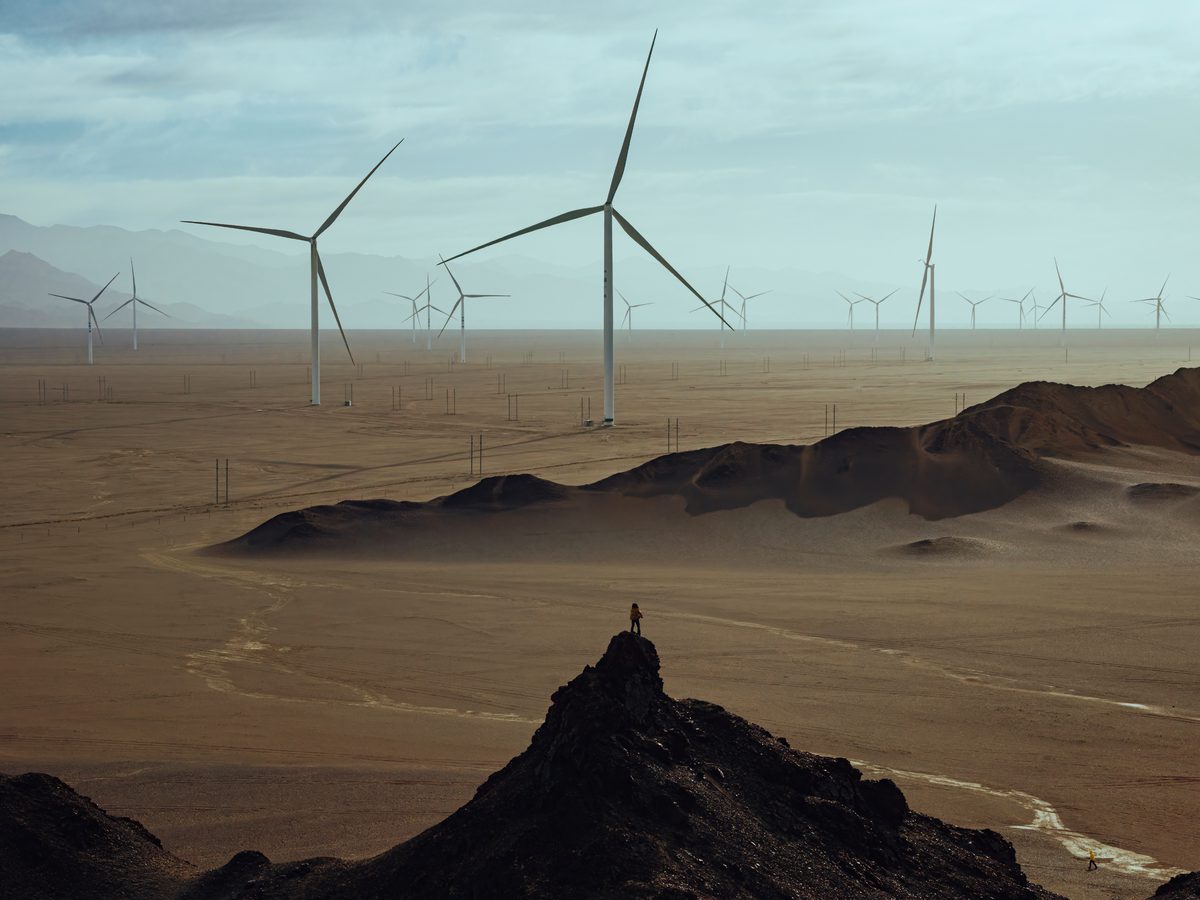
E360 DIGEST JANUARY 13, 2026 Photos Capture the Breathtaking Scale of China’s Wind and Solar Buildout A wind farm near the Heidu Mountain Scenic Area in Qinghai Province. WEIMIN CHU…
Sources
Related posts
- How I Learned Programming: Why You Don’t Need LLMs to Learn Code
- UK’s AR7 auction delivers record 8.4 GW offshore wind at prices well below gas
- HN discussion highlights practical steps and barriers to tackling loneliness