
TL;DR
Researchers at the MIT Media Lab developed the agonist-antagonist myoneural interface (AMI) to restore proprioceptive feedback in amputees by surgically linking muscle pairs and interfacing them with robotic joints. The approach was validated preclinically and deployed in a first human case, producing improved control, reflexive gait behavior, and a sense of embodiment with a powered ankle-foot prosthesis.
What happened
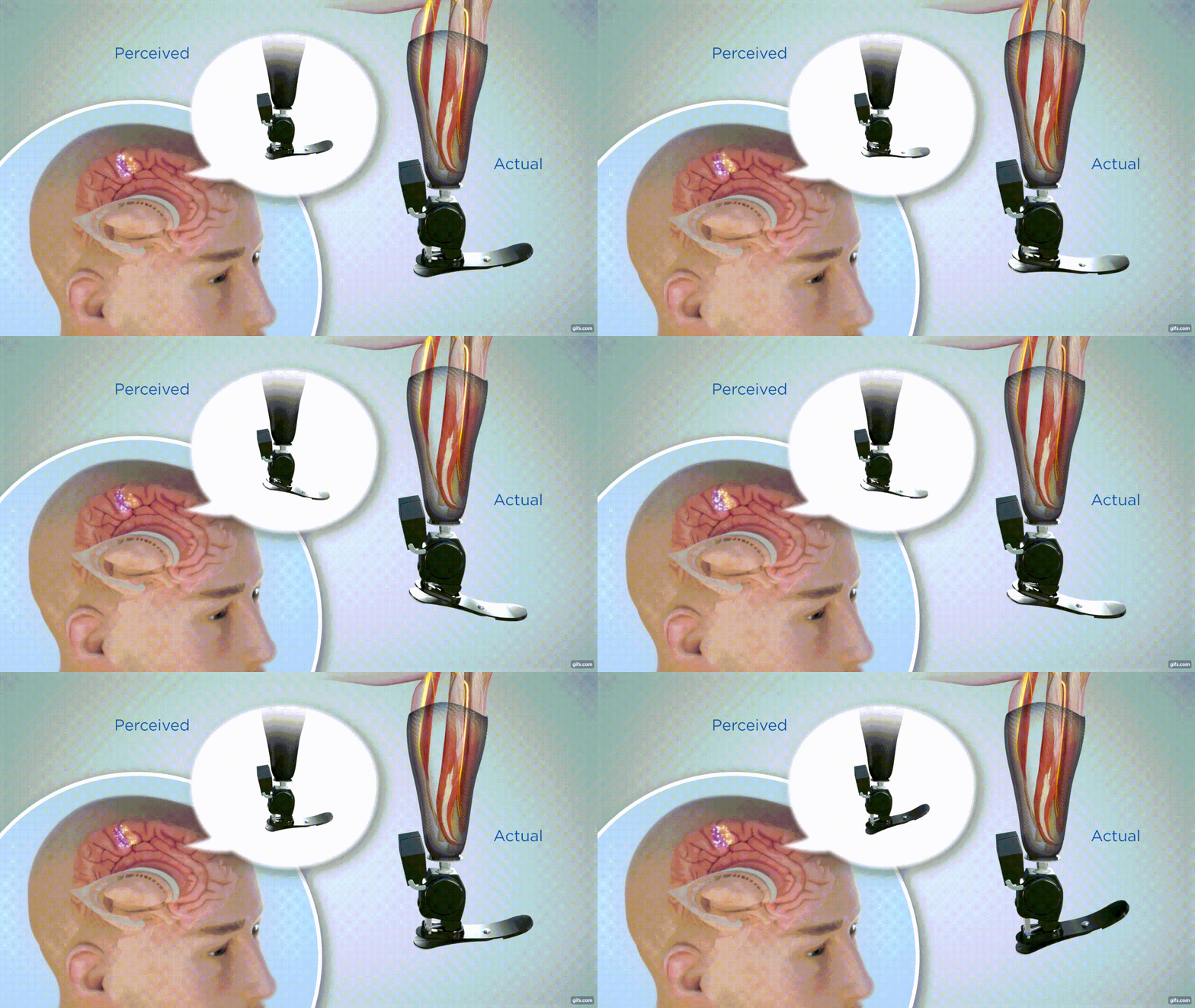
Researchers at the MIT Media Lab devised the agonist-antagonist myoneural interface (AMI) to re-establish proprioceptive sensation in persons with limb amputation. During amputation surgery, surgeons link pairs of muscles in the residual limb so that one muscle’s contraction stretches its partner, recreating the natural agonist–antagonist mechanical relationship that underlies proprioception. Electrodes placed over these reconnected muscles relay signals to on-board computers in an advanced bionic limb, while movement of the prosthetic joint produces mechanical inputs to the muscles that travel back to the wearer’s nervous system. After extensive preclinical testing at MIT, the team implemented two AMIs in a below-knee amputation patient at Brigham and Women’s Faulkner Hospital and connected them to a robotic ankle-foot prosthesis. The patient reported natural sensations of ankle position and movement without visual cues, demonstrated improved intentional control versus conventional amputees, and exhibited involuntary, reflexive gait patterns—outcomes the team frames as evidence of neurological embodiment.
Why it matters
- Restoring proprioception addresses a major limitation of current prostheses, which largely lack native sensory feedback and require visual monitoring.
- Bi-directional muscle–prosthesis interfaces can improve voluntary control and enable reflexive, automatic movements mediated by the central nervous system.
- Closed-loop feedback of joint torque and position could enable more precise and energy-efficient locomotion and object interaction with bionic limbs.
- The AMI exemplifies a design approach labeled NeuroEmbodied Design, which integrates surgical modification of biology with device engineering to enhance neural communication.
Key facts
- AMI recreates a natural agonist–antagonist muscle pairing in the amputated residuum so one muscle’s contraction stretches its partner.
- Artificial muscle electrodes over each AMI muscle communicate with small computers inside an advanced bionic limb to exchange motor and sensory signals.
- The technology underwent extensive preclinical validation at MIT before surgical implementation in a human patient.
- The first clinical implementation involved constructing two AMIs during a below-knee amputation performed at Brigham and Women’s Faulkner Hospital.
- Results from the inaugural patient showed natural sensations of ankle–foot position and movement even when blindfolded.
- The case demonstrated closed-loop joint control with natural neural feedback of prosthetic joint torque, reported to improve function.
- The initial human procedure and outcomes were described in a paper published in Science Translational Medicine on May 30, 2018.
- The first patient, Jim Ewing, had the surgical approach informally named the 'Ewing Amputation' by the research team.
- Earlier related research by Srinivasan et al. appeared in Science Robotics (2017) and contributed to the project’s development.
What to watch next
- Larger clinical trials to assess AMI outcomes across more patients and amputation levels — not confirmed in the source
- Regulatory and commercialization pathways for translating AMI-linked prostheses into wider clinical use — not confirmed in the source
- Adaptation of the AMI approach to upper-limb prosthetics or multiple-joint systems — not confirmed in the source
Quick glossary
- Proprioception: The body’s internal sense of limb position, movement, and force that enables coordinated motion without relying on vision.
- Agonist–antagonist muscle pair: Two muscles that work in opposition around a joint; when one contracts, the other lengthens, producing coordinated movement and sensory feedback.
- Myoneural interface: A surgical and engineering approach that connects muscle tissue and neural pathways to electronic prosthetic controllers to exchange motor and sensory signals.
- Closed-loop control: A system architecture in which sensory feedback is used in real time to adjust a device’s actions, enabling responsive and adaptive behavior.
- NeuroEmbodied Design: A design paradigm that intentionally shapes biological tissues and engineered devices together to enhance two-way neural communication between humans and technology.
Reader FAQ
Who was the first human to receive AMIs?
The first patient reported in the project materials is named Jim Ewing; the procedure has been referred to as the 'Ewing Amputation.'
Has AMI been tested beyond a single human case?
The source states extensive preclinical testing and a reported first human implementation, but broader clinical trial results are not described in the source.
Does the AMI provide force or torque feedback from the prosthesis?
Yes. The team reports a system for closed-loop joint control that delivers natural neural feedback of prosthetic joint torque.
Is AMI commercially available or standard clinical practice?
not confirmed in the source
Project Agonist-antagonist Myoneural Interface (AMI) BWH/Vessel Animation Research In this Project: Overview Publications People Frequently Asked Questions Video Press Kit Updates Project Contact: Tsung-Han Hsieh thhsieh@media.mit.edu Other Press Inquiries Groups…
Sources
- Agonist-Antagonist Myoneural Interface
- The Agonist-antagonist Myoneural Interface – PubMed Central
- Agonist-antagonist myoneural interface surgery on the …
- Intuitive control of myoelectric prostheses with agonist …
Related posts
- Packing a Complete Chess Position into 26 Bytes with Bit-Level Tricks
- ICE custody data: 73% of detainees had no criminal convictions
- Why Developers Are Chasing the Wrong Goal in the Age of Vibe Coding