
TL;DR
Faced with a congested grid and urgent revenue timelines, AI companies are building onsite gas generation to power datacenters. The shift has triggered a fast-growing market for modular turbines, engines and fuel systems, but it raises costs, permitting and operational questions.
What happened
As large AI clusters demand capacity faster than utilities can approve interconnections, many operators are bypassing the grid by deploying onsite gas generation. Earlier forecasts predicted US AI power demand would climb from roughly 3 GW in 2023 to about 28 GW by 2026; load requests now total on the order of a terawatt, creating long queues for grid approval. xAI led the trend, bringing a 100,000-GPU cluster online in months using truck-mounted and modular gas turbines and reportedly has over 500 MW of turbines near its sites. In October 2025 OpenAI and Oracle placed a combined onsite gas equipment order for roughly 2.3 GW in Texas. A growing set of suppliers — including GE Vernova, Siemens Energy, Doosan Enerbility, Wärtsilä and others — have captured large datacenter orders. The BYOG approach accelerates go-live timelines but introduces higher operating costs, complex permitting and deployment tradeoffs that operators are still navigating.
Why it matters
- Faster onsite generation can unlock billions in annual AI cloud revenue by bringing capacity online months earlier.
- Widespread BYOG adoption reshapes datacenter procurement and creates new, high-growth markets for turbine and engine makers.
- The shift relieves near-term grid congestion but adds local permitting, emissions and cost challenges that affect project timelines.
- If sustained, BYOG deployments will change how grid operators and regulators plan future transmission and interconnection processes.
Key facts
- SemiAnalysis previously forecasted US AI power demand rising from ~3 GW in 2023 to over 28 GW by 2026.
- In Texas, tens of gigawatts of datacenter load requests are submitted monthly while just over 1 GW was approved in the past 12 months (ERCOT data cited).
- xAI used truck-mounted and small modular turbines to bring a large cluster online in months and has deployed over 500 MW of turbines near datacenters.
- OpenAI and Oracle placed a roughly 2.3 GW onsite gas generation order in Texas in October 2025.
- Doosan Enerbility booked about 1.9 GW of orders tied to xAI; Wärtsilä signed about 800 MW of US datacenter contracts; Boom Supersonic announced a 1.2 GW turbine contract with Crusoe, per the report.
- The report’s industry tracker shows at least 12 different suppliers have secured more than 400 MW of datacenter orders each in the US.
- Interconnection and system studies can stretch from request to commercial operation to about five years for many generation types (source cited Lawrence Berkeley National Lab).
- Combined-cycle gas turbines offer fuel efficiency above 60% but have long lead times and multi-year construction timelines.
- FERC reforms from 2023 pushed cluster studies to speed interconnection processing, but those reforms were only solidified in 2025.
What to watch next
- Whether onsite generation installed now will be converted to backup power once grid service arrives (BYOG operators describe this as a strategy).
- Permitting outcomes in key states — the report cites site selection strategies (including building on state borders) and examples where one state permitted faster than another.
- How quickly manufacturers can scale modular turbine and engine supply to meet triple-digit annual growth (not confirmed in the source).
- Long-term total cost of ownership comparisons between BYOG and grid-delivered power across regions and fuel-price scenarios (not confirmed in the source).
Quick glossary
- Bring Your Own Generation (BYOG): A strategy where a datacenter operator installs local power generation (turbines, engines, fuel cells, batteries) to run independently of the electric grid.
- Combined-Cycle Gas Turbine (CCGT): A power plant design that captures waste heat from a gas turbine to run a steam turbine, improving fuel efficiency compared with single-cycle plants.
- Interconnection request: A formal application submitted to a utility or grid operator seeking permission to connect a new large load or generator to the transmission network.
- Modular turbine/engine: Smaller, factory-built power units that can be deployed faster and in multiple units to scale generation, often used to accelerate project timelines.
Reader FAQ
Why are AI companies building onsite power plants?
Because grid interconnection and transmission upgrades are slow and congested, and getting capacity online faster can generate large revenue gains; onsite generation lets datacenters run without waiting years for grid service.
Does onsite generation replace the grid permanently?
Not confirmed in the source.
Are onsite plants cheaper than grid power?
The report states onsite power is often noticeably more expensive than grid power, although faster deployment can justify the cost through earlier revenue.
Who are the major equipment suppliers mentioned?
Suppliers cited include GE Vernova, Siemens Energy, Doosan Enerbility, Wärtsilä, Solar Turbines (CAT), Jenbacher and Bloom Energy, among others.
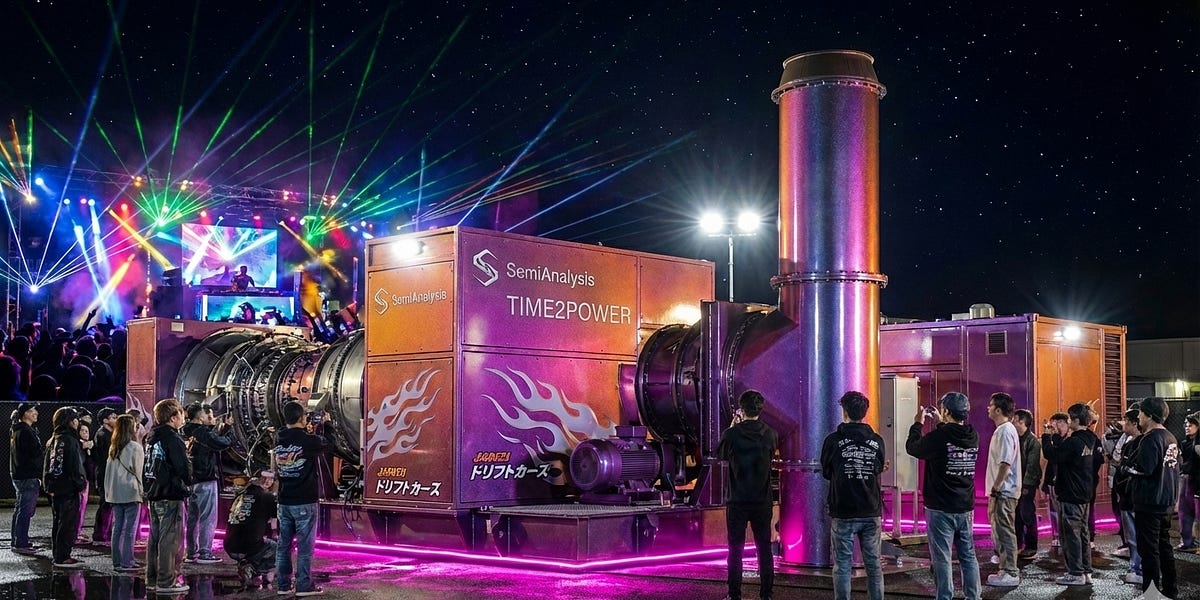
How AI Labs Are Solving the Power Crisis: The Onsite Gas Deep Dive Bring Your Own Generation, Sayonara Electric Grid, Turbines vs. Recips. vs. Fuel Cells, Why Not Build More…
Sources
- AI Labs Are Solving the Power Problem
- AI's Insane Energy Problem Just Got Solved… By Natural …
- How AI Data Centers Are Driving a $42 Billion Onsite …
- AI Data Centers, Desperate for Electricity, Are Building …
Related posts
- The dumbest tech moments of 2025 — from soup stunts to olive oil gaffes
- Industrial software: AI is turning software development into mass production
- Save Up to 14% on Google Workspace Plans With Promo Codes in 2026