
TL;DR
A hands-on comparison pits Nvidia's GB10-based DGX Spark against HP's Z2 Mini G1a running AMD's Ryzen AI Max+ (Strix Halo). Both boxes pack 128 GB of LPDDR5x memory but take different approaches to design, connectivity, CPU/GPU balance, software stacks and price.
What happened
Digital Tech New York conducted a side-by-side examination of two compact AI workstations: Nvidia's DGX Spark (GB10) and an HP Z2 Mini G1a configured with AMD's Ryzen AI Max+ "Strix Halo." Each system offers 128 GB of LPDDR5x unified memory, but they diverge in chassis design, I/O choices and silicon focus. The Spark is a smaller, appliance-like unit with an external power brick, an all-metal chassis that doubles as a heatsink, and datacenter-style networking (10 GbE plus dual QSFP cages driven by a ConnectX-7 NIC). The HP Z2 Mini is larger with an integrated 300 W PSU, easier serviceability, user-replaceable M.2 SSDs and Thunderbolt ports. In benchmarks mentioned, AMD's Zen 5 CPU in the Z2 Mini delivered 10–15% higher results in several CPU tests, while the Spark showed much higher theoretical and measured matrix-multiply throughput for GB10 in select low-precision formats. Pricing and configuration options vary across OEMs.
Why it matters
- Compact workstations let developers prototype and test GenAI models locally without large datacenter racks.
- Unified LPDDR5x memory in both platforms supports larger single-model workloads on a single box.
- Different design priorities—Spark for clustered, high-bandwidth networking; Z2 Mini for desktop flexibility and serviceability—affect deployment choices.
- Software stacks and migration paths (ROCm/HIP for AMD; DGX OS and GB10 software for Nvidia) influence how easily desktop workmaps map to datacenter environments.
Key facts
- Both systems tested ship with 128 GB of LPDDR5x memory (Spark: 8533 MT/s; Z2 Mini G1a: 8000 MT/s ECC).
- Nvidia DGX Spark MSRP is $3,999; the HP Z2 Mini G1a as tested retails around $2,949, with other OEM configurations available at lower prices.
- GPU and compute: Spark uses GB10 Blackwell with 6,144 CUDA cores, 192 tensor cores and a quoted 1 petaFLOPS sparse FP4 peak; the Z2 Mini uses a Radeon 8060S with 2,560 stream processors and an estimated 56 TFLOPS dense BF16/FP16 GPU throughput.
- Measured MAMF results for the GB10 Spark reached about 101 TFLOPS at BF16 and 207 TFLOPS at FP8 in the article's tests.
- CPU: Spark uses a 20-core Arm design (10x X925 + 10x A725); the Z2 Mini uses a 16-core Zen 5 CPU clocking up to 5.1 GHz. AMD's CPU delivered ~10–15% better scores in several desktop workloads cited.
- Storage: Spark example had 4 TB NVMe; HP Z2 Mini includes two user-serviceable 2280 PCIe 4.0 x4 M.2 SSDs (tested configuration: 2×1 TB TLC NVMe).
- I/O and networking differ: Spark emphasizes high-speed networking (10 GbE + two QSFP for up to 200 Gbps); HP favors USB/Thunderbolt and includes a 2.5 GbE RJ45 port with optional Flex IO modules.
- Form factor and serviceability: Spark is smaller and more appliance-like with an external power brick; HP's chassis is larger, heavier and built for easier access and service.
- Power and operating systems: Spark example uses a 240 W adapter and runs Nvidia DGX OS; the HP Z2 Mini uses a 300 W PSU and ships with Windows 11 Pro / Ubuntu 24.04 options.
What to watch next
- Software and driver maturity for ROCm/HIP on Strix Halo and how smoothly desktop workloads migrate to AMD datacenter stacks.
- Real-world sustained throughput for both platforms across common GenAI precisions (BF16/FP8/INT8) as software and libraries evolve.
- Price and availability fluctuations driven by memory supply (article notes a memory shortage affecting prices) and OEM configuration choices.
- Potential multi-node clustering using the Z2 Mini's Thunderbolt ports—the article notes this could be possible but the use case was not tested.
Quick glossary
- Unified memory: A memory architecture where CPU and GPU share a single pool of RAM, simplifying data access for workloads that use both processors.
- GB10 (Grace Blackwell): Nvidia's system-on-chip platform combining Arm CPUs and Blackwell GPUs designed for AI workloads in compact systems like the DGX Spark.
- ROCm/HIP: AMD's open compute stack and portability layer for running GPU-accelerated workloads and easing migration between AMD data-center and desktop GPUs.
- FP4 / FP8 / BF16: Low-precision floating-point numeric formats commonly used in AI to increase throughput and reduce memory usage at the cost of precision.
- TOPS: Tera-operations per second, a metric often used to express integer or mixed-precision accelerator throughput in AI inference contexts.
Reader FAQ
Which box is faster for GenAI?
It depends on precision and workload. Nvidia's GB10 Spark shows higher theoretical and measured matrix-multiply throughput in low-precision formats, while the Strix Halo system has a stronger general-purpose CPU and a different GPU performance profile. A single definitive winner for all GenAI tasks is not given in the source.
Are these systems upgradable?
Both use soldered LPDDR5x memory (not user-upgradable). The HP Z2 Mini provides user-serviceable M.2 SSDs; the Spark's SSD can be swapped after removing a magnetic plate and screws.
Can you cluster the HP Z2 Mini like a Spark?
The Spark is explicitly designed for multinode setups with QSFP cages and ConnectX-7 networking. The article notes you could potentially use the Z2 Mini's Thunderbolt ports for high-speed networking but that use case was not tested.
Which is better value?
List prices in the article show the Spark at $3,999 and the tested Z2 Mini at about $2,949, but the source notes OEM variants and memory-limited availability mean you can find different price points; a clear value judgment is not asserted in the source.
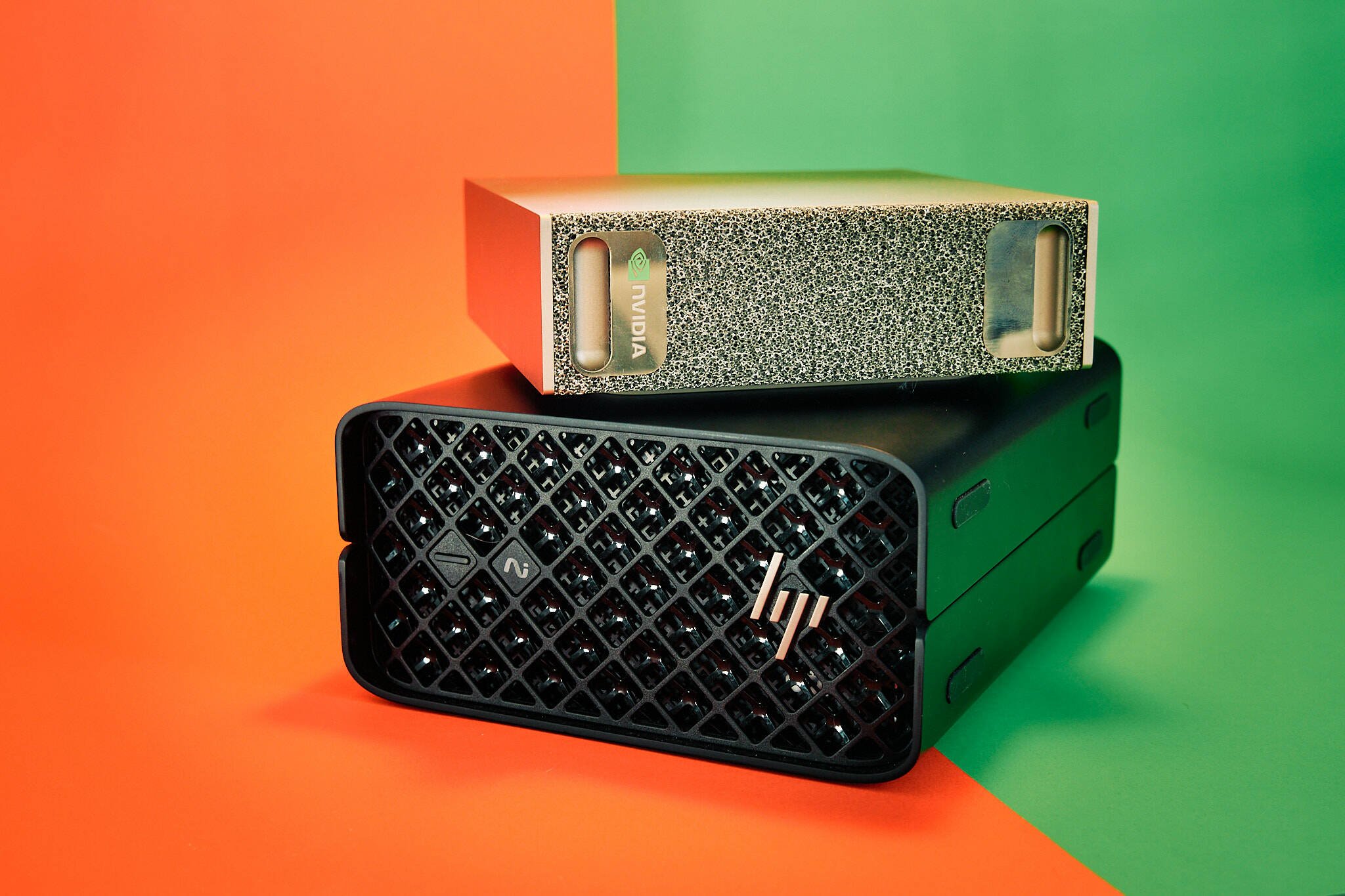
SYSTEMS AMD Strix Halo vs Nvidia DGX Spark: Which AI workstation comes out on top? Two tiny boxes, 128 GB apiece – but very different strengths Tobias Mann Thu 25 Dec 2025 //…
Sources
- AMD Strix Halo vs Nvidia DGX Spark: Which AI workstation comes out on top?
- Tested: AMD's Strix Halo vs Nvidia's DGX Spark
- DGX Spark vs. Strix Halo – Initial Impressions
- NVIDIA DGX Spark “AI Supercomputer” Versus AMD Strix …
Related posts
- 2025’s Best Phones Were Also Its Wackiest and Most Inventive Designs
- Tested: A $200 Home Depot Electric Fireplace That May Soothe Stress
- Handheld PC Community Forums: Latest Activity, Support Boards & Stats