
TL;DR
At CES 2026 AMD announced the Ryzen AI 400 laptop family, an incremental follow-up to the Ryzen AI 300 chips. The new 'Gorgon Point' parts keep the same Zen 5/ZEN 5c cores and RDNA 3.5 graphics but add modest CPU/GPU frequency bumps, higher memory bandwidth and faster NPUs in the top SKUs; laptops from major OEMs are due in Q1 2026.
What happened
AMD introduced the Ryzen AI 400 series at CES, positioning it as the successor to the Ryzen AI 300 'Strix Point' laptop chips. The new 'Gorgon Point' lineup retains the same Zen 5 and Zen 5c CPU cores, RDNA 3.5 integrated graphics, and identical core counts across comparable SKUs. Changes are evolutionary rather than architectural: modest increases in CPU and GPU clock speeds, expanded memory bandwidth, and a quicker neural processing unit in the two highest-end models. AMD cites implementation and manufacturing refinements along with firmware, software, and frequency and memory improvements as sources of performance gains, but declined to provide detailed head-to-head numbers against its own prior chips. The HX 475 and HX 470 NPUs are rated at 60 TOPS and 55 TOPS respectively. Systems from Acer, Asus, Dell, HP, and Lenovo are expected to ship in Q1 2026, and AMD also announced two lower-end Ryzen AI Max Plus 'Strix Halo' parts aimed at broader price tiers.
Why it matters
- Ryzen AI 400's modest upgrades will determine whether AMD can extend momentum from the well-received AI 300 platform without a major architectural pivot.
- Faster NPUs in top SKUs could improve on-device AI tasks, shifting some workloads away from cloud inference.
- The chips will face immediate competition from Intel’s newly revealed Panther Lake and Qualcomm’s Snapdragon X2, all arriving in a similar timeframe.
- OEM pricing, battery life, and thermal behavior in real laptops will be decisive for mainstream adoption, since the silicon is largely iterative.
Key facts
- Ryzen AI 400 uses the same Zen 5 and Zen 5c CPU cores as Ryzen AI 300.
- Integrated graphics remain RDNA 3.5 and comparable CU counts are unchanged between matched SKUs.
- Core counts are unchanged across the stack (example: a '475' retains 12 cores and 24 threads).
- Top-end NPU ratings: HX 475 at 60 TOPS and HX 470 at 55 TOPS.
- Main hardware differences are modest CPU/GPU frequency increases and greater memory bandwidth.
- AMD attributes gains to manufacturing, firmware, software, and frequency/memory improvements but provided few direct performance numbers versus AI 300.
- OEM partners expected to ship laptops with these chips in Q1 2026, including Acer, Asus, Dell, HP, and Lenovo.
- AMD announced two new lower-end Ryzen AI Max Plus 'Strix Halo' chips intended to broaden access to stronger integrated graphics.
- AMD did not provide full pricing details; it suggested Ryzen AI systems can start around $499 and Ryzen AI Max systems typically range $1,000–$1,500.
What to watch next
- Independent benchmarks comparing Ryzen AI 400 to Ryzen AI 300 and to Intel Panther Lake and Qualcomm Snapdragon X2 — not confirmed in the source.
- Street prices, OEM configurations, and exact availability dates for Q1 2026 systems — not confirmed in the source.
- Battery life and thermal performance of shipping laptops using Ryzen AI 400 silicon — not confirmed in the source.
Quick glossary
- Zen 5 / Zen 5c: AMD's CPU core microarchitectures used for client processors; define core design and execution capabilities.
- RDNA 3.5: A generation of AMD's integrated GPU architecture used for graphics and some compute tasks inside the chip.
- NPU: Neural Processing Unit — dedicated hardware designed to accelerate machine learning and AI inference workloads.
- TOPS: Tera Operations Per Second — a common metric used to describe the raw throughput of AI accelerators like NPUs.
- SKU: Stock Keeping Unit — a model variant designation used to differentiate processors by performance and configuration.
Reader FAQ
Is Ryzen AI 400 a major architectural change from Ryzen AI 300?
No. The chips use the same Zen 5/Zen 5c cores and RDNA 3.5 graphics; changes are mainly frequency, memory bandwidth, and NPU speed.
How much faster is Ryzen AI 400 than AI 300?
AMD says it is 'somewhat faster' due to multiple improvements, but detailed comparative benchmarks versus AI 300 were not provided in the source.
When will laptops with these chips be available?
AMD expects systems from several OEMs to ship in Q1 2026.
What about pricing?
AMD did not give full pricing; it suggested Ryzen AI systems can start around $499 and Ryzen AI Max systems often retail between $1,000 and $1,500.
Who are the main competitors?
Intel's upcoming Panther Lake and Qualcomm's Snapdragon X2 lines are mentioned as contemporaneous competitors.
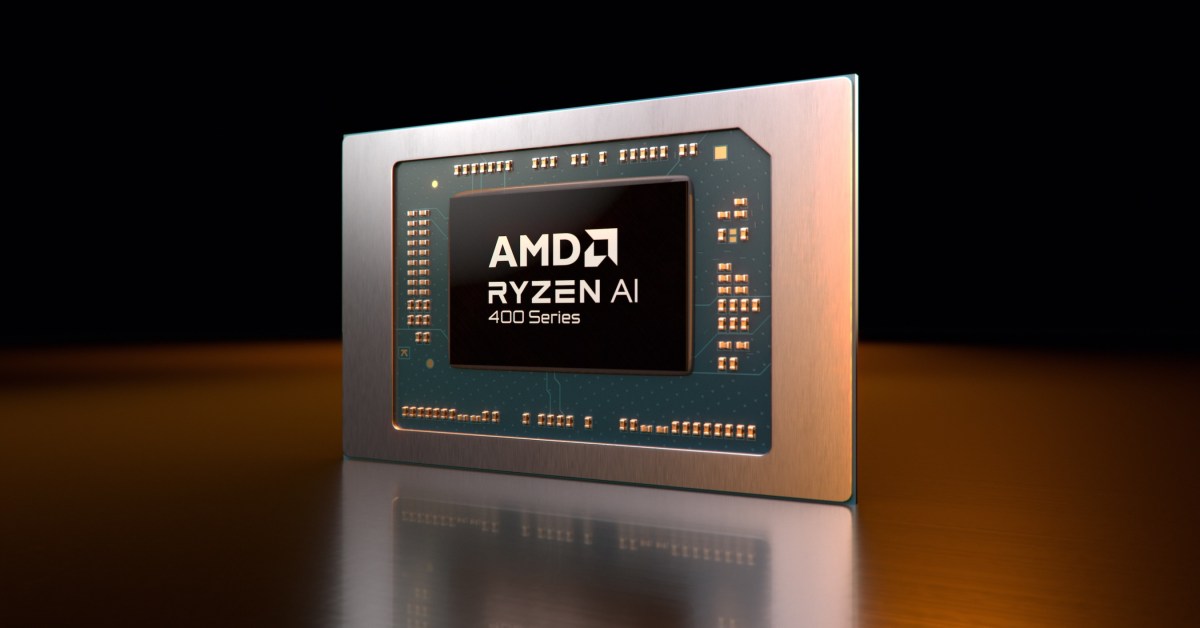
TECH GADGETS CES AMD Ryzen AI 400 official: Will these laptop chips maintain AMD’s lead? Ryzen AI 400 looks a lot like Ryzen AI 300. by Sean Hollister Jan 6,…
Sources
- AMD Ryzen AI 400 official: Will these laptop chips maintain AMD’s lead?
- AMD's Ryzen AI 400 processors play it safe, but add …
- AMD Unveils Strategy to Lead the $1 Trillion Compute …
- AMD "Ryzen AI 400 Series" Spotted in Official PMF Package
Related posts
- AMD trims Strix Halo lineup with Ryzen AI Max Plus chips for handhelds
- Vivoo’s FlowPad converts menstrual pads into an FSH at-home test
- Eureka’s $299 E10 Evo Plus: a hybrid robovac with self-empty dock