
TL;DR
Asus’ ROG Falcata merges gaming-grade speed with an ergonomic split layout, offering adjustable Hall effect switches, an 8,000 Hz wireless polling option and modular hardware tweaks. The keyboard’s hybrid design and high price leave it targeted at a niche audience, while software and wiring choices undermine some of its promise.
What happened
Asus introduced the ROG Falcata, a split 75 percent keyboard that aims to combine gaming performance and ergonomic design. The keyboard offers adjustable Hall effect switches with customizable actuation, Rapid Trigger and SOCD settings, and an 8,000-Hz wireless polling mode intended for low-latency gaming. Physically, the Falcata can be tented and angled with swappable feet and screw-on wrist rests, and includes a left-side control wheel and an LED actuation display. Typing feel is described as smooth with well-lubed stabilizers and a consistent sonic profile due to shorter split space bars. However, the halves are physically connected by a cable, leaving the left side wireless but the right half wired, which frustrates users expecting a fully wireless split. Asus shifted customization to a new web-based Gear Link system, which started in beta and initially had remapping bugs later fixed on the reviewer’s unit via firmware.
Why it matters
- The Falcata is one of the few keyboards that targets both competitive gaming and ergonomic typing, which could influence future hybrid designs.
- High polling rates and adjustable Hall effect switches bring advanced gaming features to a split form factor, changing expectations for ergonomics-focused keyboards.
- Software and connectivity choices show that hardware innovation can be undermined by unfinished ecosystem support, affecting usability for owners.
- At a premium price, the Falcata’s compromises (wired connection between halves, beta software) matter for buyers weighing cost against convenience and polish.
Key facts
- Layout: split 75 percent keyboard with two halves that slot together without a gap.
- Switches: Hall effect switches with adjustable actuation distance and Rapid Trigger functionality.
- Polling: supports an 8,000-Hz wireless polling mode for low-latency input.
- Connectivity: left half operates wirelessly; the two halves are linked by a physical cable and the right half is not wireless.
- Software: customization moved from Armoury Crate to a new web-based Gear Link, which started in beta and initially had remapping issues fixed on the review unit by a firmware update.
- Modularity: includes screw-on wrist rests, two sizes of feet for tenting/angling, and physical controls including a left-side wheel and LED actuation display.
- Stabilizers and sound: clip-in plate-mounted stabilizers are well-lubed with minimal rattle; split space bars make overall key sound more consistent.
- Aftermarket options: supports at least one alternative switch type (TTC Gold magnetic switches) in addition to stock Hall effect switches.
- Internal design: employs a bottom-mount-like assembly that reduces central 'dead zones' and isolates typing vibrations.
- Price: MSRP listed at $420, with common discounts sometimes bringing the street price down (example $280 mentioned).
What to watch next
- Whether Asus releases the firmware update that fixed remapping on the reviewer’s unit to the broader user base and when that rollout will occur; not confirmed in the source.
- If Asus updates Gear Link out of beta and restores full feature parity with Armoury Crate (including in-app firmware flashing); timeline not confirmed in the source.
- Game compatibility and policy enforcement around SOCD/Rapid Trigger settings—some titles like Counter-Strike 2 block certain inputs tied to these features.
Quick glossary
- Hall effect switch: A contactless keyboard switch that uses a magnet and Hall effect sensor to detect key position, often allowing adjustable actuation and longer durability.
- Polling rate: How frequently a device reports input to the host system, measured in hertz; higher rates can reduce input latency.
- SOCD (Simultaneous Opposing Cardinal Direction): A keyboard or controller input handling mode that defines how the device treats simultaneous presses of opposing directional inputs (e.g., left and right).
- Stabilizer: A mechanism used on larger keys (space, enter, shift) to keep the keycap level and reduce wobble and noise.
- Rapid Trigger: A switch behavior that allows the key to register a new press shortly after release, enabling faster repeated inputs.
Reader FAQ
Is the Falcata primarily a gaming keyboard or an ergonomic board?
The review positions it as a hybrid: it targets gaming with high polling and switch features while incorporating ergonomic split-layout adjustments.
Can you use just the left half wirelessly for gaming?
Yes, the left half can operate wirelessly alone, but practical limitations arise because the right half remains wired and many typing functions are unavailable when it’s detached.
Is the customization software stable and fully featured?
Asus moved customization to a web-based Gear Link that was in beta and initially had remapping problems; the reviewer received a firmware fix on their unit, but broader availability and feature parity with Armoury Crate are unclear.
What is the battery life of the keyboard?
not confirmed in the source
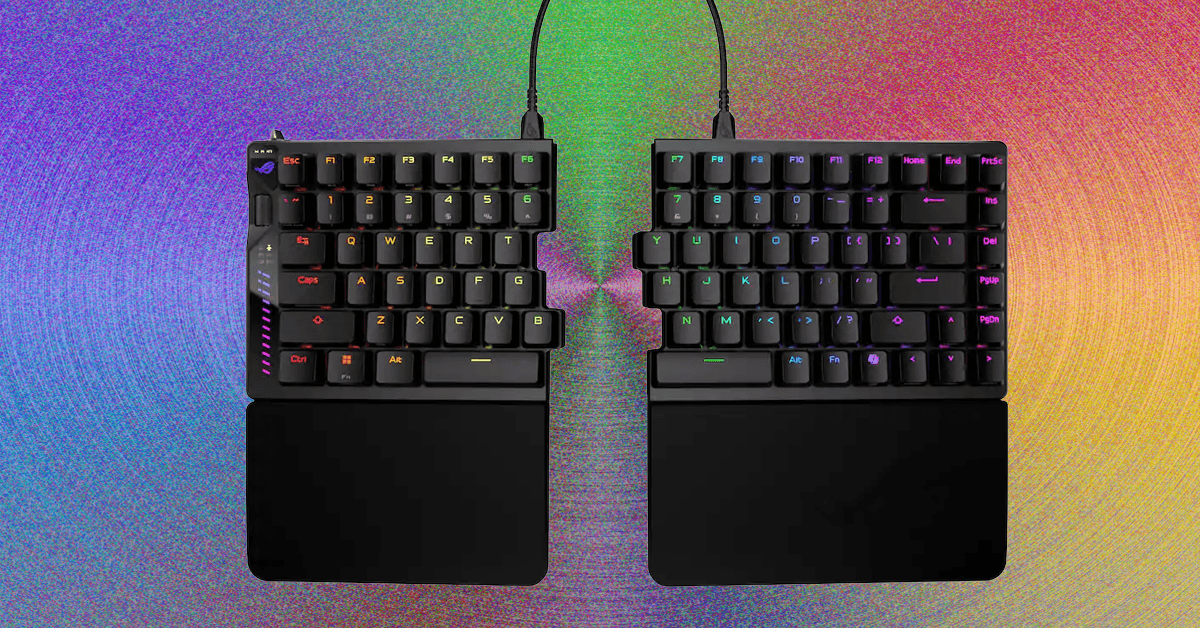
HENRI ROBBINS GEAR JAN 15, 2026 6:30 AM Review: Asus ROG Falcata With the looks and speed of a gaming keyboard and the comfort of an ergonomic keyboard, the Falcata…
Sources
- Asus ROG Falcata Review: A Split Gaming Keyboard
- ASUS ROG Falcata Review: Split 75% Keyboard with Hall Effect Switches
- ASUS ROG Falcata is a 75% Split Layout Keyboard with ROG HFX V2 …
- Asus ROG Falcata Review: Better Ergonomics by Half
Related posts
- The Samsung Galaxy S26 Ultra Needs One Key Improvement to Succeed
- Lizn Hearpieces review: Earbud-style hearables are affordable but painful
- Popular Coway Airmega Purifiers Discounted Through January 30