
TL;DR
A game designer argues that most RPGs rely on three basic place types—Outside, Dungeon and Town—and proposes making their borders messier to foster discovery and wonder. The piece critiques modern habits like explicit location pop-ups and promises to apply blurrier spatial design in the author’s own project, Free Tiya Bannet.
What happened
A design essay examined a recurring spatial pattern in many adventure and role-playing games: a tripartite distinction between Outside, Dungeon and Town. The author outlines typical characteristics for each — Outside as connective, Dungeon as monster- and treasure-dense, and Town as safe and activity-focused — and says this pattern remains useful. The core argument asks for more ‘messiness’: blurred transitions, underground networks that interconnect disparate places, and examples such as a dungeon opening from a town basement or caves that feel like personal discoveries rather than pre-labeled instances. The writer criticizes modern conveniences like on-screen location announcements for undermining player discovery and singles out Tears of the Kingdom’s underworld as too self-contained. They also note that many high-budget games tend toward conservative clarity and say they intend to experiment with these ideas in their own game, Free Tiya Bannet.
Why it matters
- Blurring spatial categories could increase player-driven discovery and emergent exploration.
- Stronger interconnections between areas may enhance world coherence and surprise.
- Design conservatism (clear signposting/instancing) trades predictability for reduced wonder.
- Reworking spatial language is a modest, actionable lever for changing player experience.
Key facts
- The essay defines three common place types: Outside, Dungeon and Town, each with distinct traits.
- Outside is described as connective and flexible, usually lower in NPCs and monsters.
- Dungeons typically contain abundant enemies, treasure and bosses; shops and NPCs are rare.
- Towns concentrate NPCs, shops and activities and are generally safe from combat.
- The author cites Kakariko Village (Ocarina of Time) as an example of a town with ambiguous, underground areas.
- The author says Final Fantasy VII Rebirth shows a clear separation among the three place types.
- The underworld in Tears of the Kingdom is described by the author as too separate — an ‘its own map’ design choice.
- The writer objects to location pop-ups that turn discoveries into checklist items, reducing the sense of discovery.
- The author plans to apply blurrier spatial designs in their own game, Free Tiya Bannet.
- Some roguelikes (Shiren the Wanderer) are noted as exceptions where dungeons can include NPC-like elements.
What to watch next
- Progress and design details for the author’s upcoming game Free Tiya Bannet, which the author says will use blurrier space integration.
- not confirmed in the source
- not confirmed in the source
Quick glossary
- Outside: Open or connective overworld areas that link other locations; typically less dense with enemies and NPCs.
- Dungeon: Closed or purpose-built areas focused on combat, treasure and bosses; often intended to be cleared by the player.
- Town: Safe, dense hubs with NPCs, shops, quests and activities; typically combat-free zones.
- Instancing: Design practice of treating locations as discrete, self-contained spaces often signposted to players (e.g., named pop-ups).
- Underworld: An underground layer or map beneath the main world; can be designed as either integrated networks or separate maps.
Reader FAQ
What are the three places discussed in the essay?
Outside, Dungeon and Town — broad spatial categories the author sees in many RPGs and adventure games.
Is the author asking designers to abandon these categories?
No — the author argues the categories are useful but wants their borders to be blurrier rather than eliminated.
Why does the author criticize location pop-ups and instancing?
They argue pop-ups turn discoveries into checklist items and reduce the feeling that the player has found something special.
When will Free Tiya Bannet be released?
not confirmed in the source
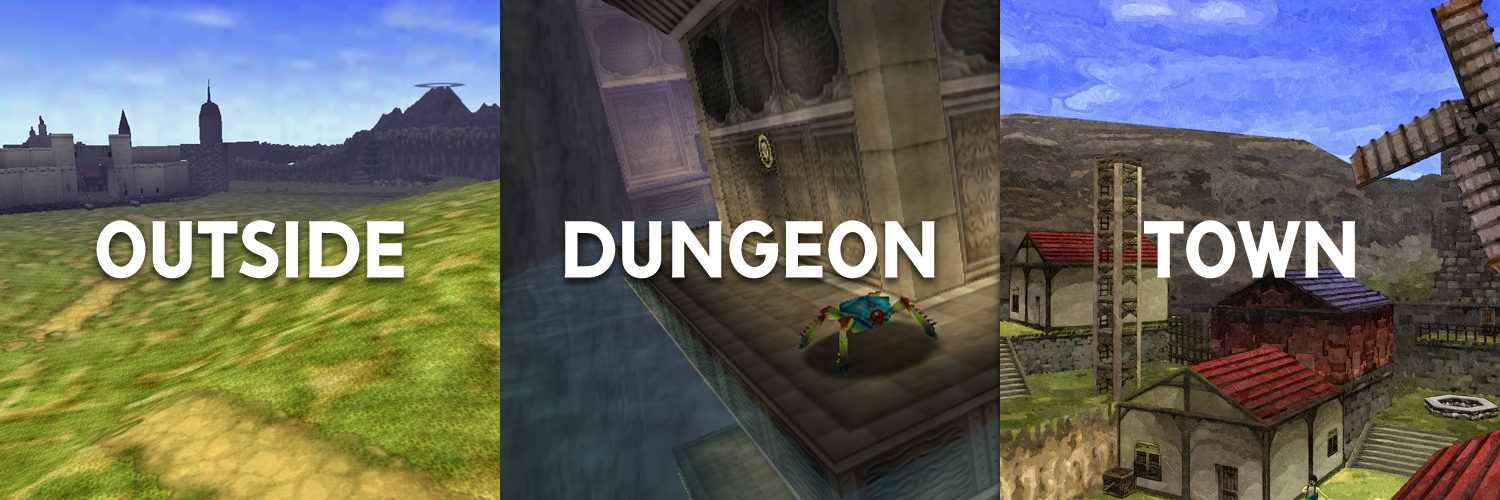
Outside, Dungeon, Town: integrating the Three Places in Videogames March 13, 2024 / Game Design, RPGs / 0 Comments Videogames, at least the kind I’m talking about (RPGs, adventure kinds…
Sources
- Outside, Dungeon, Town: Integrating the Three Places in Videogames (2024)
- Outside, Dungeon, Town: integrating the Three Places in …
- Whither the Dungeon? – The Decline and Fall of D&D …
- Mapping the Town – What should a Fantasy Town look like?
Related posts
- Geology of the Gulf of the Farallones National Marine Sanctuary
- Stranger Things Creator Urges Fans to Disable ‘Garbage’ TV Settings
- 50,000 Drums of Radioactive Waste Dumped Near the Farallones, 1946–1970