
TL;DR
A personal migration replaced US-based services with mainly EU-hosted tools, centered on Proton and other European providers. The author says the switch improved privacy, matched or exceeded usability, and cut annual costs by roughly €528.
What happened
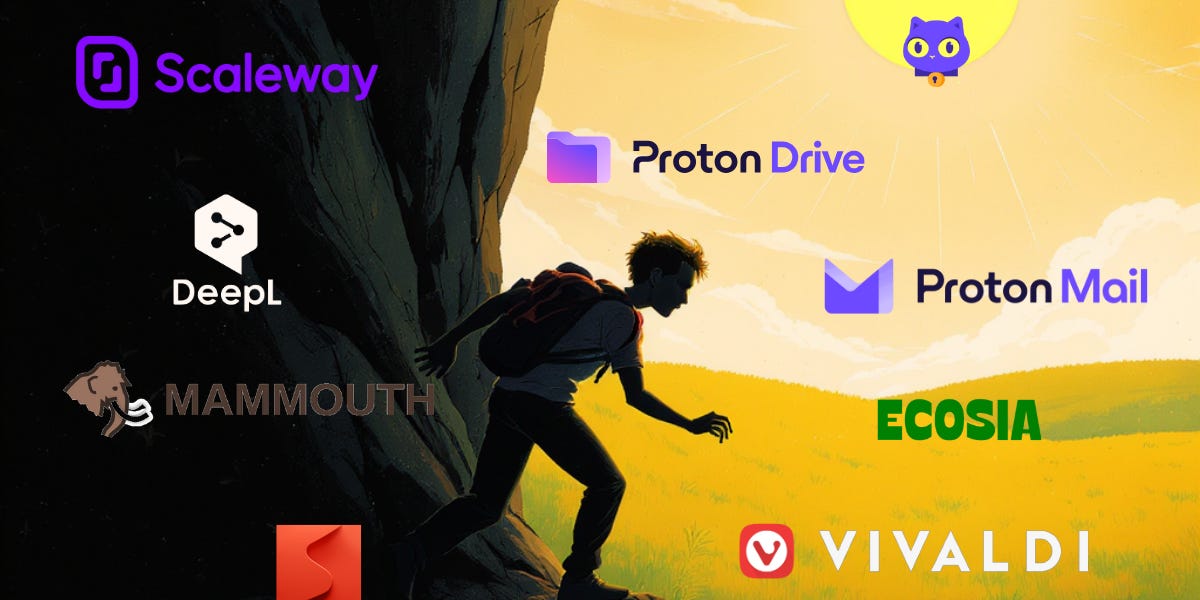
The author moved their personal digital setup away from major US services to predominantly EU-hosted alternatives. Proton became the core: encrypted mail and calendar, cloud storage with docs and tables, Proton Pass for passwords and MFA, a VPN, Standard Notes for notes, and Lumo AI for privacy-focused generative AI. For heavier AI workloads they use Mammouth (access to many models and image generation) and pick different models depending on the task. Browsing and search shifted to Vivaldi and Ecosia, while DeepL stayed as the primary translator. Hosting and domains were moved to Scaleway. Task management migrated from Todoist to Superlist after a brief trial of MeisterTask. The author reports a drop in monthly spending from about €83 to €39, estimating more than €500 saved per year, and notes remaining frictions around social platforms, single‑sign‑on convenience, and office-suite compatibility.
Why it matters
- Demonstrates that privacy-focused, EU-hosted tools can match mainstream usability for personal setups.
- Shows potential cost savings when replacing multiple US services with a consolidated EU stack.
- Highlights trade-offs users should expect (SSO friction, certain social platforms still unavoidable).
- Signals maturing alternatives in areas such as encrypted email, cloud storage, and privacy‑first AI.
Key facts
- Primary backbone of the stack is Proton: mail, calendar, drive, Proton Pass, VPN, and Standard Notes.
- Author uses Lumo AI for privacy-first GenAI tasks and Mammouth for access to many larger AI models and image generation.
- Most-used AI models cited: Mistral Medium 3.1 and Flux 2 Pro/Fast; Claude Code is used for large codebases; Gemini is sometimes preferred for complex research.
- Browser moved to Vivaldi; default search engine is Ecosia; DeepL retained for translation; Grammarly remains for spell check.
- Hosting and domain services were migrated to Scaleway.
- Task management moved from Todoist to Superlist; MeisterTask was evaluated and rejected by the author.
- Monthly cost reported to fall from ~€83 to ~€39, yielding about €528 saved annually.
- Some features remain missing or awkward: Google SSO replacement friction, office-suite feel of LibreOffice/Collabora, and dependence on platforms like LinkedIn, GitHub, YouTube, Medium, and Substack.
What to watch next
- The planned release of Proton Meet, which the author expects will complete Proton's suite.
- Whether Lumo AI becomes a more central part of the workflow as the author experiments more with it.
- not confirmed in the source
Quick glossary
- Proton ecosystem: A suite of privacy-focused services from an EU company, including encrypted email, calendar, cloud storage, password manager, VPN, and related apps.
- GenAI: Generative artificial intelligence systems that produce text, code, images, or other content based on prompts.
- E2E encryption: End-to-end encryption ensures only communicating users can read the data, preventing intermediaries from accessing plaintext.
- VPN: Virtual private network — a service that routes internet traffic through encrypted tunnels to protect privacy and mask IP addresses.
- SSO: Single sign-on, a user authentication process that permits using one set of login credentials across multiple applications.
Reader FAQ
How much did the migration save per year?
The author reports monthly costs dropping from about €83 to €39, roughly €528 saved annually.
Did the author fully replace Google and other big US services?
Most personal services were replaced, but the author still relies on platforms like LinkedIn, GitHub, YouTube, Medium and Substack for social and publishing needs.
Was the migration technically difficult?
The author describes the migration as surprisingly simple overall but notes friction around document/spreadsheet workflow and losing Google SSO convenience.
Is this approach recommended for companies?
The post is explicitly focused on personal setups; whether the same stack is appropriate for companies is not confirmed in the source.
Discover more from Zeitgeist of Bytes Staying in time of technology, infused by sociotechnological and personal thoughts 📩 a Newsletter for everyone who ❤️ tech and personal development Subscribe By…
Sources
- Bye Bye Big Tech: How I Migrated to an Almost All-EU Stack (and Saved 500€/Year)
- How I Migrated to an Almost All-EU Stack (and Saved 500€ …
- A look back at 2025
- New Report: Building A European Tech Stack Could Cost € …
Related posts
- Stranger Things Creator Urges Fans to Disable ‘Garbage’ TV Settings
- LG announces Gallery TV at CES — mini‑LED framed art TV tied to Gallery+
- Meta to acquire Chinese AI startup Manus to bring ‘general agents’ technology