
TL;DR
A writer reports that command-line AI agents such as Claude Code have lowered the friction of running personal services on a cheap home server. Combined with small mini‑PC hardware and Tailscale for networking, the author set up multiple self-hosted apps without deep Docker or config knowledge.
What happened
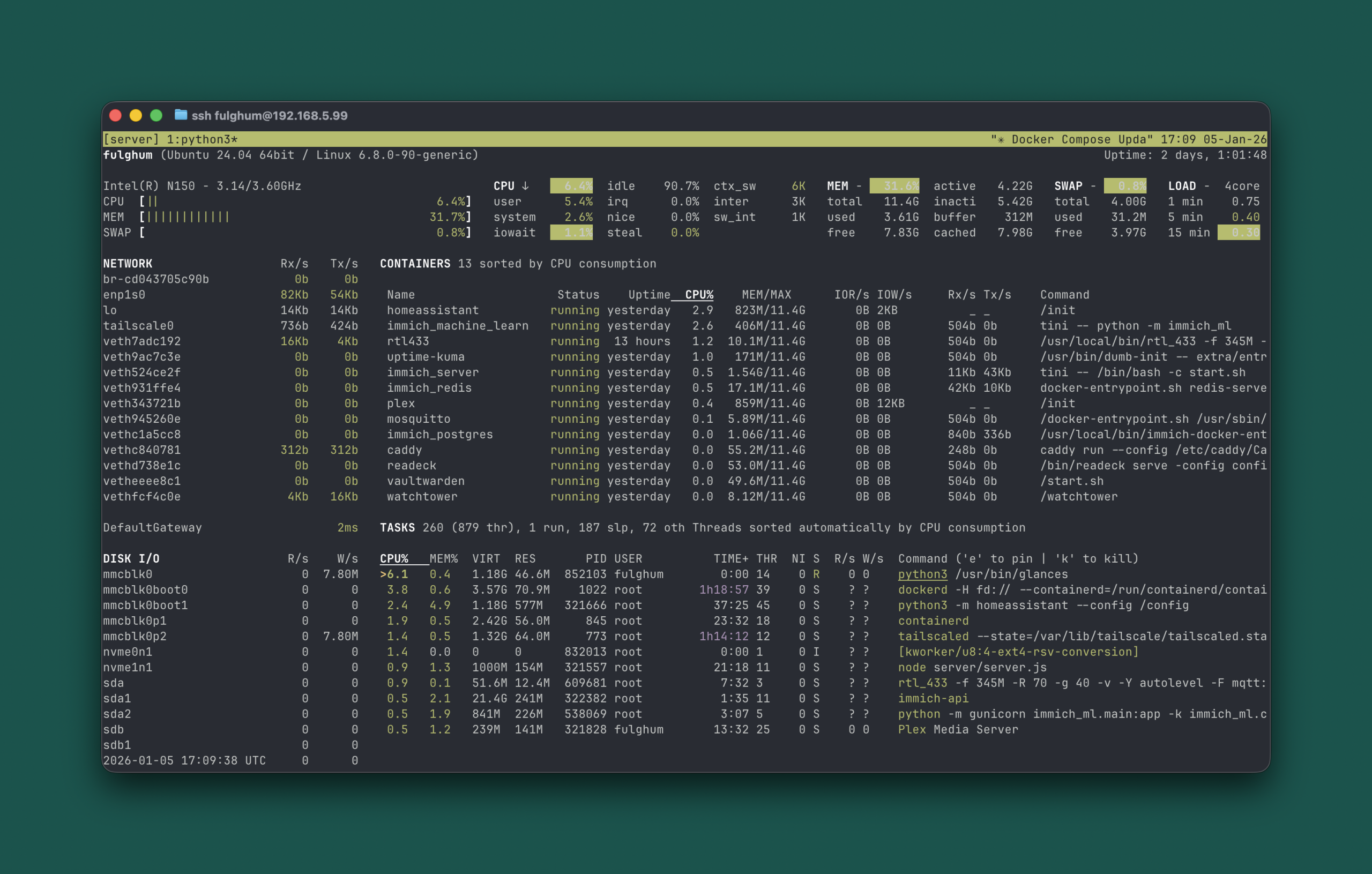
The author rebuilt a personal home server workflow in early 2026 using a low-cost mini PC (a Beelink Mini N150), Ubuntu Server (22.04 LTS), Tailscale for private networking, and a CLI agent—Claude Code—installed directly on the server. Instead of manually searching for Docker and Compose examples, the writer instructed Claude Code to install Docker, generate Docker Compose files, place services behind a Caddy reverse proxy, persist data, enable auto‑updates, secure the host with reasonable packages, and ensure services restart after reboots. The box now runs a suite of containers — including Vaultwarden, Plex, Immich, Uptime Kuma, Caddy, Home Assistant, and ReadDeck — all reachable from the author’s phone, laptop, and tablet. Monitoring tools such as Lazydocker and Glances show 13 containers consuming about 6% CPU and 32% memory; the author reports the N150 using roughly 4 GB RAM and very little CPU while running these services.
Why it matters
- CLI agents can abstract away manual Docker and config work, lowering the technical barrier for self-hosting.
- Affordable, energy-efficient mini PCs make always-on personal servers financially accessible.
- Tailscale removes the need for complex port forwarding, simplifying secure remote access.
- Self-hosting becomes more approachable for non-infrastructure specialists who still want control over core services.
Key facts
- Hardware used: Beelink Mini N150; author paid about $379 plus 'another few hundred USD' for 8TB NVMe storage.
- OS and network: Ubuntu Server 22.04 LTS installed; Tailscale used for private networking.
- CLI agent: Claude Code installed on the server to perform setup and maintenance tasks.
- Claude Code tasks included installing Docker, creating Docker Compose files, adding services behind Caddy, persisting data, keeping images updated, and configuring restart-on-boot.
- Services run as containers: Vaultwarden (Bitwarden-compatible), Plex, Immich (photo replacement), Uptime Kuma, Caddy (reverse proxy with automatic TLS), Home Assistant, and ReadDeck.
- Monitoring/utilities: Lazydocker for container UI; Glances for system-wide resource view.
- Observed utilization: Glances showed 13 containers, about 6% CPU, and 32% memory usage; author notes roughly 4 GB RAM in use.
- Alerts: Uptime Kuma sends basic email alerts when services go down and when they recover.
What to watch next
- Whether this CLI-agent-first approach scales well beyond a personal set of services (not confirmed in the source).
- Security and update-management practices for agent-driven automation over time (not confirmed in the source).
- Adoption among less technical users who are comfortable in a terminal — the author recommends it for 'normie/software-literate' people, but broader uptake is not quantified in the source.
Quick glossary
- CLI agent: A command-line program that can perform tasks, automate workflows, and execute commands based on natural-language or scripted instructions.
- Docker / Docker Compose: Containerization tools that package applications and their dependencies; Compose defines and runs multi-container Docker apps using YAML files.
- Tailscale: A mesh VPN service that creates secure private networking between devices without manual port forwarding or complex network configuration.
- Reverse proxy (Caddy): A server that routes external requests to internal services; Caddy also automates TLS certificate provisioning.
- Vaultwarden: A lightweight, Bitwarden-compatible server implementation that can be self-hosted and used with Bitwarden clients.
Reader FAQ
Do you need expensive hardware to self-host like this?
No — the author used a budget mini PC (Beelink Mini N150) and said it handled 13 containers with low resource use; exact costs beyond the cited examples are not confirmed in the source.
Can Vaultwarden replace Bitwarden?
Vaultwarden is Bitwarden-compatible and the author used it as a self-hosted replacement for Bitwarden clients and browser extensions.
What exactly is Claude Code doing on the server?
According to the author, Claude Code generated Docker Compose files, installed services, configured reverse proxying and persistence, handled updates, and set services to restart on boot.
Is running this setup secure for sensitive data?
Not confirmed in the source.
2026 is the Year of Self-hosting by Jordan Fulghum, January 2026 Your home server's new sysadmin: Claude Code I have flirted with self-hosting at home for years. I always bounced…
Sources
- CLI agents make self-hosting on a home server easier and fun
- CLI agents like Claude Code make self-hosting on a home …
- Code research projects with async coding agents like Claude …
- 10 Claude Code Alternatives That Every Developer Must Use
Related posts
- Which programming languages are most token-efficient for LLM-powered coding?
- CLI agents such as Claude Code make home server self‑hosting simpler
- What If AI Agents Were Assigned Zodiac Personalities — An LLM Experiment