
TL;DR
A multi-hour Cloudflare outage on Nov. 18 disrupted many high-profile sites and forced some customers to bypass the service. Security experts say the event revealed how heavily organizations rely on Cloudflare protections and created a short-lived window to assess exposed defenses and potential compromises.
What happened
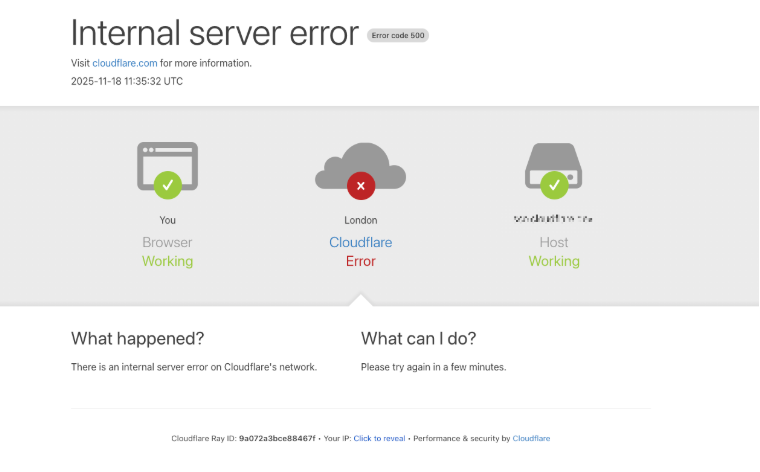
On Nov. 18 at about 06:30 EST (11:30 UTC), Cloudflare reported an internal service degradation that caused intermittent failures across its network. Over several hours the company’s services returned and then faltered again; in many cases customers could not switch away from Cloudflare because the company’s control portal was unreachable or because their DNS was also hosted there. Some customers did manage temporary pivots away from Cloudflare to preserve availability. Security practitioners warn that removing Cloudflare’s edge protections for that period likely exposed application infrastructure to direct traffic that would normally have been filtered by Cloudflare’s WAF and bot controls. Experts urged organizations to review WAF and access logs for the outage window to separate legitimate traffic from malicious activity and to investigate any signs of persistence. Cloudflare published a postmortem saying the incident was not caused by an attack, and traced the root cause to a change in a database permissions setting that led to an oversized feature file for its Bot Management system being propagated across the network.
Why it matters
- Many organizations rely on Cloudflare to block common application-layer attacks; outages can reveal gaps in internal defenses.
- Temporary routing or DNS pivots can expose infrastructure directly to malicious traffic and give attackers an opportunity to probe or persist.
- Concentration of services with a single provider creates a single point of failure for availability and security controls.
- The incident serves as a practical test of incident playbooks, emergency routing procedures and shadow-IT behavior under pressure.
Key facts
- Cloudflare first noted an internal service degradation at about 06:30 EST / 11:30 UTC on Nov. 18.
- Some customers could not migrate away from Cloudflare because the company portal was inaccessible or their DNS was hosted with Cloudflare.
- Other customers temporarily removed Cloudflare protections to maintain availability during the outage.
- Security experts recommend reviewing WAF logs for the outage period to distinguish between benign spikes and malicious activity.
- Cloudflare’s WAF is cited as filtering many of the OWASP Top Ten application-layer threats and various bot attacks.
- Cloudflare said the disruption was not due to malicious activity; the company attributed it to a database permission change that caused a bot-management feature file to double in size and propagate across its network.
- Cloudflare estimates roughly 20% of websites use its services, highlighting the scope of potential impact when a major provider has issues.
- Consultants advised measures such as splitting services across zones, using multiple DNS vendors, and segmenting applications to reduce single-vendor risk.
What to watch next
- Customer audits of WAF and access logs for the outage window to detect exploitation or lingering persistence — confirmed in the source.
- Whether organizations identify active compromises tied to the outage period and report remediation findings — not confirmed in the source.
- Industry moves toward multi-vendor DNS, split architectures and reduced single-provider dependencies as a result of this outage — not confirmed in the source.
Quick glossary
- Cloudflare: A CDN and security provider that offers services like DDoS mitigation, WAF, DNS hosting and bot management to websites and applications.
- WAF (Web Application Firewall): A security control that inspects and blocks malicious web traffic aimed at application-layer vulnerabilities such as SQL injection and XSS.
- DNS (Domain Name System): A system that translates human-friendly domain names into the IP addresses that computers use to route traffic on the internet.
- Bot management: Tools and techniques used to detect and mitigate automated traffic, distinguishing legitimate bots from malicious or abusive automation.
- OWASP Top Ten: A widely referenced list of the most common and critical web application security risks maintained by the Open Web Application Security Project.
Reader FAQ
Was the outage caused by a cyberattack?
Cloudflare said the disruption was not caused by an attack; it traced the incident to a database permissions change that produced an oversized bot-management feature file.
When did the outage begin?
Cloudflare reported an internal service degradation around 06:30 EST (11:30 UTC) on Nov. 18.
Were all Cloudflare customers able to switch away during the outage?
No. Some customers could not migrate because the Cloudflare portal was unreachable or their DNS was hosted with Cloudflare; others did pivot away temporarily.
Should organizations be worried about compromises from that window?
Experts recommend reviewing logs and infrastructure exposed during the outage for signs of malicious activity or persistence; specific compromises are not confirmed in the source.
Will Cloudflare change its systems or policies after this?
Not confirmed in the source.
November 19, 2025 28 Comments An intermittent outage at Cloudflare on Tuesday briefly knocked many of the Internet’s top destinations offline. Some affected Cloudflare customers were able to pivot away…
Sources
- The Cloudflare Outage May Be a Security Roadmap
- Cloudflare Incident: What It Teaches About Systemic Risk …
- Cloudflare outage on November 18, 2025
- Major Cloudflare Outage Disrupts Global Web Traffic …
Related posts
- Engineer saved company money — by quietly gaming at work during reimages
- MPs accuse UK government of neglecting surge in mobile phone thefts
- Microsoft December 2025 security update disrupts MSMQ on older Windows systems