
TL;DR
A Commodore History YouTube video shows a 1982 Commodore 1541 floppy drive contains a 1 MHz MOS 6502 CPU plus RAM, ROM and I/O and can be repurposed as a very limited standalone computer. The creator loaded a KIM-1 kernel and a Tiny BASIC port into the drive’s ROMs and interacted with it over a serial terminal, though the setup is constrained by limited I/O.
What happened
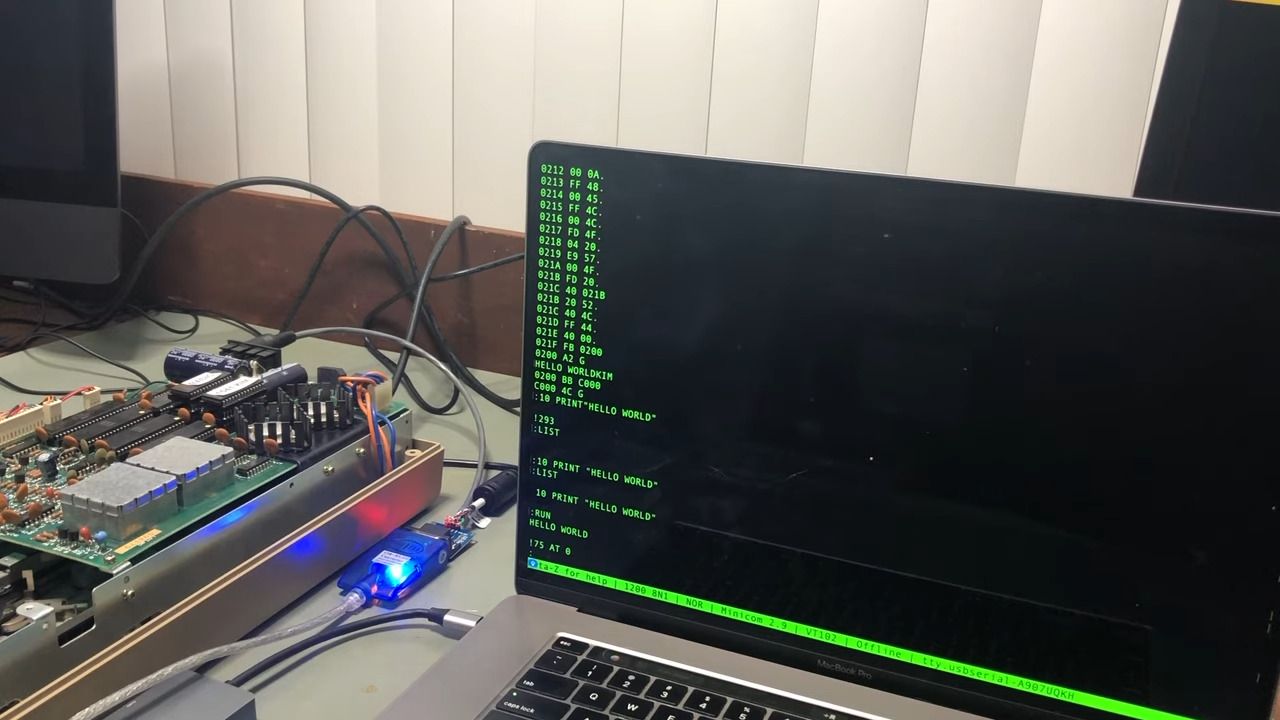
A retro-computing video demonstrated that the electronics inside a 1982 Commodore 1541 floppy drive are capable of operating as a standalone computing platform. The drive already includes a 1 MHz MOS 6502 processor, RAM, ROM and I/O chips; the presenter, Dave from the Commodore History channel, kept hardware changes minimal and instead reprogrammed the drive’s firmware. He adapted the published KIM-1 kernel, adjusted initialisation and serial I/O routines, burned the modified code to an EEPROM and connected the drive to a Mac using a homemade USB→RS232→TTL dongle. Using a Minicom terminal, Dave executed hand-entered 6502 assembly “Hello World” code successfully, then ported Tiny BASIC to the drive and installed it as a ROM to speed up coding. The experiment worked but remained limited to serial-terminal use because the 1541 lacks the graphics/sound IC and broader I/O that systems like the VIC-20 provide.
Why it matters
- Demonstrates that peripheral controller boards from the era contained near-complete computing subsystems, not just I/O logic.
- Highlights how software/firmware changes alone can repurpose vintage hardware into different roles.
- Underscores the importance of dedicated graphics and I/O chips for general-purpose use — absence limits practical applications.
- Prompts questions about the processing capability of modern storage-controller electronics and their potential repurposing.
Key facts
- The Commodore 1541 floppy drive dates from 1982 and was sold as a disk peripheral for the Commodore 64.
- The drive’s electronics include a 1 MHz MOS 6502 CPU, along with on-board RAM, ROM and I/O chips.
- The MOS 6502 is closely related to the C64’s MOS 6510 and is the same processor used in the VIC-20.
- Dave from the Commodore History channel used a published KIM-1 kernel, modified it for the 1541, and burned it to an EEPROM.
- A USB→RS232→TTL adaptor was built to connect the 1541’s serial port to a Mac; interaction used the Minicom terminal.
- Hand-entered 6502 assembly produced a working Hello World via the serial terminal in the video demonstration.
- Tiny BASIC was ported to the KIM-1 code, burned to ROM on the 1541, and allowed BASIC programs to run on the drive.
- Because the 1541 lacks a dedicated graphics/sound VIC chip and ample I/O, the experiment was constrained to serial terminal use.
- The Commodore 64 originally sold for $599 in 1982 (~$1,950 today) and the 1541 drive was $399 in 1982 (~$1,300 today).
- The modified code and ROM images used in the project are hosted on GitHub, according to the video.
What to watch next
- Whether anyone extends this work with hardware mods to add a VIC-like graphics/sound chip to the 1541 — not confirmed in the source
- Further projects that attempt fuller I/O expansion of the 1541 to make it a more general-purpose machine — not confirmed in the source
- Explorations of modern drive-controller electronics for similar repurposing or computation experiments — not confirmed in the source
Quick glossary
- MOS 6502: An 8-bit microprocessor introduced in the 1970s that powered many early home computers and game consoles.
- ROM: Read-only memory storing firmware or software that typically cannot be changed during normal operation.
- EEPROM: Electrically erasable programmable read-only memory that can be rewritten and used for storing updated firmware.
- I/O: Input/output — the circuits and interfaces that let a system communicate with peripherals, displays, and other devices.
- Tiny BASIC: A compact implementation of the BASIC programming language suitable for small systems with limited resources.
Reader FAQ
Can a Commodore 1541 floppy drive function as a standalone computer?
Yes — the video shows a 1541 running a modified KIM-1 kernel and Tiny BASIC via its onboard CPU, but operation was limited to serial-terminal use.
Did the project require heavy hardware modification?
No — the presenter kept hardware mods minimal, instead burning modified firmware to EEPROM and using an external serial adaptor.
Can the 1541 display graphics like a VIC-20?
No — the 1541 lacks the VIC-20’s dedicated 6560 VIC graphics/sound chip and broader I/O, so graphics capability is not present without hardware additions.
Is the project code available to the public?
Yes — the article states the code was published on GitHub.
PC Components CPUs Commodore 64 floppy drive has the power to be a computer — bulky 1982 Commodore 1541 5.25 inch drive packs a 1 MHz MOS 6502 CPU News…
Sources
- Commodore 64 floppy drive has the power to be a computer and runs BASIC
- bulky 1982 Commodore 1541 5.25 inch drive packs a 1 …
- Commodore 1541 Disk Drive Becomes a Tiny Computer
- Commodore Disk Drive Becomes General Purpose …
Related posts
- Dell’s CES 2026 briefing stood out for being refreshingly low on AI talk
- Many Hells of WebDAV: Building a Go WebDAV/CalDAV Client and Server
- Breville Luxe Brewer (2025) Review: Strong Drip Coffee and True Cold Brew