
TL;DR
Researchers have identified a previously undescribed mushroom, Lanmaoa asiatica (locally Jian shou qing), that reliably produces lilliputian hallucinations when undercooked. DNA and chemical work so far show the species is new to science, related to porcini, and contains no known psychoactive compounds, prompting ongoing investigation.
What happened
Scientists sampling wild fungi sold in Yunnan markets identified a mushroom long known locally as Jian shou qing and formally described it as Lanmaoa asiatica. The species is widely eaten and prized for flavor but is also associated with striking visual experiences in which consumers report seeing numerous tiny people — a syndrome clinicians call lilliputian hallucinations. Researchers performing DNA sequencing on market specimens confirmed the species was new to science and found it to be more closely related to porcini than to known hallucinogenic mushrooms. Independent foraging in the Northern Philippines recovered the same species, suggesting a broader geographic distribution. Chemical and genomic screens to date have not detected any known psychoactive molecules, and some commercial dried packages labeled as Jian shou qing were found to contain multiple different, sometimes poisonous, species rather than the hallucinogenic mushroom itself. Work continues to identify the compound or mechanism responsible for the unusual perceptual effects.
Why it matters
- Identifying the active compound could reveal a previously unknown mechanism that produces a consistent, unusual form of hallucination.
- Mislabeling and mixed-species commercial packages create potential public-health risks for consumers of wild-harvested mushrooms.
- Finding the same species across distant regions suggests a real biological basis for a culturally recognized effect rather than isolated folklore.
- Taxonomic clarification helps distinguish an edible, prized market species from look-alikes that may be toxic.
Key facts
- Formal scientific name: Lanmaoa asiatica; local name in Yunnan: Jian shou qing.
- The species was described after DNA sequencing of mushrooms purchased in Kunming markets; it was new to science.
- Lanmaoa asiatica is more closely related to porcini than to known psychedelic mushroom species.
- Consuming undercooked specimens is commonly linked to vivid lilliputian hallucinations — seeing many tiny people interacting with the environment.
- According to Yunnan Hospital records cited by researchers, 96% of affected patients reported seeing abundant 'little people' or 'elves.'
- Independent collections in the Northern Philippines identified the same species, indicating a wider distribution.
- Chemical and genomic analyses so far found no traces of any known psychoactive compounds in Lanmaoa asiatica.
- DNA checks of some commercially sold dried packages labeled as Jian shou qing revealed mixtures that included poisonous species and, in some samples, no trace of the psychoactive mushroom.
What to watch next
- Identification and characterization of the novel chemical(s) responsible for the lilliputian hallucinations — ongoing research.
- Regulatory and market responses to findings of mislabelled or mixed-species dried mushroom packages.
- not confirmed in the source: clinical trials or therapeutic research into any compounds derived from Lanmaoa asiatica.
Quick glossary
- Lilliputian hallucinations: A type of visual hallucination in which a person perceives numerous miniature humanlike figures interacting within their real environment.
- DNA sequencing: A laboratory process that determines the order of nucleotides in an organism's genetic material, used to identify species and relationships.
- Taxonomic identity: The classification and formal scientific naming of a species based on morphological and genetic evidence.
- Psychoactive compound: A chemical substance that produces changes in perception, mood, consciousness, cognition, or behavior.
Reader FAQ
What is the mushroom called?
Formally described as Lanmaoa asiatica and locally known in Yunnan as Jian shou qing.
Does it contain known psychedelic chemicals like psilocybin?
Researchers reported no traces of known psychoactive compounds in chemical and genomic analyses.
Is the mushroom poisonous?
Not confirmed in the source whether Lanmaoa asiatica itself is poisonous; the source notes some commercial packages labeled as Jian shou qing contained poisonous species.
How widespread are reports of these tiny-people hallucinations?
Accounts come from Yunnan markets, historical reports from Papua New Guinea, and recent collections in the Northern Philippines, indicating independent occurrences across regions.
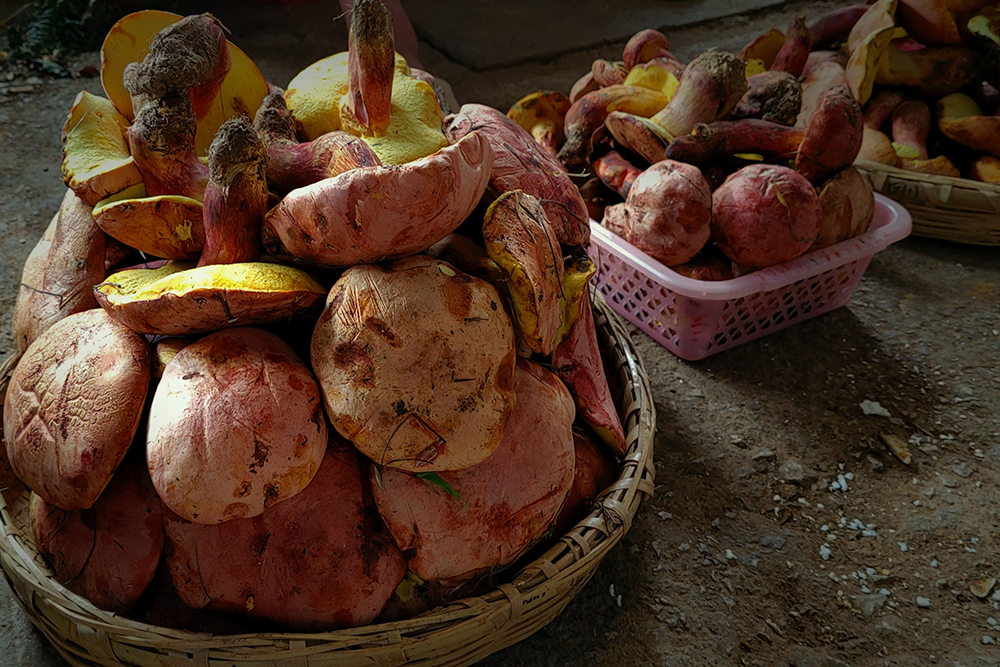
Mushroom markets are scattered throughout the capital city of Kunming, ranging in size from a few street blocks to no less than the largest wild mushroom market in the world,…
Sources
- Experts explore new mushroom which causes fairytale-like hallucinations
- The Hallucinogenic Mushroom That Makes You See …
- Hallucinogenic bolete mushroom
- Experts Explore New Mushroom Which Causes Fairytale- …
Related posts
- A Proclamation on Restoring the Em—Dash: Reclaiming the Writer’s Mark
- How Charles Dodgson (Lewis Carroll) developed condensation for determinants
- How uv got so fast: design choices behind a speedy Python installer