
TL;DR
The EFF guide explains how age-verification systems work, lays out the privacy and security trade-offs of different methods, and recommends submitting the least amount of data possible. It reviews common approaches — inferred age, facial age estimation, and document-based checks — and highlights vendor practices and past failures to help users weigh risks.
What happened
The Electronic Frontier Foundation published practical guidance for people encountering online age gates imposed by platforms and by law. The guide explains common verification paths — using existing account signals, automated face-based age estimation, third-party vendors, or submitting government IDs — and stresses that all of these carry privacy and accuracy risks. It urges users to ‘follow the data,’ asking about what information is collected, who sees it during verification, how long it is retained, whether independent audits exist, and who will know you attempted verification. The piece catalogs real-world examples: some vendors perform on-device estimation, others upload images to servers; one provider used by major platforms says it deletes images after estimating age; some verifiers keep ID images indefinitely by default. The guide also cites past operational failures, including a customer-service workflow that left ID photos exposed after a breach, as reminders that stated deletion and retention policies are not foolproof.
Why it matters
- Age gates can require highly sensitive data (photos of faces or government IDs) that tie online accounts to real identities and addresses.
- Verification systems have a track record of leaks and operational errors that can expose ID images and other private information.
- Automated face-based checks perform less reliably for some groups, raising risks of misclassification and unequal access.
- Long or default retention policies increase the window for breaches and historical data requests.
- Alternatives like credit-card or email checks reduce some sensitivity but still undermine anonymity and can enable tracking.
Key facts
- EFF opposes age-verification mandates but notes such mandates are already in effect in some places.
- Recommendation: submit the minimum data necessary and ask vendors about data, access, retention, audits, and visibility.
- Platforms often try to infer age from existing account signals before asking for a verification check.
- Facial age-estimation vendors differ: Private ID and k-ID can run on-device; Yoti uploads images to its servers for some checks.
- Yoti states it deletes facial images immediately after estimating age; it also reports security measures like pentesting and a bug bounty.
- Researchers observed trackers in Yoti’s app and website, raising concerns that verification attempts could be visible beyond the vendor.
- Document-based verification proves identity as well as age; third-party or in-house processing and long retention increase exposure risk.
- Discord routed ID images through its customer-service workflow and later had a breach that led to disclosure of nearly 70,000 ID photos.
- Some document verifiers have default retention policies that keep images indefinitely; the guide cites one vendor that holds images forever by default while platforms may promise deletions.
What to watch next
- Whether platforms increase use of on-device age estimation rather than server-side uploads, reducing the amount of data sent off-device.
- Publication of independent, security-focused audits (for example by specialized auditors) of verification vendors and platform dataflows.
- Changes to vendor and platform retention policies and deletion practices following regulatory or public pressure.
- not confirmed in the source: The ultimate legal outcomes of efforts to overturn or block age-verification mandates.
Quick glossary
- Age gate: A technical or procedural check used by websites or apps to limit access based on a user’s age.
- Facial age estimation: An automated method that analyzes a photo of a face to estimate whether a person meets an age threshold.
- Document-based verification: A process that requires a government-issued ID or other official document to prove both age and identity.
- On-device processing: Computation that happens locally on a user’s device rather than being uploaded to a remote server, which can reduce external data exposure.
- Data retention policy: A vendor or platform’s stated rules for how long it keeps user data and under what conditions it deletes that data.
Reader FAQ
Do I have to provide ID to use most major platforms?
Not always. Platforms often try to infer age from account signals first, but if they can’t, they may offer options that include facial checks or ID uploads.
Which verification method is safest for privacy?
The guide recommends providing the least data possible; on-device age estimation can reduce server uploads but may not be available or accurate for everyone.
Will verification images and IDs be deleted after use?
It depends: some vendors and platforms claim immediate or time-limited deletion (for example, a platform may keep an ID image for 30 days), while other verifiers have default policies that retain images indefinitely.
Are there lower-risk alternatives to face or ID checks?
Yes. Some services offer credit-card checks or email/database checks that carry less sensitivity but still affect anonymity and can enable tracking.
Will mandates for age verification be overturned?
not confirmed in the source
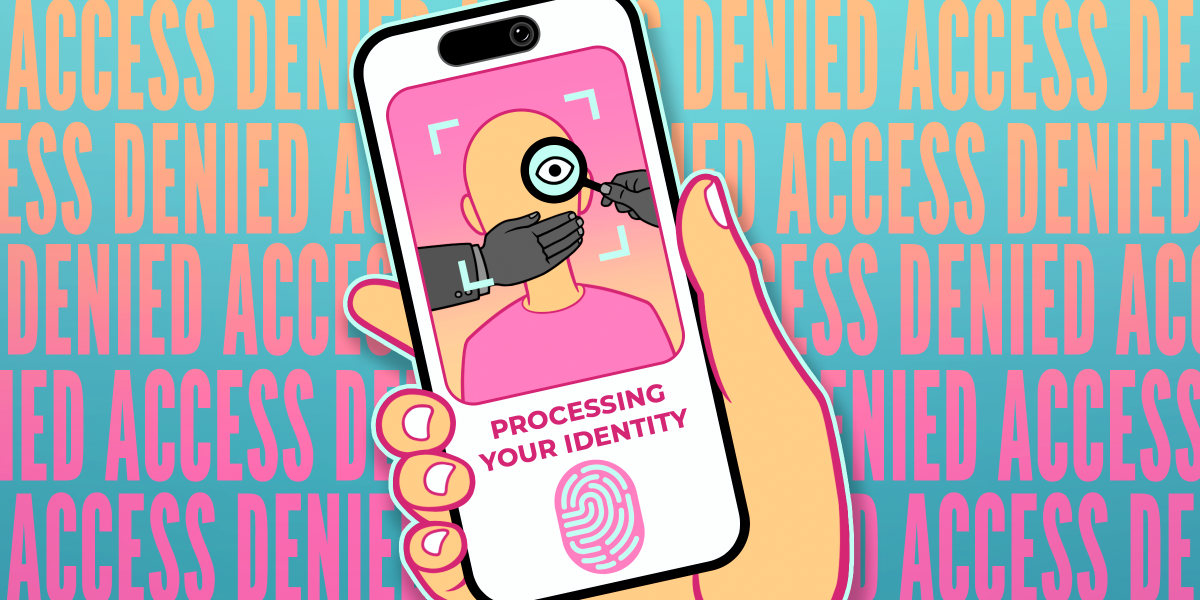
This blog also appears in our Age Verification Resource Hub: our one-stop shop for users seeking to understand what age-gating laws actually do, what’s at stake, how to protect yourself, and…
Sources
- So, You've Hit an Age Gate. What Now?
- 3 Essential Age Verification Online Strategies for Parents' …
- Online Age Restrictions Need Strong Rules and …
- Age Gating vs Age Verification: Protecting Minors Online
Related posts
- UK government drops plan to make national digital ID compulsory for workers
- Bandcamp bans AI-generated music from its platform, citing human-made standard
- FBI Searches Washington Post Reporter’s Home in Classified Probe