
TL;DR
Researchers at the University of Bonn developed a patent-pending filter modeled on fish gill arches that removed over 99% of plastic fibers in washing-machine wastewater during early tests. The design aims to be self-cleaning, inexpensive to produce, and integrable into future washing machines to reduce microplastic release to the environment.
What happened
A research team at the University of Bonn has designed a microplastic filter for washing machines based on the gill-arch filtration system found in certain fish. Using experiments and computer simulations the group identified mesh sizes and funnel angles that let water pass while steering trapped fibers toward an outlet, preventing clogging. Early laboratory tests reported more than 99 percent removal of plastic fibers from washing wastewater. Captured material is periodically suctioned from the filter outlet and can be pressed into a small plastic pellet for disposal after several dozen washes. The work, co-authored with the Fraunhofer Institute UMSICHT, is published in npj Emerging Contaminants (DOI: 10.1038/s44454-025-00020-2). A patent application has been filed in Germany and EU-wide protection is in progress. Funding came from Germany's Federal Ministry of Research, Technology and Space and the European Research Council.
Why it matters
- Washing machines are a major microplastic source: a single machine in a household of four can emit up to 500 grams of microplastics per year.
- Capturing fibers at the washing-machine outlet could reduce microplastics entering wastewater treatment plants and accumulating in sewage sludge applied to agricultural land.
- A self-cleaning, low-mechanics design may avoid common problems like rapid clogging and high manufacturing cost.
- If adopted by manufacturers, the filter could be a practical mitigation step built into future household appliances.
Key facts
- The prototype is modeled on gill arches and gill rakers used by filter-feeding fish such as anchovies and sardines.
- Researchers report more than 99% removal of plastic fibers in their tests and simulations.
- The filter uses a funnel-shaped, mesh-like structure that directs trapped particles toward an outlet rather than allowing them to block the sieve.
- Captured microplastics are suctioned from the outlet several times per minute and can be pressed into a pellet for disposal every few dozen washes.
- The study was published in npj Emerging Contaminants (Reference with DOI provided in the source).
- Development involved the University of Bonn and the Fraunhofer Institute for Environmental, Safety, and Energy Technology UMSICHT.
- A patent application has been submitted in Germany; EU-wide patenting is underway.
- The project received funding from the Federal Ministry of Research, Technology and Space (BMFTR) and the European Research Council (ERC).
What to watch next
- Whether appliance manufacturers will adopt and integrate the design into future washing-machine models (researchers have expressed hope this will happen).
- The outcome and scope of the pending patent applications in Germany and across the EU.
- Large-scale field trials or real-world performance data beyond laboratory tests — not confirmed in the source.
Quick glossary
- Microplastics: Tiny plastic particles typically smaller than 5 millimeters that originate from the breakdown of larger plastics or are shed directly from products like textiles.
- Gill rakers: Comb-like structures on the gill arches of filter-feeding fish that trap plankton and other particles while letting water pass.
- Cross-flow filtration: A filtration principle where fluid flows tangentially across a filter surface, reducing clogging by carrying rejected particles along the surface.
- Sewage sludge: The semi-solid residual material produced during wastewater treatment, which is often used as agricultural fertilizer in some regions.
- Patent application: A formal request submitted to a patent office seeking legal protection for an invention, which can be filed nationally or across jurisdictions such as the EU.
Reader FAQ
How effective is the filter?
Laboratory tests and simulations reported removal of more than 99% of plastic fibers from washing-machine effluent.
Is this filter commercially available now?
Not confirmed in the source. The team has filed a patent in Germany and is pursuing EU-wide protection; they hope manufacturers will integrate the design.
How does the filter avoid clogging?
The funnel-shaped, mesh design steers trapped fibers toward an outlet so particles roll off the sieve rather than blocking it, a self-cleaning principle inspired by fish gill structures.
Do microplastics pose health risks?
The source says analyses indicate microplastics may cause serious health damage and notes detections of particles in breast milk, placenta and the brain.
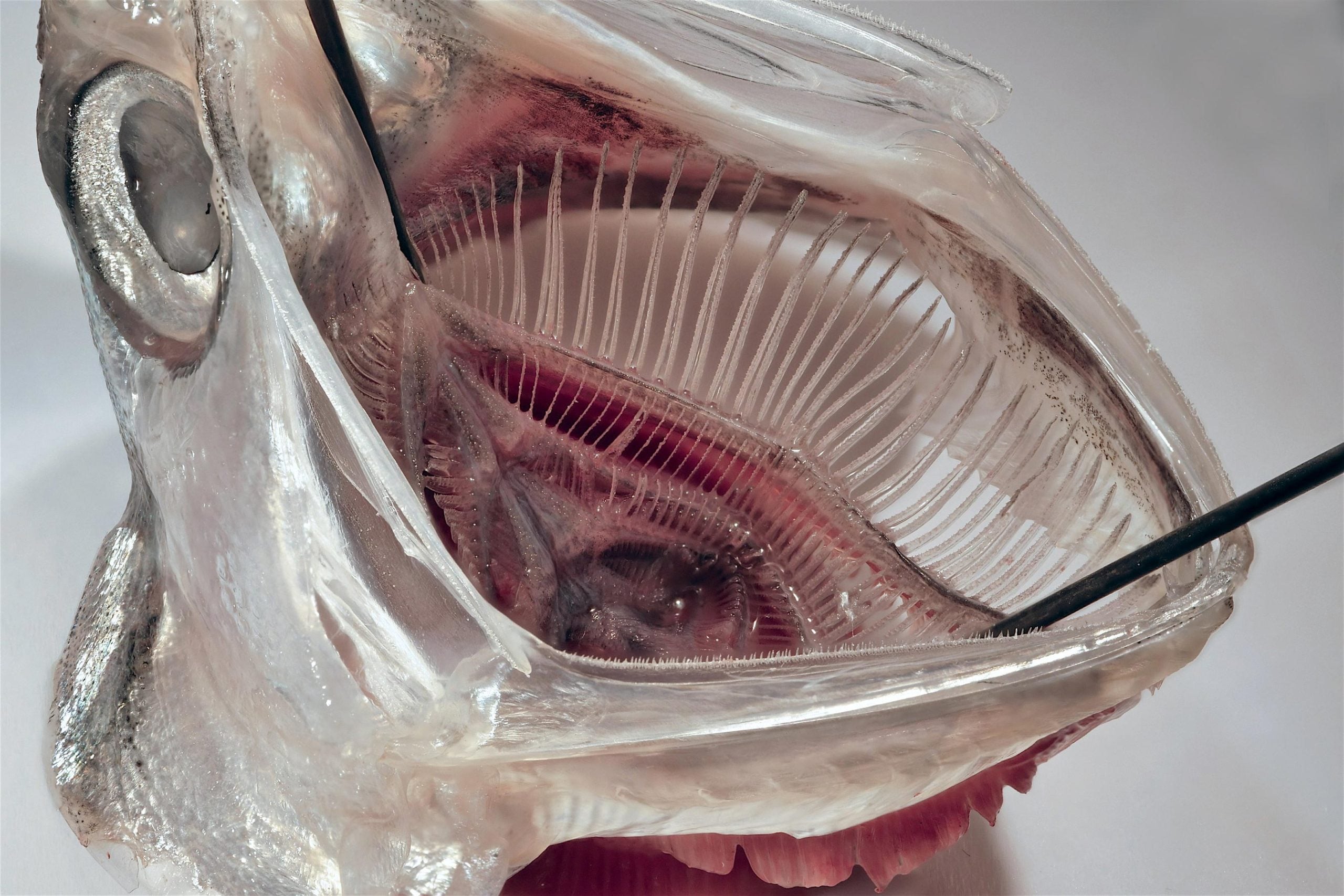
SHARE Inside the mouth – of this anchovy, plankton particles are captured by the gill arch system. Credit: Jens Hamann Researchers at the University of Bonn aim to improve the…
Sources
- Fish-Inspired Filter That Removes over 99% of Microplastics
- This fish-inspired filter removes over 99% of microplastics
- A self-cleaning, bio-inspired high retention filter for a major …
- Sardine-inspired washing machine filter removes 99% of …
Related posts
- Purple Promo Codes and Deals: Save Up to 30% on Mattresses, Pillows, and Bedding
- GeneGuessr — Daily protein-guessing web puzzle offering progressive gene hints
- SQLite AI unifies on-device intelligence with cloud-scale services