
TL;DR
Ford announced a Google Cloud‑hosted AI assistant arriving in its redesigned mobile app in early 2026, with an in‑vehicle integration slated for 2027. The company also teased a next‑generation BlueCruise system that it says will cost 30% less to build, debut on a new EV in 2027 and enable eyes‑off driving by 2028.
What happened
At CES 2026, Ford disclosed plans for a new digital assistant and an upgraded BlueCruise driver‑assistance system during a session titled “Great Minds.” The assistant will be hosted on Google Cloud and constructed with off‑the‑shelf large language models, and Ford says it will have deep access to vehicle‑specific data so it can answer both high‑level questions (for example, cargo capacity) and real‑time diagnostics like oil life. The assistant will appear first inside Ford’s revamped smartphone app in early 2026, with a native in‑car integration expected in 2027; Ford did not name which models will get priority. Separately, Ford previewed a next‑generation BlueCruise that it claims is about 30% cheaper to manufacture than the current system. That BlueCruise iteration is planned to debut in 2027 on the automaker’s first EV built on its low‑cost Universal Electric Vehicle platform, and Ford projects the technology will support eyes‑off driving by 2028.
Why it matters
- Lower manufacturing costs for BlueCruise could make advanced driver assistance more widely available across Ford’s lineup.
- A Google Cloud‑hosted assistant with access to vehicle telemetry changes how owners may interact with car health and utility data.
- The staged rollout—app first, in‑vehicle later—gives Ford time to refine integrations and safety checks before embedding assistants in cars.
- Eyes‑off driving and point‑to‑point capabilities shift ADAS closer to supervised autonomy, raising regulatory and safety scrutiny.
Key facts
- Ford’s AI assistant will be hosted by Google Cloud and built using off‑the‑shelf large language models.
- The assistant will be added to Ford’s redesigned mobile app in early 2026; an in‑car native integration is planned for 2027.
- Ford says the next‑generation BlueCruise will be roughly 30% cheaper to produce than current BlueCruise hardware.
- That BlueCruise update is expected to debut in 2027 on the first EV built on Ford’s Universal Electric Vehicle (UEV) platform, projected to be a mid‑sized pickup.
- Ford projects the new BlueCruise will support hands‑off (eyes‑off) driving by 2028.
- Ford described future BlueCruise capabilities as including “point‑to‑point autonomy,” comparable to Tesla’s supervised Full Self‑Driving offering.
- Announcements were made during a CES session rather than a large automaker keynote, and Ford did not spell out which models will receive the in‑car assistant first.
- Ford did not provide detailed descriptions of the in‑vehicle user experience for the assistant at the announcement.
What to watch next
- Early 2026 rollout of the assistant inside the revamped Ford smartphone app (confirmed in the source).
- In‑vehicle integration timeline and which Ford models receive the assistant in 2027 (confirmed in the source that integration is planned in 2027; specific models not specified).
- Regulatory approvals, safety validation and testing required before enabling eyes‑off driving features in 2028 (not confirmed in the source).
- How Ford’s in‑car assistant capabilities compare with competitors like Tesla and Rivian once in‑vehicle functionality is revealed (not confirmed in the source).
Quick glossary
- Large language model (LLM): A type of AI trained on large text datasets to generate and understand humanlike language, often used for chatbots and assistants.
- Google Cloud: Google’s suite of cloud computing services that can host applications, store data, and run machine‑learning models.
- Advanced driver assistance system (ADAS): Technology that helps drivers with steering, braking, acceleration or other tasks to improve convenience and safety, short of full autonomy.
- BlueCruise: Ford’s branded hands‑free highway driving assistance system that enables semi‑automated driving under specific conditions.
- Point‑to‑point autonomy: A system feature that can autonomously drive a vehicle along a planned route between two locations while remaining under supervised control.
Reader FAQ
When will Ford’s AI assistant first be available?
Ford plans to add the assistant to its redesigned mobile app in early 2026; a native in‑vehicle version is scheduled for 2027.
Will the assistant access vehicle data?
Yes. Ford says the assistant will have deep access to vehicle‑specific information and can report real‑time details such as oil life.
Which Ford models will get the in‑car assistant first?
Not confirmed in the source.
Does the new BlueCruise mean fully autonomous driving?
Ford describes point‑to‑point and eyes‑off capabilities similar to supervised systems like Tesla’s Full Self‑Driving; drivers are expected to remain ready to take control.
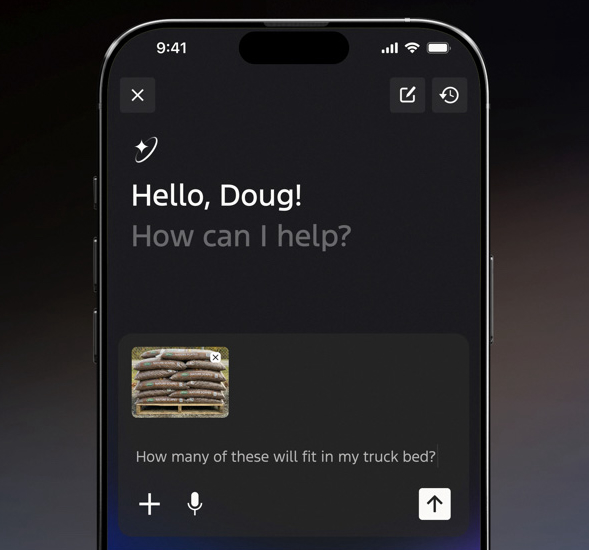
Ford is developing an AI assistant that will debut in the company’s smartphone app, before expanding to its vehicles in 2027, the company announced Wednesday at the 2026 Consumer Electronics…
Sources
- Ford has an AI assistant and new hands-free BlueCruise tech on the way
- Helping Build a Better World
- Eric Walz
- ArentFox Schiff Industry Guide to Artificial Intelligence
Related posts
- Bluetti’s Charger 2 enables up to 1,200W charging of power stations in cars
- AMD teases MI500 GPUs, Helios racks and Venice Epyc to challenge Nvidia
- T-Mobile launches ‘Better Value’ family plans and raises per-line fees in 2026