
TL;DR
Eighteen-year-old Matteo Paz developed a machine-learning model that sifted through roughly 200 billion detections from NASA’s NEOWISE telescope and flagged about 1.5 million candidate variable astronomical objects. His work, packaged as the VarWISE catalog, earned him first place in the Regeneron Science Talent Search and a $250,000 prize.
What happened
Matteo Paz, an 18-year-old from Pasadena, built an artificial-intelligence pipeline to search for subtle changes in infrared measurements recorded by NASA’s NEOWISE survey. Working with Caltech mentor Davy Kirkpatrick after attending the Planet Finder Academy in summer 2022, Paz scaled the approach to run across a roughly 200‑billion‑row table of NEOWISE detections. The model identified about 1.5 million candidate variable objects — a set that the researcher and collaborators call VarWISE. The candidates include signals consistent with phenomena such as supernovas and black holes, according to reporting. Paz is listed as the sole author on a study published in The Astronomical Journal in November, and Caltech researchers have begun using the VarWISE catalog to study systems such as binary stars. Paz’s project also received recognition in the 2025 Regeneron Science Talent Search, where he won first prize and a $250,000 award.
Why it matters
- Applies machine learning to large archival astronomical datasets, revealing otherwise overlooked signals.
- Creates a substantial catalog of variable candidates that can guide targeted follow-up observations.
- Demonstrates how student-led research can contribute substantive resources to professional astronomy.
- The algorithm’s approach could be adapted to other time-series data beyond astronomy, per the developer.
Key facts
- Researcher: Matteo Paz, 18-year-old high school student from Pasadena, California.
- Prize: First place in the 2025 Regeneron Science Talent Search and a $250,000 award.
- Data source: NEOWISE infrared telescope detections; the project processed about 200 billion rows of detections.
- Findings: Approximately 1.5 million potential new variable astronomical objects flagged by the model.
- Catalog: The candidate list is compiled as VarWISE and is already being used by Caltech researchers.
- Mentorship and training: Paz worked with Caltech/IPAC senior scientist Davy Kirkpatrick and attended Caltech’s Planet Finder Academy in summer 2022.
- Publication: Paz is the sole author on a study published in The Astronomical Journal in November.
- NEOWISE background: The telescope launched in 2009 to search for near‑Earth asteroids and comets; its survey data also record variable infrared sources.
What to watch next
- Follow-up observations and community vetting of the 1.5 million VarWISE candidates — these will determine which are confirmed variable objects.
- Ongoing Caltech research using VarWISE to study binary star systems, which is already underway.
- Potential broader applications of Paz’s temporal-analysis model to other datasets (Paz suggested uses such as market charts or atmospheric monitoring).
- Timetable and scope for additional publications or formal validation of individual candidates: not confirmed in the source.
Quick glossary
- NEOWISE: A NASA infrared space telescope mission that surveyed the sky for near‑Earth asteroids, comets and other infrared sources.
- Variable object: An astronomical source whose observed brightness or emission changes over time, potentially indicating phenomena like exploding stars or accreting black holes.
- Machine learning model: A computational algorithm that learns patterns from data to make classifications or predictions without explicit rules for each case.
- Catalog (astronomy): A structured list of detected astronomical objects and their measured properties used to guide further study and observation.
Reader FAQ
Who led the discovery?
Matteo Paz, an 18‑year‑old high school student from Pasadena, with mentorship from Caltech scientist Davy Kirkpatrick.
What was found?
An AI model flagged roughly 1.5 million candidate variable astronomical objects from NEOWISE survey data.
Are the objects confirmed?
The candidates are identified as potential variable sources; confirmation through follow-up observations is pending and not detailed in the source.
Where can the results be accessed?
The flagged candidates are compiled in a catalog called VarWISE; further distribution or access details are not confirmed in the source.
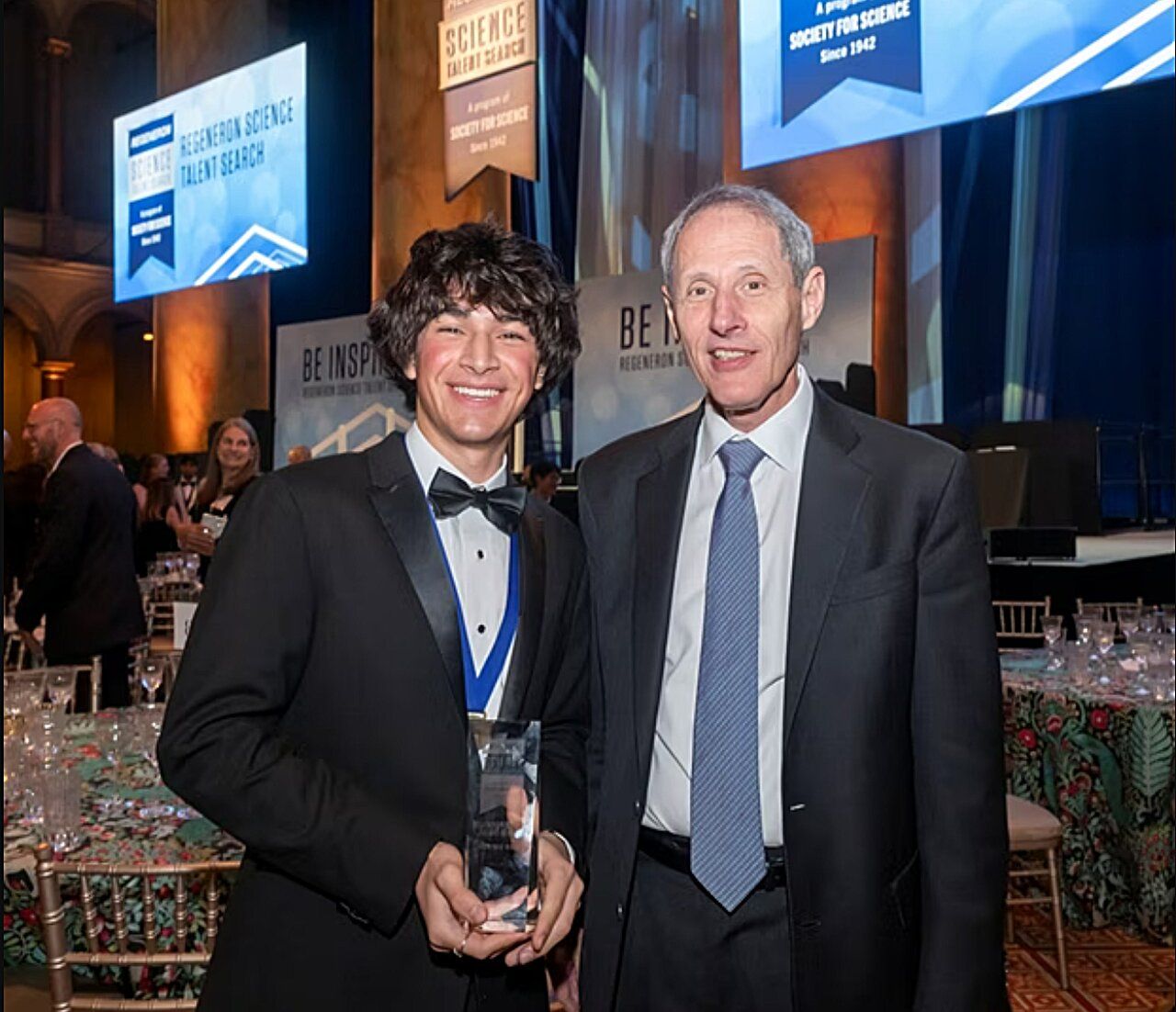
High School Student Discovers 1.5 Million Potential New Astronomical Objects by Developing an A.I. Algorithm The 18-year-old won $250,000 for training a machine learning model to analyze understudied data from…
Sources
- High school student discovers 1.5M potential new astronomical objects
- High school student uses AI to reveal 1.5 million previously …
- Steward PhD Alum Mentors Teen Who Wins $250K for Using …
- High School Student Discovers 1.5M New Astronomical …
Related posts
- A Proclamation on Restoring the Em—Dash: Reclaiming the Writer’s Mark
- NullSplats: Three Ways to Produce 3D Gaussian Splatting from Casual Captures
- Rob Pike Received a Spam ‘Act of Kindness’ From an AI Village Agent