
TL;DR
NASA is removing 25 structures at Marshall Space Flight Center, including two major test stands slated for controlled implosion no earlier than sunrise on January 10, 2026. The affected facilities — dating to the Apollo and Shuttle eras — have been documented and were National Historic Landmarks, but NASA cites safety and cost concerns for the removals.
What happened
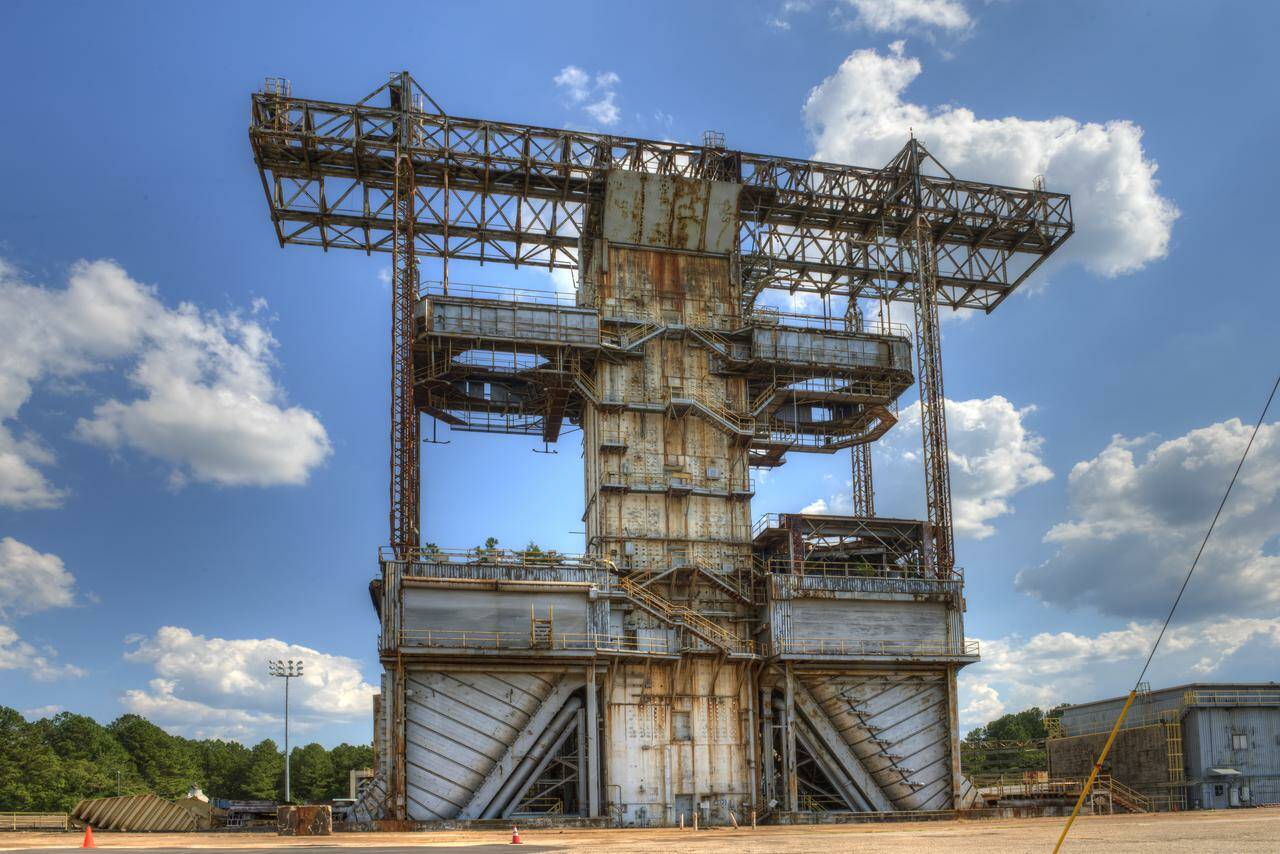
With less than a month remaining before NASA’s next crewed lunar attempt under the Artemis program, Marshall Space Flight Center in Huntsville, Alabama is preparing to remove 25 aging structures. Two prominent test stands are scheduled for controlled implosion no earlier than sunrise on January 10, 2026. The Propulsion and Structural Test Facility, known as the T-tower, was built in 1957 by the US Army Ballistic Missile Agency and transferred to NASA in 1960; it supported development of the F-1 engine and the Saturn V first stage and later saw testing of Space Shuttle solid rocket boosters. The Dynamic Test Stand, about 360 feet tall, handled full-scale Saturn V testing and was the first site where all Shuttle elements were assembled together. Demolition work has already begun on the Neutral Buoyancy Simulator, an underwater 1960s facility used to rehearse weightless operations and hardware procedures including Hubble servicing. Though these structures were designated National Historic Landmarks in 1985, NASA says upkeep is no longer financially or physically viable and has warned nearby communities to expect a loud noise during the Jan. 10 implosion window.
Why it matters
- Loss of physical artifacts from the Apollo and Shuttle programs removes direct, tangible links to early US human spaceflight history.
- NASA frames the removals as a safety and budget decision: the buildings are described as unsafe and costly to maintain.
- The timing coincides with the Artemis program’s ramp-up, underscoring a shift from legacy infrastructure toward current program needs.
- Nearby communities will experience immediate impacts from the controlled implosion, including expected loud noise and related safety measures.
Key facts
- Twenty-five structures at Marshall Space Flight Center are slated for removal.
- Two test stands are planned for controlled implosion no earlier than sunrise on January 10, 2026.
- The Propulsion and Structural Test Facility (T-tower) was built in 1957 and transferred to NASA in 1960.
- The T-tower supported development of the F-1 engine and testing of the Saturn V S-IC first stage and later the Space Shuttle solid rocket boosters.
- The Dynamic Test Stand is roughly 360 feet tall and was used for full-scale Saturn V tests and Shuttle element integration.
- Demolition has already begun on the Neutral Buoyancy Simulator, a 1960s-era underwater training and test facility.
- The Neutral Buoyancy Simulator was used for procedures including those required for servicing the Hubble Space Telescope and has since been superseded by a facility at Johnson Space Center.
- All three highlighted facilities were designated National Historic Landmarks in 1985.
- Acting Marshall center director Rae Ann Meyer said the structures are unsafe and that removing them saves money on upkeep.
- NASA warned communities near Redstone Arsenal to expect a loud noise associated with the demolition on the morning of Jan. 10.
What to watch next
- Official NASA updates and safety notices for the exact timing and execution of the Jan. 10 controlled implosion.
- not confirmed in the source: public or preservationist responses to the demolition plans and documentation efforts.
- not confirmed in the source: long-term redevelopment plans for the cleared sites at Marshall Space Flight Center.
Quick glossary
- Artemis: NASA’s program to return humans to the Moon and establish a sustained presence, involving new rockets, spacecraft, and lunar systems.
- Saturn V: A three-stage heavy-lift rocket used by NASA during the Apollo program to send astronauts to the Moon.
- Neutral Buoyancy Simulator: An underwater facility used to simulate weightless conditions for astronaut training and hardware testing.
- National Historic Landmark: A designation for properties that hold exceptional value to the history of the United States.
Reader FAQ
Why is NASA demolishing these historic test towers?
NASA says the structures are unsafe, have not been used in decades, and are no longer economically viable to maintain.
When will the implosions take place?
The two test stands are scheduled for controlled implosion no earlier than sunrise on January 10, 2026, and nearby communities were warned about expected loud noise.
Were the facilities protected as historic sites?
Yes — the T-tower, Dynamic Test Stand, and Neutral Buoyancy Simulator were designated National Historic Landmarks in 1985.
Will demolition affect the Artemis launch schedule?
not confirmed in the source
SCIENCE Historic NASA test towers face their final countdown Apollo-era Saturn V and Shuttle stands set for controlled demolition as Artemis ramps up Richard Speed Wed 7 Jan 2026 // 16:55 UTC With less…
Sources
- Historic NASA test towers face their final countdown
- NASA Marshall Prepares for Demolition of Historic Test …
- NASA to demolish aging test facilities at Marshall as part of …
- A piece of Apollo history faces demolition – Aerospace America
Related posts
- Examining Nushell: Why a Structured, Modern Shell Deserves Attention
- BillG the Manager: How Bill Gates Scoped Product Leadership at Microsoft
- New Research Revives Ancient Nasal Rinse as a Tool to Fight Colds