
TL;DR
Fifty years ago AMD entered the microprocessor market by producing the Am9080, a reverse-engineered clone of Intel's 8080. The chip was inexpensive to manufacture yet sold at a high margin to customers like the military, and a 1976 cross-licensing deal with Intel formalized AMD as a second source.
What happened
In the early 1970s a set of detailed photographs of an Intel 8080 pre-production chip enabled engineers outside Intel to reconstruct its circuitry. AMD adapted that work to its newly developed N-channel MOS fabrication and produced the Am9080. Initial production runs may have appeared in 1974, but AMD began marketing and mass-producing the Am9080 in 1975. Manufacturing costs were reportedly very low — about $0.50 per chip at 100 per wafer — while unit sales to some customers, particularly military contractors who required multiple suppliers, fetched prices as high as $700. To resolve potential disputes and meet second-source requirements, AMD and Intel signed a cross-licensing agreement in 1976 that included upfront and annual payments and released both firms from liability over prior infringements. AMD continued to iterate on the design, producing many variants with clock speeds up to 4.0 MHz and versions rated for extreme military temperature ranges.
Why it matters
- The Am9080 provided AMD a profitable entry into CPU manufacturing and helped establish its semiconductor business.
- Second-sourcing requirements from large buyers created commercial incentives for Intel to license AMD rather than pursue prolonged litigation.
- The 1976 agreement set a commercial precedent that enabled future licensing deals, including an expanded arrangement that later allowed AMD to make x86 processors.
- Advances in AMD’s N-channel MOS process produced a smaller die and higher clock options, illustrating how fabrication choices affect product competitiveness.
Key facts
- Am9080 was a reverse-engineered implementation of the Intel 8080.
- Photographs used to recreate the 8080 pre-production sample were taken in 1973, according to sources cited in the reporting.
- AMD began marketing and mass-producing the Am9080 in 1975; some sources suggest limited sales in 1974.
- Reported manufacturing cost: about $0.50 per Am9080 (at 100 per wafer); reported sale price to some customers: up to $700 each.
- In 1976 AMD and Intel signed a cross-licensing agreement that included a $25,000 payment on signing and $75,000 per year in licensing fees.
- The agreement freed both parties from liability over past infringements and designated AMD as a second source for the 8080 family.
- WikiChip lists 28 Am9080 variants with clock speeds ranging from 2.083 MHz to 4.0 MHz.
- Some military-grade Am9080 variants were specified to operate from about -70°C to +125°C.
- AMD’s N-channel MOS process produced a noticeably smaller die for the Am9080 compared with Intel’s 8080, allowing higher clock rates in some SKUs.
What to watch next
- Clarification or archival evidence confirming whether AMD sold Am9080 parts in 1974 (not confirmed in the source).
- Detailed terms and technical scope of the expanded 1982 Intel–AMD agreement that later permitted AMD to produce x86-compatible chips (some context referenced, full terms not detailed in the source).
- Analysis of how the early AMD–Intel arrangements influenced later competitive and licensing dynamics in the PC CPU market (not confirmed in the source).
Quick glossary
- Reverse engineering: Analyzing a finished product to recreate its design, schematics, or logic without access to original design files.
- Second source: An alternate supplier approved to produce the same component to ensure supply security for large buyers, often required in defense contracts.
- Cross-licensing agreement: A legal contract where two companies grant each other rights to use specified intellectual property, sometimes including payment terms and liability releases.
- N-channel MOS: A semiconductor fabrication process using N-channel metal–oxide–semiconductor transistors, which can offer different performance and density characteristics than other processes.
Reader FAQ
Was the Am9080 an official Intel product?
No. The Am9080 was a reverse-engineered implementation of Intel’s 8080 produced by AMD; Intel later licensed AMD as a second source under a 1976 agreement.
How much did AMD pay Intel under the 1976 deal?
The source reports a $25,000 payment on signing and $75,000 per year in licensing fees.
Did AMD’s Am9080 run faster than Intel’s 8080?
Some Am9080 variants ran up to 4.0 MHz, while Intel’s listed 8080 SKUs did not exceed 3.125 MHz, per the reporting.
Did the Am9080 directly lead to AMD’s later x86 CPUs?
The source says the 1976 agreement became the foundation for later deals and that an expanded 1982 agreement allowed AMD to make its Am286, but further causal details are not provided.
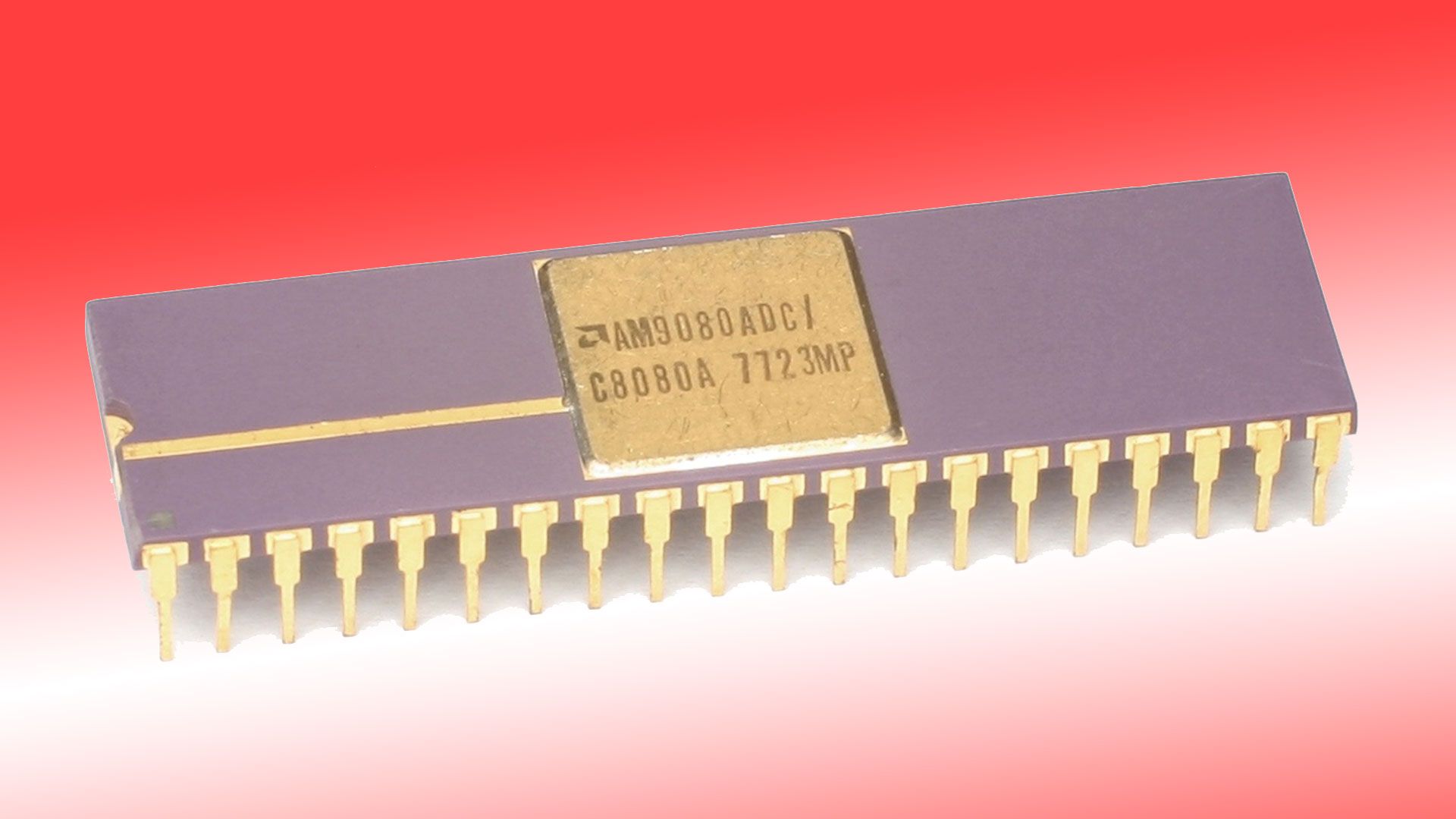
PC Components CPUs AMD first entered the CPU market with reverse-engineered Intel 8080 clone 50 years ago — the Am9080 cost 50 cents apiece to make, but sold for $700…
Sources
- AMD entered the CPU market with reverse-engineered Intel 8080 clone 50 years ago
- AMD Am9080
- AMD's Am9080 at 50: The reverse-engineered chip that …
- Intel & AMD: The First 30 Years – by Jon Y
Related posts
- My 2026 Open Social Web Predictions — Forecasts for Bluesky, Fediverse, Threads
- SPICE at 40: The open-source simulator that shaped modern IC design
- POSTECH reports 1,270 Wh/L anode-free lithium metal battery breakthrough