
TL;DR
An essay argues that adults experience time differently from children, proposing a logarithmic model of subjective time where childhood occupies a disproportionately large portion of lived experience. Children, the piece contends, renew adults’ perception through firsts, rituals and the sense of passing something forward.
What happened
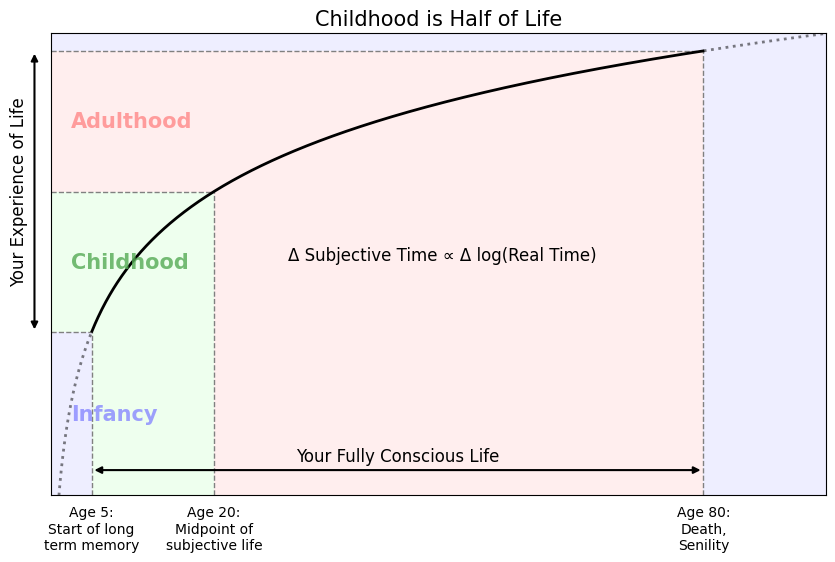
In a reflective essay, the author explores how people’s subjective sense of time shifts across the lifespan and how children alter that perception. Using a model where the felt length of an interval depends on what fraction of one’s life it occupies, the author suggests we perceive time approximately logarithmically: early years feel long, later years compress. The piece then connects this idea to parenting, arguing that children inject frequent “firsts” and revive traditions, which can make weeks and years feel fuller to adults. The author recounts personal examples — from seeing Saturn through a telescope as a child to recreating similar moments for his own kids — to illustrate how being present for others’ discoveries renews adult experience. The essay concludes that parenting can serve as a form of legacy, a practical way of extending oneself into the future by shaping another person’s life and memory.
Why it matters
- Reframes childhood as an intrinsically valuable part of life rather than merely preparation for adulthood, implying different priorities for how society treats children.
- Suggests that adults can influence their subjective sense of time by seeking novelty or investing in others’ first experiences.
- Highlights the role of traditions and small rituals in creating durable family memory and identity.
- Positions parenting as a concrete means of passing aspects of oneself into the future, which may affect how people weigh long-term goals.
Key facts
- The author proposes a model where subjective experience of an interval scales with the fraction of life that interval represents, leading to a roughly logarithmic perception of time.
- Under that model, childhood occupies a far larger felt share of life than later decades — for example, a year at age five feels proportionally much bigger than a year at age 40.
- Children create frequent ‘firsts’ (first words, first steps, first sights) that provide adults with renewed moments of discovery and meaning.
- Adults often become custodians of memories and traditions their children may not recall, recording events that shape a child’s later sense of identity.
- Traditions can be reanimated for adults through children, turning once-routine rituals into fresh, meaningful occasions.
- Seeking novelty (learning, travel, new hobbies) can introduce new ‘firsts’ for adults and slow the subjective acceleration of time, but this strategy has limits.
- The author describes parenting as a way to secure a personal continuity into the future by investing parts of oneself in another person.
What to watch next
- Whether public conversations about schooling shift toward valuing childhood as an experience in itself rather than only for long-term outcomes (not confirmed in the source).
- How cultural practices around holidays and family rituals evolve as adults aim to recreate childhood feelings for new generations (not confirmed in the source).
Quick glossary
- Logarithmic perception of time: A proposed way of describing subjective time in which intervals feel shorter as one’s total lived time increases; early life stretches while later years feel compressed.
- Firsts: Events experienced for the first time (e.g., first words, first sight of a planet) that often carry strong emotional weight and become memorable landmarks.
- Tradition: A repeated practice or ritual passed within families or communities that contributes to shared identity and recurring meaning.
- Nostalgia: A sentimental longing for the past that can motivate people to recreate or preserve experiences for themselves or their children.
Reader FAQ
Does the author claim we literally experience time logarithmically?
The essay presents a model in which perceived duration scales with the proportion of life an interval represents and suggests a roughly logarithmic feeling of time; it is offered as a conceptual framework rather than empirical proof.
Does having children make you feel younger or extend time?
The author argues parenting brings frequent firsts and renewed traditions that can make life feel fuller and slower in subjective terms, but does not present scientific evidence quantifying this effect.
Should schools be redesigned based on this argument?
The author suggests childhood should be valued for its own sake and that schooling should be more rewarding for children’s present experience; specific policy prescriptions are not provided.
Can adults reproduce first-time experiences for themselves?
The essay says adults can seek new experiences or learn new skills to create fresh firsts, but notes there are limits and that witnessing children’s discoveries can be a powerful alternative.
Children and Helical Time Ryan Moulton December 30, 2025 Life We feel time differently over our lives. As a toddler, an afternoon feels like an eternity. In middle age, “no matter…
Sources
- Children and Helical Time
- To reignite the joy of childhood, learn to live on 'toddler time'
- What Kids Know About Time
- Children's Ability To Describe Past Event Develops Over …
Related posts
- How Cameras and Lenses Form Images: Sensors, Pinhole to Vignetting
- Survey of 18 Memory Subsystem Optimization Posts and Techniques
- Autism diagnoses rose as criteria broadened, not due to higher severe prevalence