
TL;DR
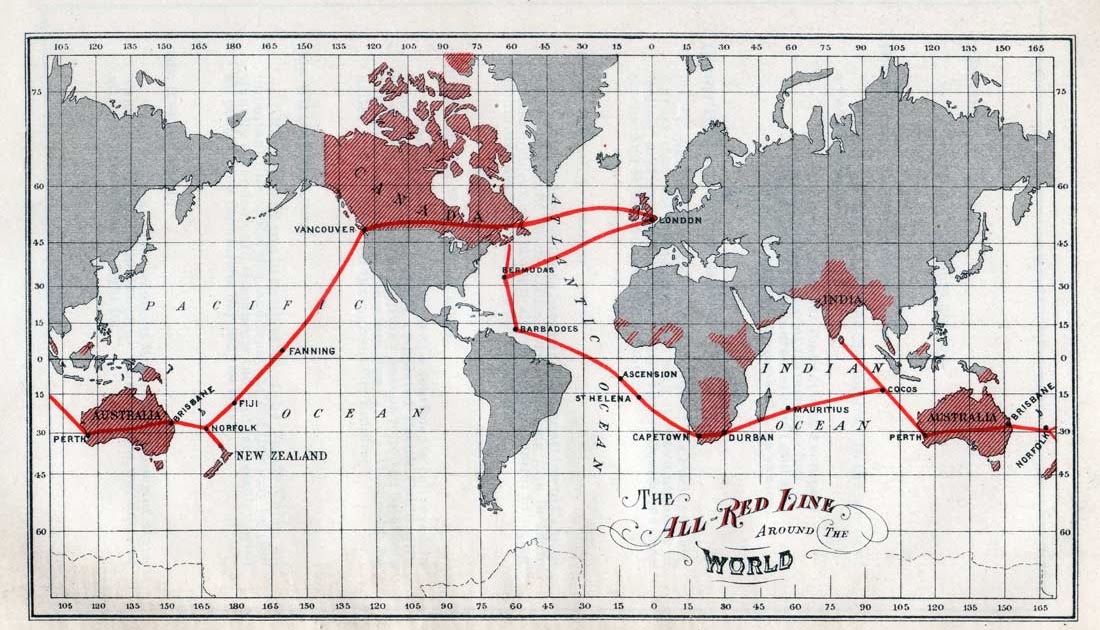
By about 1902 the British Empire had largely completed the Red Line subsea telegraph network, a global ring that delivered messages in minutes to hours depending on queue length. The design emphasized redundancy—multiple cables and a ring topology—so traffic could be rerouted and the military judged it highly resistant to deliberate cuts.
What happened
By 1902 the British Empire had largely finished assembling the Red Line, a worldwide subsea telegraph system that carried news and dispatches across the globe. The network formed a ring so that data could traverse the opposite direction if a segment was disrupted, and operators generally saw delivery times measured in minutes or at most hours depending on message queues. Planners layered resilience into the design by deploying multiple parallel cables between many endpoints rather than relying on single links. Contemporary military and strategic assessments treated the system as robust: analysts at the time argued it would be impractical for an adversary to sever enough cables along any given route to isolate two endpoints. A wartime estimate by the Committee of Imperial Defense identified specific thresholds for isolation—57 cable failures to cut off the British Isles, 15 for Canada and 7 for South Africa. The empire also maintained domestic capacity to manufacture cable components and to repair broken lines, supported by a dominant navy.
Why it matters
- Faster global communications reshaped imperial governance and military coordination by shortening message times to minutes or hours.
- Ring topology and multiple parallel cables provided practical redundancy, allowing traffic rerouting after local failures.
- Strategic planning treated undersea infrastructure as a national security asset, with quantified thresholds for isolation.
- Self-sufficiency in cable manufacture and repair reduced reliance on foreign suppliers and bolstered operational resilience.
Key facts
- The network is known as the Red Line and was largely completed by 1902.
- Message delivery across the network typically took minutes or, depending on queue length, several hours.
- The system formed a ring so traffic could be routed the other way if a section failed.
- Design relied on multiple cables between many endpoint pairs to maintain uptime.
- Contemporary military assessments judged it unlikely an enemy could cut enough cables to sever communications between given endpoints.
- The Committee of Imperial Defense estimated 57 cable failures would be required to isolate the British Isles from the Red Line network.
- The same committee estimated 15 cables would need to be shut down to isolate Canada and 7 for South Africa.
- The empire was capable of producing cable components and conducting repairs domestically.
- Naval strength supported the upkeep and protection of the subsea network.
What to watch next
- Whether modern analysts draw direct operational lessons from the Red Line's topology and redundancy: not confirmed in the source
- How frequently the ring topology was actually used to reroute traffic during interruptions: not confirmed in the source
- Any archival records detailing attempts (successful or unsuccessful) to cut cables in wartime: not confirmed in the source
Quick glossary
- Subsea telegraph cable: A physical cable laid on the ocean floor that carries telegraph signals between land stations across bodies of water.
- Network ring (topology): A configuration in which nodes are connected in a closed loop so traffic can flow in either direction, enabling rerouting if a segment fails.
- Redundancy: The inclusion of extra components or pathways (for example, multiple cables) so that the failure of one element does not interrupt overall service.
- Committee of Imperial Defense: A formal advisory body involved in assessing and planning the security and defense needs of the British Empire (as referenced in contemporary estimates).
- Telegraphy: A communication method that transmits coded electrical signals over wires or cables to convey messages across distances.
Reader FAQ
When was the Red Line network completed?
The Red Line was largely completed by 1902, according to the source.
How fast did messages travel over the network?
Messages were delivered in minutes or, depending on the message queue, several hours.
Could an enemy sever the empire's communications by cutting cables?
Contemporary military opinion treated this as unlikely; the Committee of Imperial Defense calculated specific numbers of cable failures needed to isolate major territories.
Was Britain able to build and repair its own cables?
Yes—the source states the empire was self-sufficient in manufacturing components and repairing subsea telegraph cables.
Who is Dr. Michael Delaunay?
Not confirmed in the source.
The British Empire's Resilient Subsea Telegraph Network December 29, 2025 The British empire had largely completed its Red Line cable network by 1902. This network allowed news and messages to…
Sources
- The British Empire's Resilient Subsea Telegraph Network
- To Secure Undersea Cables, Take Lessons from the British …
- To Rule the Waves: Britain's Cable Empire and the Birth of …
- The legacy of undersea cables
Related posts
- Times New American: State Department’s Typeface Swap and Its Meaning
- Fucking Approachable: Practical Guide to Swift Concurrency, Tasks and Actors
- curl bans strcpy too, replacing it with a checked memcpy-based curlx_strcopy helper