
TL;DR
In late December 1990 Tim Berners-Lee created the first usable web server on a NeXT workstation at CERN, alongside the first web browser and the initial HTML specification. Accounts differ on the exact completion date, and early copies or screenshots of the original page are not available; CERN later recognized the site with a memorial page.
What happened
In the closing weeks of 1990, Tim Berners-Lee, then working at CERN, developed the components that became the World Wide Web: a simple server, a browser, and the HTML format to link documents. The software ran on NeXT hardware and was reachable at the host address info.cern.ch. Sources disagree on the precise day the server became usable—some cite December 20, 1990, while at least one account gives December 25. The first web page hosted there contained technical instructions about how the system worked rather than visual design. No contemporary screenshots of the earliest page have been located; the oldest archived copy found by the source dates from 2000 and stated that the original page and hosting computer no longer existed. CERN published a memorial page about the first web page and server in 2006.
Why it matters
- Established the basic architecture of the modern web: browsers, servers, and HTML linking documents.
- Unlocked distributed information by making documents readable across different machines and systems.
- Laid groundwork for later cross-platform browsers and the rapid adoption of the web on campuses and beyond.
- Set in motion developments that contributed to the commercialization of the web and the dotcom era.
- CERN’s later memorialization highlights the event’s historical and technological significance.
Key facts
- The first usable web server reached a working state in late December 1990.
- Tim Berners-Lee, a British computer scientist at CERN, created the early web components.
- The software ran on NeXT workstations and was hosted at the address info.cern.ch.
- Sources differ on the exact date: cited dates include December 20, 1990, and December 25, 1990.
- The first web page provided technical information about HTML, servers, and browsers.
- No known screenshots of the page’s earliest form exist according to the source.
- An archive.org copy from 2000 reported the original page and host machine no longer existed.
- CERN created a memorial page for the first web page and server in August 2006.
- Wider adoption accelerated after early cross-platform browsers (for example, Mosaic in January 1993) led to broader campus use and later commercialization.
What to watch next
- Ongoing historical research clarifying the exact completion date (accounts vary between Dec. 20 and Dec. 25, 1990).
- Preservation or restoration efforts for early web artifacts and server software — not confirmed in the source.
- How institutions and archives continue to document and commemorate the web’s origins.
- Discovery of any contemporaneous screenshots or records from 1990–1992 would change the historical record — not confirmed in the source.
Quick glossary
- Web server: Software (and often the hardware it runs on) that delivers web pages and resources over the HTTP protocol to clients such as browsers.
- HTML: HyperText Markup Language, a standardized way to structure and link text and resources on web pages.
- Web browser: An application that retrieves, renders, and lets users navigate web pages and linked resources.
- NeXT workstation: A line of advanced workstations produced by NeXT in the late 1980s and early 1990s, used for software development and research.
- CERN: The European Organization for Nuclear Research, an intergovernmental research organization where the first web server was developed.
Reader FAQ
When was the first web server completed?
It reached a usable state in late December 1990; sources disagree on whether it was December 20 or December 25.
Who built the first web server?
Tim Berners-Lee, while working at CERN.
Where was the first website hosted?
On a NeXT workstation at CERN, address info.cern.ch.
Are there screenshots or copies of the original 1990 page?
No contemporary screenshots are known; the earliest archived copy found by the source dates from 2000 and reported the original page and machine no longer existed.
Did CERN recognize the first web server later?
Yes—CERN published a memorial page about the first web page and server in 2006.
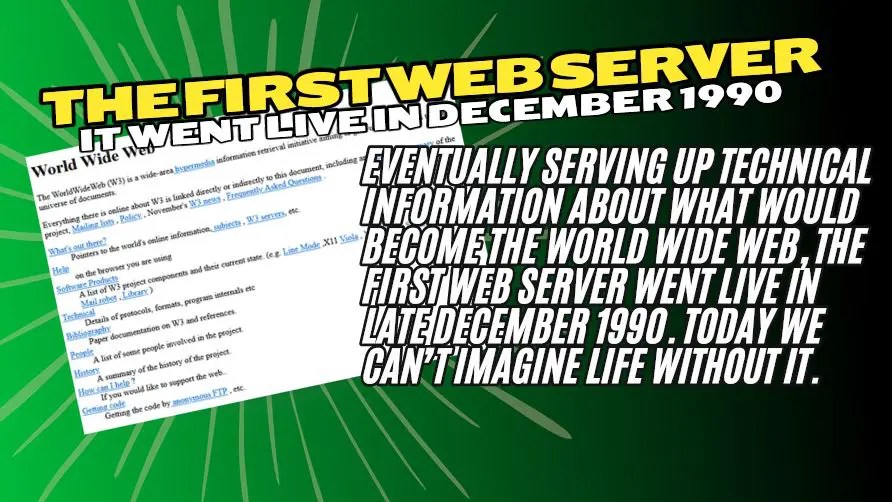
The first web server Dave Farquhar Retro Computing December 25, 2025 0 Comment Late December 1990 was a pivotal time, although none of us realized it for a few years….
Sources
Related posts
- Why package managers repeatedly fail when they treat Git as a database
- Why the Word ‘Religion’ Resists Definition but Still Matters
- Inge Lehmann: The Seismologist Who Identified Earth’s Inner Core