
TL;DR
A tech user migrated most of their personal digital tools to EU-hosted services, centering on Proton’s expanding ecosystem and several European alternatives for browsing, search, AI and hosting. The move cut their monthly bill from about €83 to €39, translating to roughly €528 of annual savings, while leaving a few convenience gaps such as single‑sign‑on and social platforms.
What happened
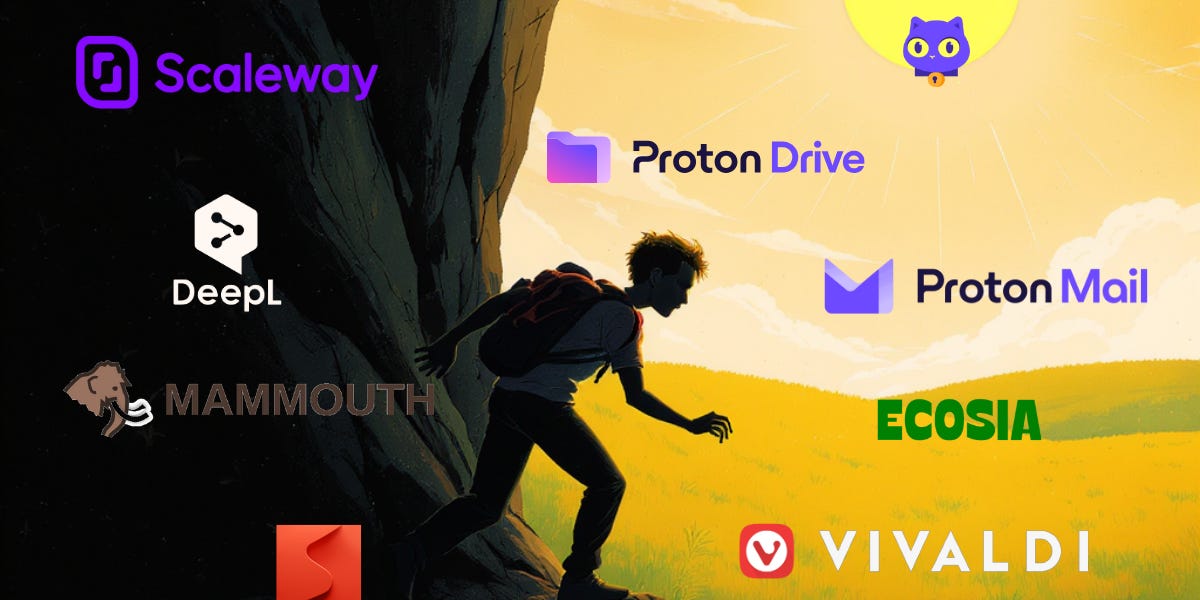
Over several months the author moved nearly all personal accounts and services to European-hosted alternatives, assembling a stack built around Proton’s growing suite and other EU providers. Proton now supplies encrypted mail, calendar, storage (Drive), password management (Proton Pass with MFA and passkey use), VPN, note-taking via Standard Notes, and a privacy-first GenAI (Lumo AI). For heavier AI work the author also subscribes to Mammouth, which provides access to multiple models (including Mistral and Flux) for about €10. Browsing, search and translation moved to Vivaldi, Ecosia and DeepL respectively, while hosting and domains shifted to Scaleway. Superlist replaced Todoist for task management, and some creative work still uses Canva. The migration is framed as a personal setup (not a company migration). The author reports improved usability in many cases but notes remaining friction around Google SSO, some office-suite compatibility, and reliance on major social platforms for connectivity.
Why it matters
- Demonstrates that EU-hosted alternatives can deliver usable, integrated tools without automatic loss of functionality.
- Shows potential cost savings: the author’s monthly bill dropped from ~€83 to ~€39, saving about €528 annually.
- Highlights growing options for privacy-preserving AI and core services, reducing dependence on US-based giants for many personal workflows.
- Exposes practical trade-offs such as loss of ubiquitous SSO, content platform dependencies, and occasional need to use non‑EU services.
Key facts
- The migration centers on the Proton ecosystem, which now covers encrypted mail, calendar, Drive, Proton Pass, VPN, and Standard Notes.
- Proton also offers Lumo AI, a privacy-focused generative AI the author uses for modest private queries.
- The author subscribes to Mammouth for broader AI access (models used include Mistral Medium 3.1, Flux 2 Pro/Fast, and occasional Claude Code).
- Monthly costs: the old stack cost roughly €83/month; the new EU stack costs about €39/month, implying an annual saving of over €528.
- Browser, search and translation choices are Vivaldi, Ecosia and DeepL respectively; Grammarly remains in use for spell checking.
- Hosting and domain services were moved to Scaleway, which the author finds leaner and cheaper than major cloud providers.
- Superlist replaced Todoist for task management; the author tried MeisterTask but found it lacking for their workflows.
- Proton Pass supports MFA and passkeys and can create anonymous email addresses; the author migrated logins into Proton Pass where possible.
- The author purchased a Duo Proton plan with their spouse to share 2TB of storage, replacing a prior 30GB Gmail plan.
- Proton Meet has not yet been released to the author’s full satisfaction and is awaited to complete the suite.
What to watch next
- Release and rollout of Proton Meet to complete Proton’s integrated productivity offering (confirmed in the source).
- Continued development and adoption of EU-focused generative AI offerings such as Lumo and Mammouth (discussed in the source).
- Wider availability of usable Google SSO alternatives or easier cross‑platform logins: not confirmed in the source.
- Potential return or expansion of tools like Grammarly into broader European integration or new privacy-focused alternatives: not confirmed in the source.
Quick glossary
- Proton ecosystem: A suite of privacy-focused services originating from Proton that includes encrypted email, storage, VPN and related productivity tools.
- GenAI: Short for generative artificial intelligence, systems that produce text, code, images, or other content from user prompts.
- VPN: Virtual private network — a service that encrypts internet traffic and masks IP addresses to improve privacy and security online.
- SSO (Single Sign-On): An authentication method that allows users to log in to multiple applications with a single set of credentials.
- E2E encryption: End-to-end encryption ensures that only the communicating users can read the exchanged data, not intermediaries or the service provider.
Reader FAQ
How much did the migration save?
The author reports a drop from about €83/month to €39/month, saving over €528 per year.
Is the new stack fully EU-hosted?
The author describes it as an 'almost all‑EU' stack; some dependencies on non‑EU services or platforms remain and full completeness is not confirmed in the source.
Can companies use this stack?
The post focuses on personal setups; whether the same configuration is suitable for organizations is not confirmed in the source.
Which AI tools does the author use?
They use Proton’s Lumo AI for privacy-first tasks and Mammouth for broader model access, regularly using Mistral models, Flux for images, and occasionally Claude Code for complex coding.
Discover more from Zeitgeist of Bytes Staying in time of technology, infused by sociotechnological and personal thoughts 📩 a Newsletter for everyone who ❤️ tech and personal development Subscribe By…
Sources
- I migrated to an almost all-EU stack and saved 500€ per year
- Shaping Europe's Tech Future
- As someone who works in an Eastern European country, i …
- New Report: Building A European Tech Stack Could Cost € …
Related posts
- 100x (YC S22) Seeks Frontend Engineer for Browser Agent UI in Bangalore
- It’s hard to say no to this 100-inch Google TV for $1,200
- Bye Bye Big Tech: I Migrated to an Almost All‑EU Stack and Saved €500