
TL;DR
A thought experiment treats subjective time as proportional to the fraction of life an interval represents, making childhood feel like half of our experienced life. The piece argues this should change how we value children’s time, how adults seek novelty, and how parenting and traditions serve as ways to renew experience and create continuity.
What happened
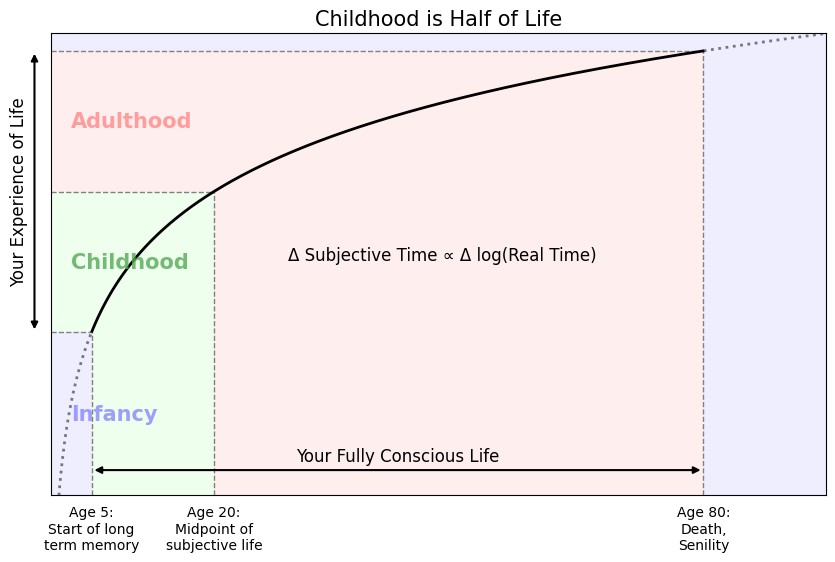
The author advances a model in which subjective experience of time compresses as life goes on: intervals feel shorter because each spans a smaller fraction of one’s total lifespan. Read this way, the vividness of early years means childhood accounts for roughly half of subjective life, while adulthood occupies the other half. From that premise the author draws practical implications. First, childhood itself warrants attention and investment — schooling and activities should be rewarding for their own sake, not only for future outcomes. Second, adults who feel time accelerating can slow subjective time by introducing new experiences, learning, travel or hobbies, though such novelty has limits. Third, parenting is presented as a particularly powerful antidote: caregivers share in children’s “firsts,” revive traditions, and gain a tangible sense of legacy. The essay uses personal anecdotes — a childhood telescope sighting and later recreating that moment for his own kids — to illustrate how children renew wonder and create new rituals that feel timeless.
Why it matters
- If childhood makes up a disproportionate share of how life feels, social choices about education and leisure carry immediate moral weight rather than only future benefits.
- Adults seeking to slow the passage of subjective time may need to prioritize novel experiences rather than only career or routine commitments.
- Parenting and caregiving change how people experience everyday time by supplying regular firsts and revitalizing rituals.
- Traditions sustained or invented for children can become a vehicle for continuity and a personal sense of contribution to the future.
Key facts
- The author describes a model where subjective time is experienced according to the fraction of life an interval represents, producing a logarithmic perception of age.
- Under that model, the midpoint between early childhood and old age shifts; childhood can feel like half of subjective life.
- The essay argues we should avoid ‘wasting’ children’s time and make childhood experiences meaningful in themselves.
- Adults can attempt to slow subjective time by seeking new experiences, learning, traveling, or taking up hobbies.
- Becoming a parent supplies many ‘firsts’ — from first words to first rainy days — that renew an adult’s sense of novelty.
- Children also revive and generate traditions, turning one-off actions into recurring rituals that feel enduring.
- The author offers personal vignettes (e.g., seeing Saturn through a telescope as a child and later showing it to his own kids) to illustrate renewal of wonder.
What to watch next
- Whether education policy or school practice shifts toward treating childhood experiences as intrinsically valuable rather than solely instrumental — not confirmed in the source.
- Trends in adult leisure that prioritize novelty, travel, or learning as responses to a sense of time acceleration — not confirmed in the source.
- Cultural patterns around holiday participation and family traditions as indicators of whether parenting continues to renew ritual engagement — not confirmed in the source.
Quick glossary
- Subjective time: An individual’s perception of how quickly or slowly time passes, which can differ from clock time.
- Logarithmic perception: A way of experiencing intervals such that each period is judged relative to the whole, compressing later intervals compared with earlier ones.
- Firsts: Initial experiences (first words, first steps, first sight of something) that register as novel and memorable.
- Tradition: A repeated practice or ritual passed down or created within a family or community that helps structure shared memories.
Reader FAQ
Does the author claim childhood literally equals half of everyone’s life?
The essay presents a thought model that, if taken literally, makes childhood feel like half of subjective life; it is presented as a perspective rather than an empirical universal.
Can adults actually reclaim the feeling of childhood?
The author argues you cannot truly return to being a child, but adults can renew experience through novel activities or by sharing children’s firsts.
Should schools be redesigned because of this idea?
The author suggests we should not waste children’s time and that schooling should be more rewarding for its own sake, but specific policy changes are not detailed.
Do children provide a sense of legacy or eternity?
The essay argues that raising children offers a tangible form of continuity and a way to pass aspects of oneself into the future.
Children and Helical Time Ryan Moulton December 30, 2025 Life We feel time differently over our lives. As a toddler, an afternoon feels like an eternity. In middle age, “no matter…
Sources
- If childhood is half of subjective life, how should that change how we live?
- According to one theory, childhood makes up half your life
- If childhood is half of subjective life, how should that …
- Growing up Faster, Feeling Older: Hardship in Childhood …
Related posts
- How to Make It Through Cold and Flu Season: Practical Prevention Tips
- Testing Popular Functional Coffee Add-Ins: Protein, Mushrooms, and Creamer Science
- 10 Tech Cleanup Tasks to Tackle on New Year’s Day for Smoother Devices