
TL;DR
The author attempted a full-day migration to Wayland in 2026 on machines using Nvidia GPUs and a Dell 8K monitor. While recent driver and compositor changes made Wayland startable, outstanding issues — notably tiled 8K output handling, input quirks, and mixed Xwayland compatibility — prevented a clean switch for the tested setup.
What happened
The author tried to migrate to Wayland in early 2026 using two Linux machines equipped with Nvidia GPUs and a Dell UP3218K (7680×4320) display. Nvidia added GBM support in driver 495 (late 2021), and explicit sync support arrived in wlroots 0.19.0 and Sway 1.11 (June 2025), which together let Wayland sessions start reliably. However, the monitor requires DisplayPort MST and TILE support; wlroots historically lacked TILE handling and a 2023 draft merge improved that, but the author still saw the monitor appear as two outputs and the right half stay black. After diagnosing the issue with automated code assistance and producing a minimal reproducer that pointed to an Nvidia DRM SRC_X problem, the author applied a workaround that copies and shifts the right half of the framebuffer. With that patch, Sway became usable on the 8K monitor, though other issues persisted during everyday use.
Why it matters
- Major distributions and projects are moving away from X11, increasing pressure to migrate to Wayland.
- High-resolution tiled displays and proprietary GPU drivers expose compatibility gaps that affect real-world usability.
- Incomplete application and Xwayland compatibility can block migrations for users relying on legacy apps.
- Driver and compositor feature parity (GBM, explicit sync, TILE) is crucial for smooth hardware support across vendors.
Key facts
- Wayland development began in 2008; the author created the i3 window manager for X11 in 2009.
- Test hardware included a Dell UP3218K (7680×4320) and Nvidia GPUs: GeForce RTX 4070 Ti (lab) and RTX 3060 Ti (main).
- Nvidia added GBM support in driver 495 (late 2021); Nvidia historically resisted the Wayland API in favor of EGLStreams.
- Explicit sync support needed for Nvidia was introduced in wlroots 0.19.0 and Sway 1.11 (June 2025).
- wlroots lacked support for the DRM 'TILE' property (issue opened in 2019); a draft merge request to add TILE support appeared in 2023.
- The author produced a minimal reproducer showing the SRC_X DRM property failing on Nvidia while working on Intel, and filed a forum report.
- A workaround that copies the right half of the framebuffer and repositions it allowed Sway to display correctly on the 8K monitor for the author.
- GNOME can configure the native 8K resolution but showed severe tearing because tiled updates were not synchronized; a mutter merge request (#!4822) is intended to address this.
- The author switched systems to NixOS and listed the configuration changes used to enable GDM, GNOME, and Sway for testing.
What to watch next
- Whether Nvidia responds to the SRC_X DRM bug report and provides a driver-level fix — not confirmed in the source.
- Progress and final merge status of wlroots TILE support and any upstream fixes for Nvidia output behavior.
- The mutter merge request #4822 that aims to eliminate unsynchronized updates on tiled displays (mentioned as a hopeful fix in the source).
- Wider distribution adoption of Sway 1.11 / wlroots 0.19.0 and any follow-up compositor fixes for input and Xwayland scaling — not confirmed in the source.
Quick glossary
- Wayland: A modern protocol and set of libraries used to implement compositors and handle graphics display on Linux, intended to replace the X server (X11).
- Xwayland: A compatibility layer that allows X11 (legacy) applications to run on a Wayland compositor.
- GBM (Generic Buffer Management): An API used by graphics drivers and compositors to allocate and manage GPU buffers; an alternative to Nvidia's earlier EGLStreams approach.
- Explicit sync / implicit sync: Mechanisms for synchronizing GPU buffer access between components; some drivers require explicit synchronization calls rather than relying on implicit behavior.
- Tiled/MST (Multi-Stream Transport): Display configurations that split a very high-resolution panel across multiple physical outputs or streams, often requiring compositor support for properties like TILE.
Reader FAQ
Can I run Wayland on an 8K Dell UP3218K with Nvidia?
The author got Wayland (Sway) to work on that monitor after diagnosing a DRM SRC_X issue and applying a framebuffer-copy workaround; a stable upstream fix was not reported in the source.
Do Nvidia drivers support Wayland now?
Nvidia added GBM support in driver 495 (late 2021) and implicit-sync differences required explicit sync workarounds; explicit sync support arrived in wlroots 0.19.0 and Sway 1.11 (June 2025).
Is GNOME usable with tiled 8K displays?
GNOME can configure the native tiled resolution, but the author observed severe tearing due to unsynchronized tile updates; a mutter merge request is intended to address this.
Has i3 been ported to Wayland?
i3 itself was not ported; the Sway project was created to provide an i3-like Wayland compositor starting around 2016.
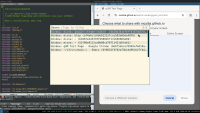
Can I finally start using Wayland in 2026? published 2026-01-04 Table of contents Wayland is the successor to the X server (X11, Xorg) to implement the graphics stack on Linux….
Sources
- Can I start using Wayland in 2026?
- Going all-in on a Wayland future – Community
- NVIDIA Outlines Current Wayland Limitations & Future …
- State of Linux Windowing Systems: Is Wayland Good in …
Related posts
- Why PGP Still Fails: Decades of Design Flaws, Compatibility and UX
- The Gentle Seduction: Reflections and Reader Comments on a Classic Essay
- pixoo-rb: Ruby client to drive Pixoo 64 LED sign with images, text