
TL;DR
At MIT.nano’s 2025 Mildred S. Dresselhaus Lecture, Jennifer Lewis outlined advances in 3D printing soft and living materials, from an autonomous soft robot to methods for fabricating perfusable human tissues. Her lab demonstrated techniques to print viscoelastic and sacrificial inks, and described a pathway toward patient-specific tissues with built-in vasculature.
What happened
Jennifer Lewis, the Hansjörg Wyss Professor of Biologically Inspired Engineering at Harvard, delivered the 2025 Mildred S. Dresselhaus Lecture on Nov. 3 to more than 500 in-person and virtual attendees. Lewis reviewed work from her lab on three-dimensional printing of soft materials used in soft robotics, electronics, and tissue engineering. She described how tuning local composition and structure during printing can change material properties across scales, and explained the development of viscoelastic inks and novel printhead designs. Lewis showed a soft autonomous ‘‘Octobot’’ built with embedded printing and temperature-responsive sacrificial inks, and presented SWIFT (sacrificial writing into functional tissue), a method for creating perfusable vasculature by printing removable gelatin inks into densely packed, stem-cell–derived building blocks. She closed by honoring Mildred Dresselhaus and joined Ritu Raman for a Q&A on topics including hardware, tissue regeneration, and bioprinting in space.
Why it matters
- Personalized tissues made from a patient’s own cells could reduce or eliminate the need for lifelong immunosuppression after transplants.
- Controlling composition and structure during printing enables multifunctional soft devices that combine mechanical, electrical, and biological functions.
- Methods that create open, perfusable channels address a major hurdle in scaling engineered tissues by allowing continuous fluid flow and nutrient delivery.
- Techniques developed for soft robotics and materials inform approaches to living-tissue fabrication, accelerating cross-disciplinary innovation.
Key facts
- Event: 2025 Mildred S. Dresselhaus Lecture organized by MIT.nano, presented Nov. 3; attendance exceeded 500 across in-person and virtual audiences.
- Speaker: Jennifer Lewis, Hansjörg Wyss Professor of Biologically Inspired Engineering at Harvard’s John A. Paulson School of Engineering and Applied Sciences.
- Lab focus: 3D printing methods, specialized printhead designs, and viscoelastic inks that switch between liquid and solid behavior.
- Octobot demonstration: a soft, autonomous robot using embedded printing and sacrificial inks that change state with temperature; movement driven by an oscillating circuit and hydrogen peroxide fuel.
- SWIFT: sacrificial writing into functional tissue — a process to print gelatin-based sacrificial inks into dense cellular matrices, then remove the ink to leave open vascular channels.
- Target tissues: ongoing work on cardiac, kidney, and cerebral tissues using patient-specific cells and stem-cell–derived building blocks.
- Functional result shown: cardiac building blocks initially beat separately but fuse in a SWIFT-compatible matrix and begin beating synchronously.
- Post-lecture Q&A with Ritu Raman covered 3D printing hardware and software, tissue repair and regeneration, and bioprinting in space.
- This lecture was the seventh in the Dresselhaus series, which honors the late Mildred S. Dresselhaus.
What to watch next
- Expansion of SWIFT to additional tissue types and construction of multi-scale vascular networks, as described by Lewis in the lecture.
- Progress toward creating tissues suitable for therapeutic use and, ultimately, whole-organ fabrication — an explicit long-term goal mentioned by Lewis.
- Clinical translation timelines, regulatory pathways, and human trial results: not confirmed in the source.
- Follow-up work on bioprinting in space and related experiments discussed during the Q&A: not confirmed in the source.
Quick glossary
- Viscoelastic ink: A printing material that exhibits both liquid-like flow and solid-like elasticity, enabling it to be extruded and then hold a printed form.
- Sacrificial ink: A material printed into a structure to create temporary support or channels that can later be removed, leaving open spaces or lumens.
- Embedded printing: A technique that prints material into a supporting bath or matrix, enabling free-form, three-dimensional structures rather than layer-by-layer deposition.
- SWIFT (sacrificial writing into functional tissue): A method for fabricating perfusable tissue by printing removable sacrificial ink into dense cellular matrices to form vascular-like channels.
- Perfusable vasculature: A network of open channels in engineered tissue that allows continuous flow of fluids, supporting nutrient delivery and waste removal.
Reader FAQ
What is the main aim of Lewis’s 3D-printing work?
To develop printing methods and materials that can produce functional soft devices and patient-specific tissues, with the long-term goal of therapeutic use and whole-organ fabrication.
Did Lewis show examples of both robots and tissues?
Yes. She presented a soft autonomous robot called Octobot and described tissue-engineering work using the SWIFT method for creating perfusable vasculature.
Are these lab-grown tissues ready for clinical transplantation?
Not confirmed in the source.
Which human tissues is the lab currently working on?
The lecture mentioned efforts on cardiac, kidney, and cerebral tissues using patient-specific and stem-cell–derived building blocks.
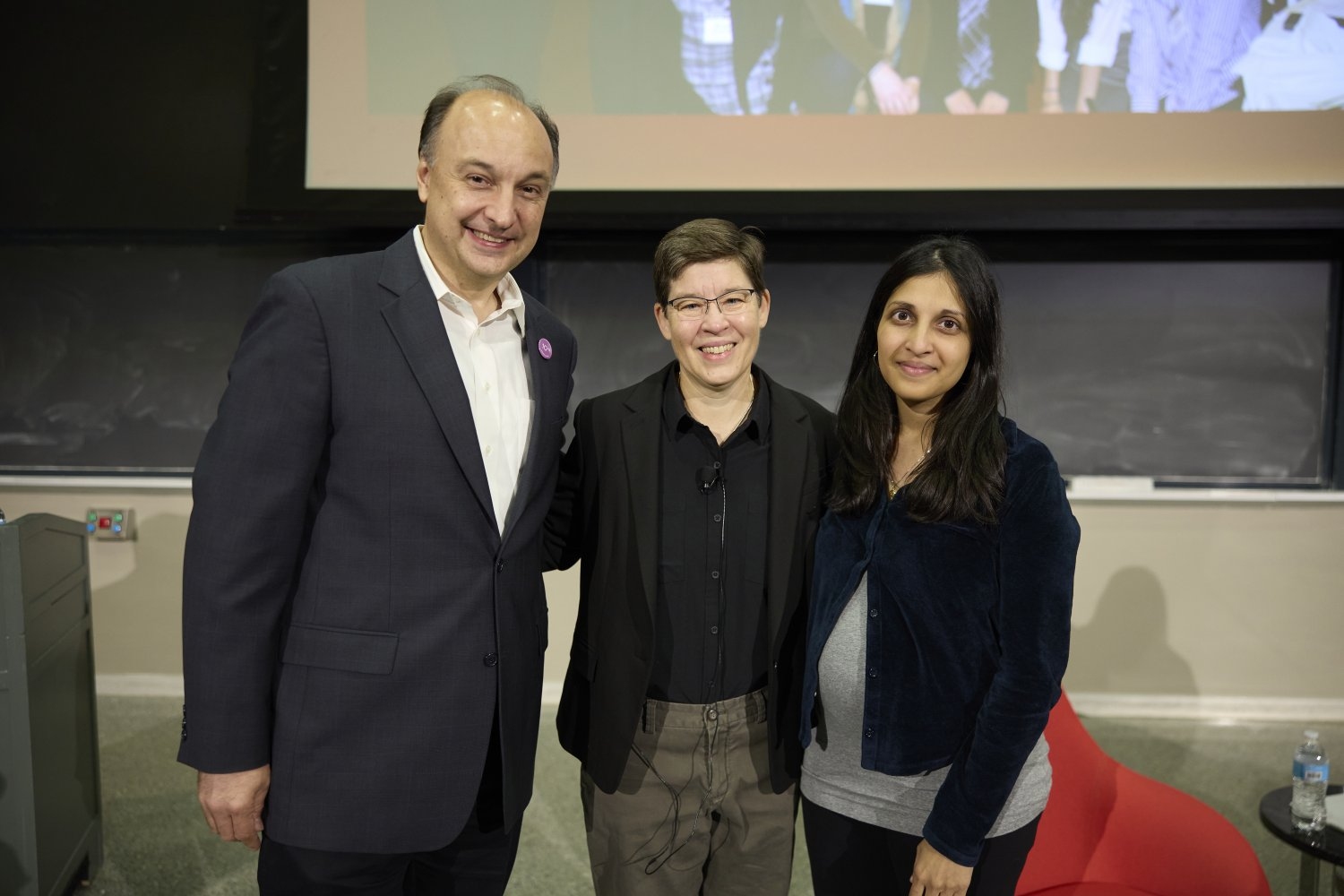
In the 2025 Dresselhaus Lecture, the materials scientist describes her work 3D printing soft materials ranging from robots to human tissues. Watch Video Amanda Stoll DiCristofaro | MIT.nano Publication Date…
Sources
- Jennifer Lewis ScD ’91: “Can we make tissues that are made from you, for you?”
- Jennifer Lewis Unlocks Future of Bioprinting and Tissue …
- Jennifer Lewis's quest for a 3-D printed kidney
- A swifter way towards 3D-printed organs – Wyss Institute
Related posts
- Vine-inspired robotic gripper gently lifts heavy and fragile objects
- Essential Questions to Ask in Your Next Job Interview — Make the Reverse Interview Count
- Researchers Build MEMS Chip That Keeps Time Nearly as Precisely as Atomic Clocks