
TL;DR
A lexicographer solicited versions of the schoolyard parody “Jingle Bells (Batman Smells)” on BlueSky and mapped dozens of variants. Responses show a sharp transatlantic split — a tightly clustered North American standard and far greater diversity across UK attestations — with media and local context offered as possible influences.
What happened
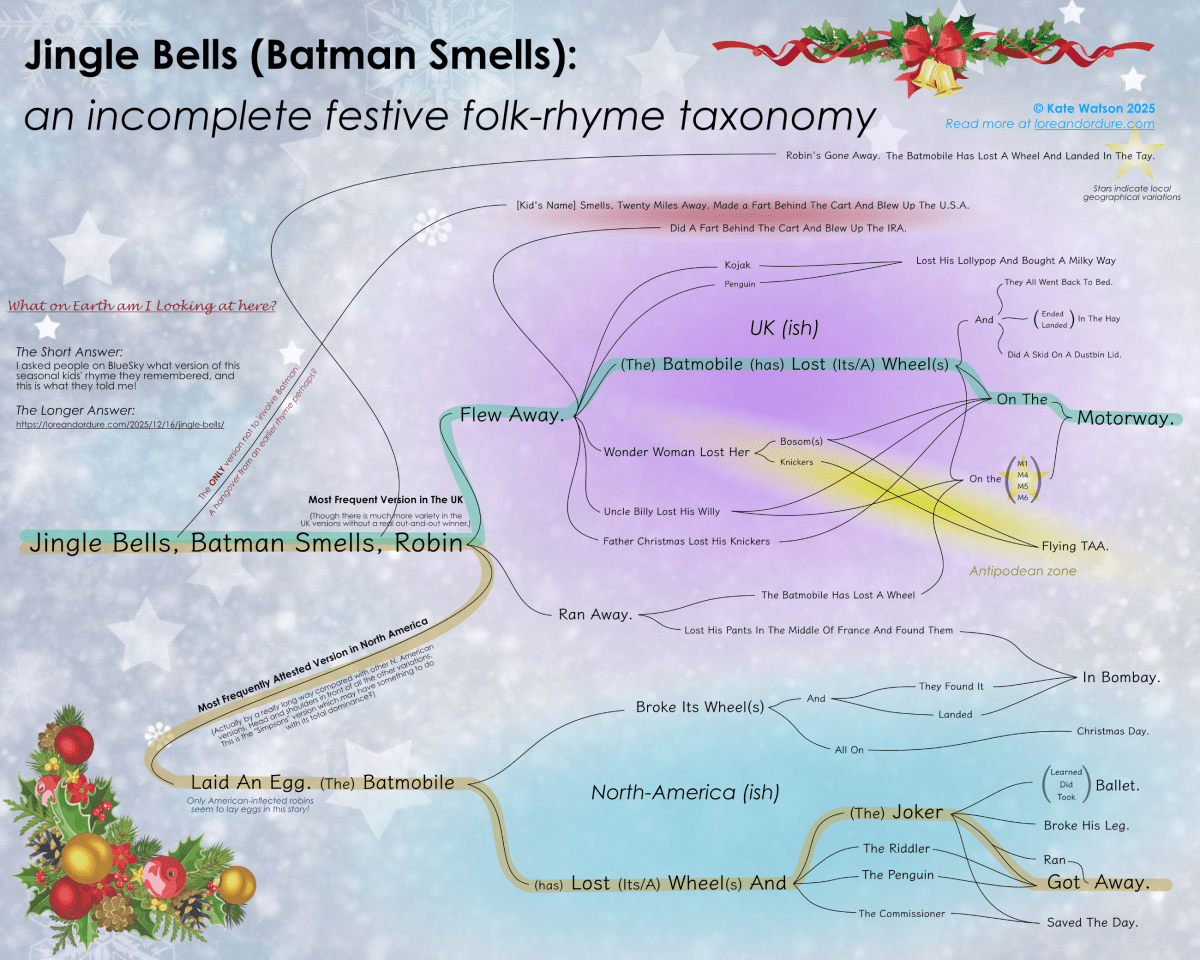
The author asked their BlueSky contacts which version of the playground parody “Jingle Bells (Batman Smells)” they recalled and compiled the replies into a provisional taxonomy. The dataset, drawn mainly from contributors in the UK and North America with a few Antipodean notes, produced a semi-quantitative diagram showing which lines were most common and how variants cluster. North American responses overwhelmingly favored a single form — commonly “Robin laid an egg” with the Batmobile losing a wheel — while UK responses were more varied, typically featuring Robin “flew away” and often placing mishaps “on the motorway,” sometimes naming local motorways. The post discusses possible reasons for these patterns, including the Simpsons’ early inclusion of the North American standard in its 1989 premiere and different broadcast histories between the US and UK. The author also notes sample limitations and describes the project as preliminary rather than exhaustive.
Why it matters
- Highlights how oral playground traditions mutate and stabilize differently across regions.
- Shows the potential for popular media to reinforce or spread particular folk variants.
- Demonstrates local cultural markers (e.g., motorway names) shaping versions of a shared rhyme.
- Underscores limits of crowdsourced linguistic samples and the need to account for collection bias.
Key facts
- The author collected responses via BlueSky from a network concentrated in the UK and North America, with a few Antipodean replies.
- North American replies were heavily clustered around a single version — commonly “Robin laid an egg” plus a Batmobile wheel failure.
- UK replies were more diverse; the most frequent UK through-line generally had Robin ‘flew away’ and the Batmobile losing a wheel on the motorway.
- Several UK attestations named local motorways (M1, M4, M5, M6) or local landmarks (river Tay) in place of a generic motorway.
- The North American standard appeared in the first episode of The Simpsons, “Simpsons Roasting on an Open, Fire,” broadcast in the US in December 1989.
- The author reports older attestations from the 1970s and 1980s, indicating the rhyme predates The Simpsons’ 1989 episode.
- The post references basic historical milestones for Batman: first appearance in 1939, the Batmobile named by 1941, and the 1966–68 TV series starring Adam West.
- Some North American variants include other canonical Batman villains (Joker, Penguin, Riddler, Commissioner); UK variants often feature assorted figures like Father Christmas, Wonder Woman, Uncle Billy, and Kojak.
- The author describes their diagram as semi-quantitative: larger type indicates more common lines and two colored lines trace common UK (green) and North American (gold) through-lines.
- The author acknowledges that the sample is not comprehensive and is shaped by the demographics of their BlueSky network.
What to watch next
- Whether academic or archival research can more firmly establish the rhyme’s earlier history and regional transmission paths — not confirmed in the source.
- The extent to which The Simpsons episode actually influenced memory and spread of the North American version versus reflecting an already-common variant — not confirmed in the source.
- Further crowdsourced or recorded evidence on how local place names (e.g., specific motorways) appear in UK versions and whether similar localization exists elsewhere.
Quick glossary
- Lexicography: The study and practice of compiling dictionaries and documenting word usage and variants.
- Taxonomy (folk-rhyme): A classificatory framework that maps relationships and variations among versions of a folk rhyme.
- BlueSky: A social media platform used by the author to solicit recollections of the rhyme; in the source it supplied the contributor sample.
- Variant: A distinct wording or phrasing of a song, rhyme, or oral tradition found in different communities.
Reader FAQ
Did The Simpsons create the “Robin laid an egg” version?
No. The Simpsons featured that version in a 1989 episode, but the author reports attestations from the 1970s and 1980s that predate the show.
Which form is most common in each region?
In the author’s sample, North America predominantly recalled a ‘Robin laid an egg’ variant; UK replies were more diverse, commonly using ‘Robin flew away’ and motorway settings.
Is this survey comprehensive?
No. The author describes the dataset as a preliminary, non-exhaustive sample drawn from their BlueSky network and notes demographic skew.
Are there notable international oddities?
A few Antipodean replies included unusual lines (e.g., Wonder Woman losing undergarments while flying TAA), but those attestations were limited.
Jingle Bells (Batman Smells): an incomplete festive folk-rhyme taxonomy Kate W. Academic Interest, Blog Post, language, Newsletter Post, Now and Then, The Way We Live December 16, 2025 8 Minutes Gather…
Sources
- Jingle Bells (Batman Smells): An incomplete festive folk-rhyme taxonomy
- Jingle Bells (Batman Smells): An incomplete festive folk- …
- 'Jingle Bells, Batman Smells…' – Origins and Taxonomy Links
- The (slightly in)complete taxonomy of Jingle Bells, Batman …
Related posts
- A Child in the State of Nature: The Wild Boy of Aveyron Reexamined
- The most damaging taboo about sexual violence: understanding intrusive fantasies
- ACME Python Labs: Applied Mathematics Hands-On Exercises for Theory and Practice