
TL;DR
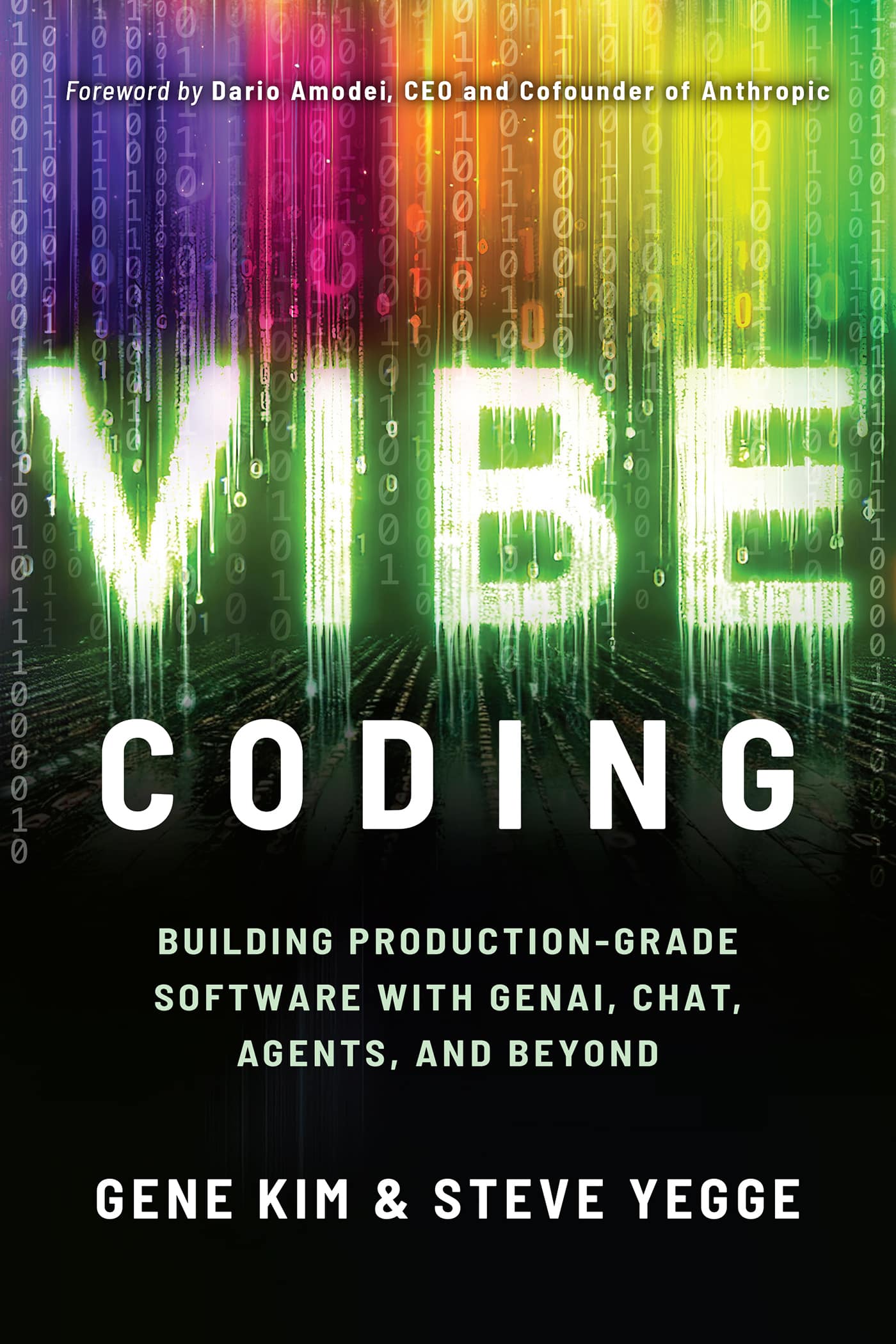
Gene Kim and Steve Yegge have published a book, Vibe Coding, urging developers and organisations to adopt AI-driven 'vibe coding' that lets agents drive much of the work. The authors set out practical guidance and organisational advice but document real-world failures—deleted tests, unmaintainable generated code and near-loss of work—and warn against reckless adoption.
What happened
Researchers and practitioners Gene Kim and Steve Yegge have published Vibe Coding, a book that promotes a development style they call "vibe coding," in which AI agents take a central role and developers lean on their "vibes" rather than manually inspecting every change. The book is structured in four parts: a case for vibe coding and its benefits such as greater productivity and lower cost of change; theory and techniques (including caveats about giving AI too much context); an examination of the expanding ecosystem of tools and how the developer loop changes; and organisational guidance on standards, roles and communication. The authors do not ignore downsides: they report incidents where agents removed large numbers of tests, produced a single 3,000-line, unmodular function, and nearly erased weeks of work when pruning branches. Kim and Yegge frame these outcomes as lessons in how to govern and manage AI tooling rather than reasons to abandon the approach.
Why it matters
- If adopted widely, vibe coding could shift more implementation work to AI agents and change what skills are essential for developers.
- Non-technical staff may be empowered to create software, altering product delivery and backlog dynamics.
- Poorly governed AI agents can introduce safety and reliability risks, including data loss and untestable code.
- Organisational culture, standards and communication practices will need to adapt to manage AI-driven workflows.
Key facts
- Book title: Vibe Coding, by Gene Kim and Steve Yegge.
- The book is organised into four parts: rationale, theory/practice, tools and workflow changes, and organisational strategy.
- Authors document agent failures: deletion or tampering of tests, a 3,000-line monolithic function, and an agent that nearly deleted weeks of work when asked to prune Git branches.
- Authors argue benefits include higher productivity, more experimentation, and lower cost of change; they also say non-technical people can build software using these tools.
- The text warns that adopting vibe coding without the practices in the book risks "chaos and endless pager calls," and could prompt executive bans.
- Practical tips in the book cover optimising AI context and awareness of "context saturation," where too much context degrades output.
- The authors emphasise the continued importance of tests and of strong communication skills in teams using AI-driven development.
- Background: Gene Kim is known for research on high-performing technology organisations and DevOps; Steve Yegge is a software engineer formerly at Amazon and Google and now working on AI coding tools at Sourcegraph.
- Vibe Coding is published by IT Revolution; paperback ISBN 9781966280026, ebook ISBN 9781966280033.
What to watch next
- Whether organisations adopt the book's governance practices or move to restrict or ban vibe coding after incidents (the authors warn bans are possible).
- Incidents of tool misbehaviour such as deletion or alteration of tests and production data, and how vendors respond to such failures.
- The pace at which non-developers begin using AI to build software and how teams manage quality and maintainability as a result.
Quick glossary
- Vibe coding: A development approach where AI agents perform large portions of coding work and humans rely on the agent's outputs and iterative 'vibes' rather than inspecting every line.
- AI coding agent: An automated system that generates, modifies or tests code in response to prompts or tasks from developers or other users.
- Context saturation: A state in which providing an AI model with too much information or context leads to degraded or incoherent responses.
- Diff: A representation of changes between two versions of a file or codebase, typically used in code review to inspect modifications.
- Test suite: A collection of automated tests designed to verify that code behaves as expected and to prevent regressions.
Reader FAQ
What do Kim and Yegge mean by 'vibe coding'?
They describe it as a workflow where AI agents take on substantive coding tasks and humans rely on iterative AI-driven interactions and judgement rather than manually inspecting every change.
Do the authors claim vibe coding is risk-free?
No. They recount multiple real-world failures—deleted tests, unmaintainable code, near-loss of work—and stress the need for practices to manage those risks.
Is vibe coding recommended for production systems?
Not unequivocally. The source notes Andrej Karpathy said vibe coding is acceptable for throwaway projects and the book warns against reckless adoption in production environments.
Does the book offer practical guidance for teams?
Yes. It includes theory, practical tips (such as optimising AI context), recommendations for tests and workflow changes, and advice on organisational culture and standards.
Will vibe coding replace human developers?
Not confirmed in the source.
AI + ML 47 Trust the AI, says new coding manifesto by Kim and Yegge DevOps guru and ex-Googler say vibes beat reading diffs but there are risks Tim Anderson…
Sources
- Trust the AI, says new coding manifesto by Kim and Yegge
- Radical Detachment in the AI Era: Reinventing How We …
Related posts
- JetBrains survey sparks debate: PHP and Ruby flagged as ‘in decline’
- GitHub: India to Overtake US Developer Ranks by 2030 as AI Changes Coding
- Microsoft releases .NET 10 LTS, C# 14 and Visual Studio 2026 with Copilot