
TL;DR
Two decades after its 2001 release, Max Payne's visuals still impress when judged against the hardware limits of the era. The game's realism relied on precomputed assets, particle flipbooks, lightmaps and clever texture tricks rather than dynamic geometry or lighting.
What happened
Released in July 2001 targeting DirectX 8.0, Max Payne delivered graphics that were widely praised at the time but were achieved within severe hardware and API constraints: a single ~450 MHz CPU and roughly 16 MB of GPU memory were typical targets. The development team used a suite of cost-effective visual techniques—large particle quads with flipbook animations, prebaked lightmaps for static illumination, detail textures to suggest high-frequency surface detail, and baked albedo textures to fake geometry and contact shadows. Many dynamic effects that look complex are actually pre-rendered or texture-based illusions; there is no fluid simulation and dynamic shadowing for moving objects is absent. The article breaks down these systems, highlights standout particle work, and points out visual artifacts and limitations such as particle-ground clipping, inconsistent detail-texture use, and timing offsets for decals.
Why it matters
- Shows how developers traded real-time computation for visual tricks to achieve perceived realism under strict hardware limits.
- Illustrates specific techniques—flipbook particles, lightmaps, detail textures—that were practical solutions in the early 2000s.
- Highlights limitations (no dynamic shadows, low-res lightmaps) that shaped the look and feel of older games.
- Provides a reference point for how much modern hardware and APIs have expanded real-time rendering possibilities.
Key facts
- Max Payne targeted DirectX 8.0 on release and was designed for systems around a 450 MHz CPU and a ~16 MB GPU.
- The rendering approach favored forward-only techniques; render-to-texture and dynamic shadow maps were not used.
- Particle effects are a major visual focus: many effects are single quads with animated flipbook textures rather than high-geometry simulations.
- There is no evidence of fluid simulation; effects like steam and leaking trails are texture-based fakes.
- Static scene lighting relied on prebaked lightmaps, not radiosity-based or fully dynamic global illumination.
- Lightmap texel density was low, producing soft shadows, light leaking, and weak contact shadows for some objects.
- Detail textures (typically single-channel) were used to suggest high-resolution surface detail while conserving memory.
- Many 3D details are painted into albedo textures or implemented with alpha-tested quads instead of modeled geometry.
- Criticisms noted include particle quads clipping unnaturally against ground, lack of particle-environment interaction, and decal/timing offsets.
What to watch next
- Whether modern re-releases address particle-ground clipping or add depth-aware particle rendering (not confirmed in the source).
- If any remaster applies dynamic shadows or higher-resolution lightmaps to reduce light leaking and improve contact shadows (not confirmed in the source).
- Potential fixes for decal timing and improved particle-environment interaction during slow-motion sequences (not confirmed in the source).
Quick glossary
- DirectX 8.0: A Microsoft graphics API standard from the early 2000s that provided basic support for vertex and pixel shaders but with strict instruction and capability limits.
- Lightmap: A texture that stores precomputed lighting information for static geometry so illumination can be rendered cheaply at runtime.
- Flipbook texture: An animation technique that cycles through frames stored in a single texture applied to a quad to simulate motion or changing appearance.
- Albedo: The base color texture of a surface, representing diffuse reflectance without lighting or shadowing baked in.
- Particle quad: A two-dimensional polygon (usually a rectangle) used to render individual particle effects; often always faces the camera and uses animated textures.
Reader FAQ
Did Max Payne receive recognition for its graphics?
The source states the rendering earned multiple graphics awards at the time.
Were dynamic shadows used for moving objects in Max Payne?
No — the game relied on prebaked lighting and did not employ dynamic shadow maps for props or characters.
Are the particle and fluid effects physically simulated?
No — many particles and fluid-like effects are texture-driven flipbook animations rather than real fluid simulations.
Was modern real-time global illumination or ray tracing used?
Not confirmed in the source.
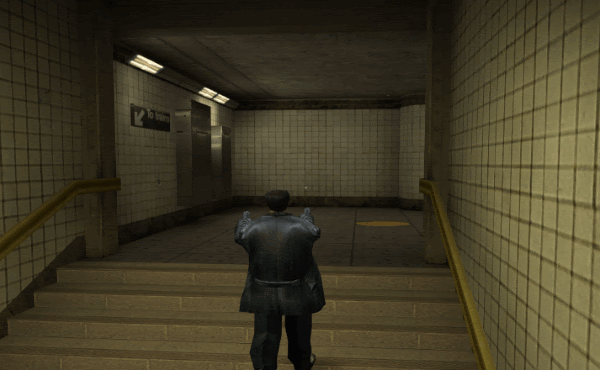
Mechanism and Its Consequences Friday, 23 July 2021 Max Payne – two decades later – Graphics Critique It has been two decades since the video game Max Payne was…
Sources
- Max Payne – two decades later – Graphics Critique
- Max Payne turns 20: Remedy Entertainment looks back on …
- 20 years on, Max Payne is still an action masterpiece
- The Legacy of Max Payne – by Zaigam Akhtar
Related posts
- More than One Hundred Years of Film Sizes: A Century of Gauge Choices
- The answer cannot be nothing: the battle over Canada’s mystery brain disease
- The Concise TypeScript Book — Free, Open-Source Guide to TypeScript 5.2