
TL;DR
Aurelia Institute, founded by MIT alumni and researchers, combines research, education, and policy work to broaden access to space. It runs annual microgravity flights, develops self-assembling space architecture (TESSERAE), and is returning to the ISS in early 2026 under a NASA grant.
What happened
Aurelia Institute, launched by Ariel Ekblaw, Danielle DeLatte, and former MIT researcher Sana Sharma, operates as a nonprofit research lab, education and outreach center, and policy hub focused on equitable access to space. The group runs yearly microgravity flights that bring roughly 25 participants and host 10–15 experiments per flight; about 200 people have taken part across related programs, and over 70% moved on to work in the space sector. A central technical effort is the TESSERAE Project — modular tiles that autonomously self-assemble into spherical structures — which flew on the first private mission to the International Space Station in 2022. TESSERAE will return to the ISS in early 2026 under a NASA grant for further testing. The project has been spun out into a for-profit company, and Aurelia continues other work including human-scale habitat design, public exhibits (such as a 20-foot dome shown at the Seattle Museum of Flight), open-source classes, and community-building across academia, industry, and the arts.
Why it matters
- Combines technical R&D with education and policy to broaden participation in space careers and research.
- Hands-on microgravity opportunities serve as workforce training and a pipeline into the growing commercial space sector.
- Self-assembly technologies like TESSERAE aim to enable larger, more efficient space structures that could support infrastructure in low Earth orbit.
- Design work links space habitat concepts with public engagement, potentially informing how future human environments are conceived both in orbit and on Earth.
Key facts
- Founders: Ariel Ekblaw (SM ’17, PhD ’20), Danielle DeLatte (’11), and Sana Sharma (former MIT research scientist).
- Aurelia functions as a research laboratory, an education/outreach center, and a policy hub.
- Annual microgravity flights carry about 25 people and host 10–15 experiments; nearly 200 people have flown across Aurelia and the Space Exploration Initiative.
- More than 70% of flight participants have continued with space-industry activities after flying.
- TESSERAE is a modular tile system designed to autonomously self-assemble into spherical space structures.
- TESSERAE flew on the first private mission to the ISS in 2022 and is slated to return for additional testing in early 2026 via a NASA grant.
- TESSERAE has been spun out from Aurelia into a separate for-profit company.
- Aurelia produces public-facing installations and exhibits, including a 20-foot dome displayed at the Seattle Museum of Flight.
- The institute offers open-source classes on designing experiments for microgravity environments.
What to watch next
- Aurelia’s planned TESSERAE testing on the International Space Station in early 2026 (funded by a NASA grant).
- Further commercial development and market adoption of the TESSERAE spin-off company and any additional spinoffs from Aurelia (Ariel Ekblaw has said she expects more spinoffs).
- Whether Aurelia’s education pipeline continues to funnel a high proportion of participants into space-sector careers and how that affects workforce diversity and capacity.
- Not confirmed in the source: regulatory, commercial, or large-scale infrastructure outcomes from Aurelia’s technologies and projects.
Quick glossary
- Microgravity flight: A parabolic or suborbital flight that creates short periods of near-weightlessness, used to test experiments and train personnel in reduced-gravity conditions.
- Self-assembly: A process by which components autonomously organize into structures without continuous external control, often used in robotics and materials research.
- Low Earth orbit (LEO): An orbital region close to Earth, typically below 2,000 kilometers altitude, where many satellites and the International Space Station operate.
- International Space Station (ISS): A habitable artificial satellite in low Earth orbit that serves as a multinational research laboratory for space science and technology testing.
Reader FAQ
Who founded the Aurelia Institute?
Ariel Ekblaw, Danielle DeLatte, and Sana Sharma.
Is Aurelia a nonprofit or a for-profit company?
Aurelia Institute is a nonprofit; one of its projects, TESSERAE, was spun off into a for-profit company.
Has TESSERAE been tested in space?
Yes — TESSERAE flew on a private mission to the ISS in 2022 and is scheduled for further ISS testing in early 2026 under a NASA grant.
Does Aurelia run microgravity flights regularly?
Yes — the institute charters annual microgravity flights for research, training, and outreach.
Will Aurelia’s work directly benefit daily life on Earth?
Aurelia aims to direct technologies toward infrastructure projects that benefit life on Earth, but specific long-term impacts are not confirmed in the source.
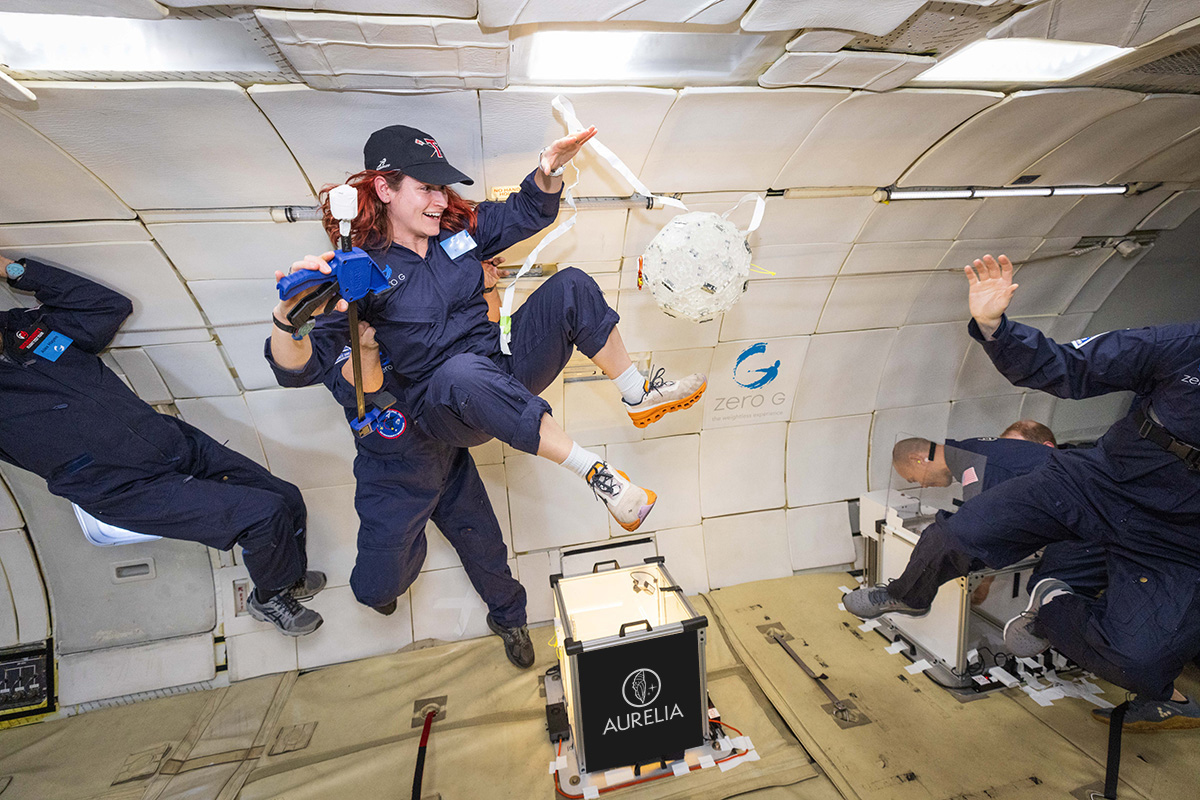
Aurelia Institute, founded by a team from MIT, serves as a research lab, an education and outreach center, and a policy hub for the space industry. Zach Winn | MIT…
Sources
- Supporting mission-driven space innovation, for Earth and beyond
- Supporting mission-driven space innovation, for Earth and …
- Mission-Driven Space Innovation, for Earth and Beyond
Related posts
- MIT PhD Student Erik Ballesteros Builds Wearable ‘SuperLimbs’ for Astronauts
- Warehouse Robots Take on Truck Unloading With AI and Heavy-Lift Arms
- Student-built NerdXing helps MIT undergrads navigate cross-department paths