
TL;DR
MIT researchers built an insect-scale flying robot that matches key flight metrics of real insects by pairing a high-performance planner with a fast AI policy. The microrobot completed 10 somersaults in 11 seconds and showed large gains in speed and acceleration over prior versions.
What happened
Researchers at MIT’s Soft and Micro Robotics Laboratory, working with collaborators in aeronautics and control, demonstrated an aerial microrobot with insect-like agility by developing a two-step, AI-driven flight controller. The small, microcassette-sized device—about 4 centimeters across and weighing less than a paperclip—uses larger flapping wings actuated by soft artificial muscles. The team first ran a computationally heavy model-predictive controller (MPC) to plan high-performance maneuvers and then used imitation learning to train a deep-learning policy that can run in real time. That approach compressed the planner’s capabilities into an efficient onboard decision model, letting the robot perform aggressive maneuvers such as continuous flips and saccade-like pitches. In tests, the system increased speed and acceleration by roughly 447% and 255% respectively versus the group’s prior demonstrations, completed 10 consecutive somersaults in 11 seconds, and stayed within 4–5 centimeters of planned trajectories even under wind disturbances.
Why it matters
- Brings insect-scale flight closer to practical use by combining high-performance planning with real-time control.
- Enables maneuvering in confined or cluttered environments where larger drones cannot operate.
- Demonstrates a pathway to compressing computationally intensive planners into efficient policies suitable for tiny robots.
- Moves the field toward adding sensing and autonomy for outdoor and coordinated operations.
Key facts
- Paper published in Science Advances.
- Device size: roughly 4 centimeters across; weight: less than a paperclip.
- New version uses larger flapping wings driven by soft artificial muscles.
- Control approach: two-step scheme—model-predictive controller (MPC) + imitation-learned policy.
- Reported performance gains: about 447% increase in speed and 255% increase in acceleration over prior MIT demonstrations.
- Achieved 10 consecutive somersaults in 11 seconds while staying within 4–5 cm of planned paths.
- Tests included wind disturbances of more than 1 meter per second and even a power tether wrapping during flips.
- Current controller runs on an external computer; researchers aim to add onboard sensors and cameras in future work.
- Lead authors and contributors include Kevin Chen, Yi-Hsuan Hsiao, Andrea Tagliabue, Owen Matteson, Suhan Kim, Tong Zhao, and Jonathan P. How.
- Funding sources include NSF, Office of Naval Research, Air Force Office of Scientific Research, MathWorks, and the Zakhartchenko Fellowship.
What to watch next
- Integration of onboard sensors and cameras to enable untethered outdoor flight and autonomy.
- Efforts to move the control policy from an external computer onto the robot itself.
- not confirmed in the source
Quick glossary
- Microrobot: A very small robotic device, often measured in millimeters or centimeters, designed for tasks in confined or delicate environments.
- Model-predictive controller (MPC): A control method that uses a dynamic model of a system to plan optimal control actions over a future time horizon while respecting constraints.
- Imitation learning: A machine learning technique where a policy is trained to mimic the outputs of an expert or planner, enabling faster execution at runtime.
- Policy (in robotics): The decision-making function that maps sensor inputs or state estimates to control commands for a robot.
- Saccade (flight): A rapid pitch-and-turn maneuver that insects use to change direction quickly and stabilize visual sensing.
Reader FAQ
How fast and agile is the robot compared with previous versions?
The team reports a roughly 447% increase in speed and a 255% increase in acceleration compared with their earlier demonstrations.
Is the robot fully autonomous and untethered now?
Not confirmed in the source; the controller currently runs on an external computer rather than fully onboard the robot.
What physical characteristics does the robot have?
The device is microcassette-sized, measures about 4 centimeters across, and weighs less than a paperclip; it uses flapping wings powered by soft artificial muscles.
Where was the work published?
The research appears in the journal Science Advances.
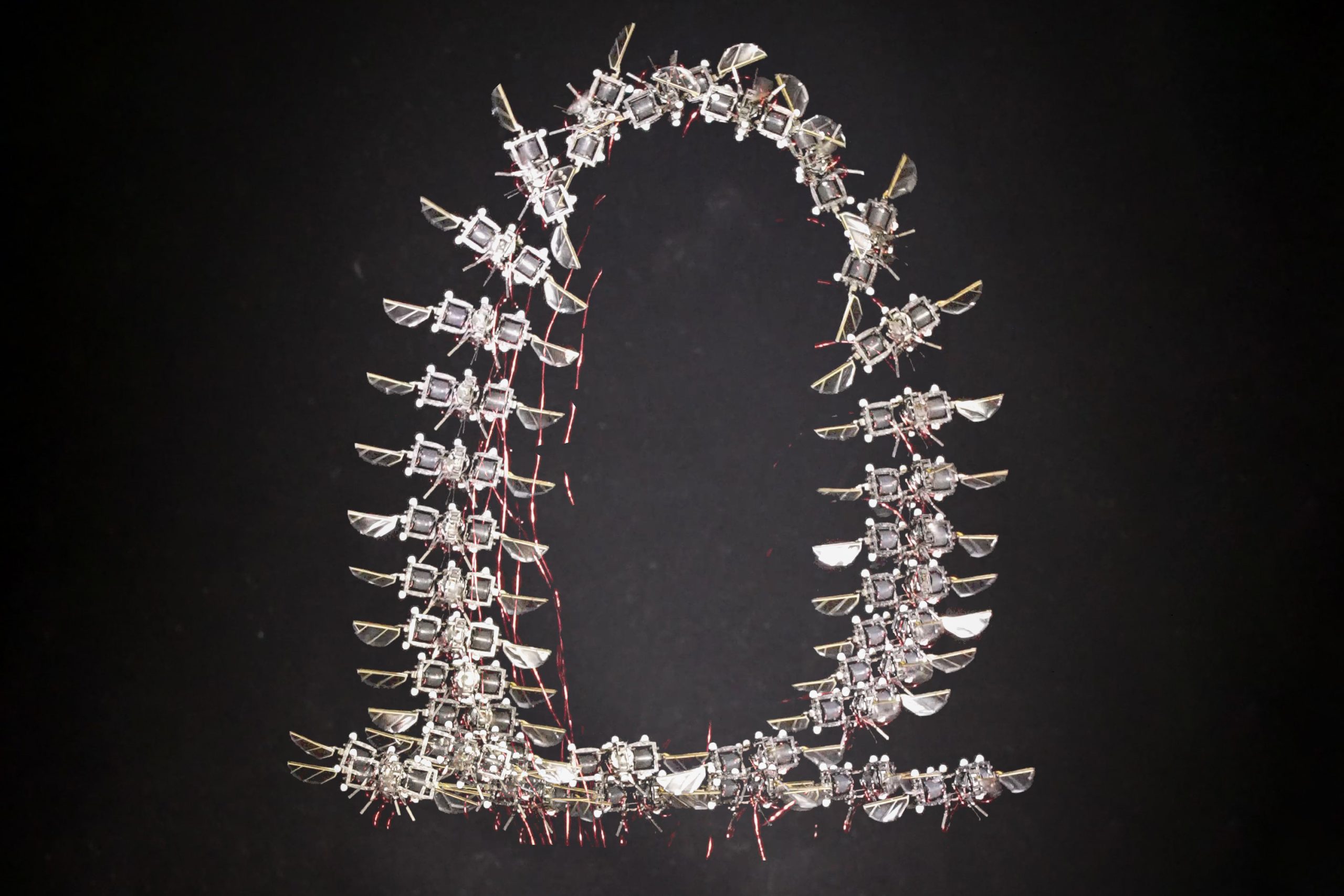
With insect-like speed and agility, the tiny robot could someday aid in search-and-rescue missions. Adam Zewe | MIT News Publication Date : December 3, 2025 PRESS INQUIRIES Caption : A…
Sources
- MIT engineers design an aerial microrobot that can fly as fast as a bumblebee
- Clip Science Watch this tiny robot somersault through the …
- Researchers at MIT develop tiny robot that can fly as fast as …
- Microrobot Flies As Fast As A Bumblebee
Related posts
- Warehouse Robots Take on Truck Unloading With AI and Heavy-Lift Arms
- MIT researchers develop speech-to-reality system that fabricates objects
- Jennifer Lewis on 3D-printed soft matter: Octobot to patient-specific tissues