
TL;DR
Two MIT undergraduates interned at SINTEF Ocean in Trondheim through an MIT Sea Grant–MISTI program to work on AI and robotic applications for offshore salmon farming. Their projects focused on feeding optimization using machine learning and simulation of an underwater vehicle–manipulator for cage repairs, within a broader collaboration between MIT and Norwegian research groups.
What happened
Under an AquaCulture Shock initiative supported by an Aquaculture Technologies and Education Travel Grant, MIT Sea Grant and MIT-Scandinavia MISTI placed two students at SINTEF Ocean in Trondheim for summer internships. Beckett Devoe, a senior studying artificial intelligence and decision-making, worked on machine-learning models aimed at optimizing feed amounts by integrating farm features such as fish size and water temperature. Tony Tang, a junior in mechanical engineering, developed simulations for an underwater vehicle equipped with a robotic arm to inspect and repair cage nets. Both were hosted in SINTEF Ocean’s Aquaculture Robotics and Autonomous Systems Laboratory (ACE‑Robotic Lab) and had a field visit to the Singsholmen industrial-scale salmon farm on Hitra, where pens can hold large populations of fish. The placements build on prior exchanges between MIT and Norwegian researchers, including collaborative work with Eleni Kelasidi and other partners at NTNU and SINTEF.
Why it matters
- Norway dominates farmed Atlantic salmon production while the U.S. remains a major importer, highlighting global supply-chain importance.
- Feed is the single largest cost in salmon farming; AI-driven feeding optimization could reduce expenses and environmental impacts.
- Scaling offshore operations requires more autonomous robotic systems because manual control of thousands of platforms is impractical.
- Interdisciplinary training that combines biological understanding with engineering and AI is presented as necessary for reliable, welfare‑conscious solutions.
Key facts
- The internships were part of AquaCulture Shock, a collaboration between MIT Sea Grant and MIT‑Scandinavia MISTI.
- Funding came from an Aquaculture Technologies and Education Travel Grant through the National Sea Grant College Program.
- Hosts were at SINTEF Ocean’s Aquaculture Robotics and Autonomous Systems Laboratory (ACE‑Robotic Lab) in Trondheim.
- Student interns: Beckett Devoe (senior, artificial intelligence and decision‑making) and Tony Tang (junior, mechanical engineering).
- Devoe’s work applied machine learning to recommend feeding amounts using farm features like fish size and water temperature.
- Tang developed simulations for an underwater vehicle–manipulator system intended to navigate farms and repair net pens.
- SINTEF Ocean’s research manager estimated roughly a thousand fish farms along the Norwegian coast and said thousands of aquaculture robots operate in Norway today.
- Singsholmen farm on Hitra has 10 circular net pens about 50 meters across, with each pen able to hold up to 200,000 salmon.
- The MIT–SINTEF collaboration began earlier, including visits and joint research with researchers such as Eleni Kelasidi and MIT faculty.
What to watch next
- Whether AI feeding models developed during internships translate into measurable feed savings and welfare outcomes (not confirmed in the source).
- Progress in raising autonomy levels across the fleet of aquaculture robots to reduce direct human control (not confirmed in the source).
- The results and broader impacts of the next cohort of MIT students placed with Norwegian labs this coming summer (not confirmed in the source).
Quick glossary
- Aquaculture: The cultivation of aquatic organisms such as fish, shellfish, and algae under controlled conditions.
- Net pen: A large, submerged enclosure made of netting used to hold and grow fish in sea‑based farming operations.
- Echosounder: An acoustic device that emits sound pulses and measures the echoes to detect objects and estimate their depth or position.
- Autonomous system: A machine or robot capable of performing tasks with limited or no human intervention, typically using sensors and control algorithms.
Reader FAQ
Who participated in the Norway internships?
Beckett Devoe, a senior in AI and decision‑making, and Tony Tang, a junior in mechanical engineering.
Where did the students work while in Norway?
They worked at SINTEF Ocean in Trondheim within the Aquaculture Robotics and Autonomous Systems Laboratory.
What did each student work on?
Devoe focused on machine‑learning models for feeding optimization; Tang worked on simulations for an underwater vehicle–manipulator system.
Will MIT continue sending students to Norway for aquaculture internships?
MIT Sea Grant and MIT‑Scandinavia MISTI are recruiting a new cohort of four students for next summer, as stated in the source.
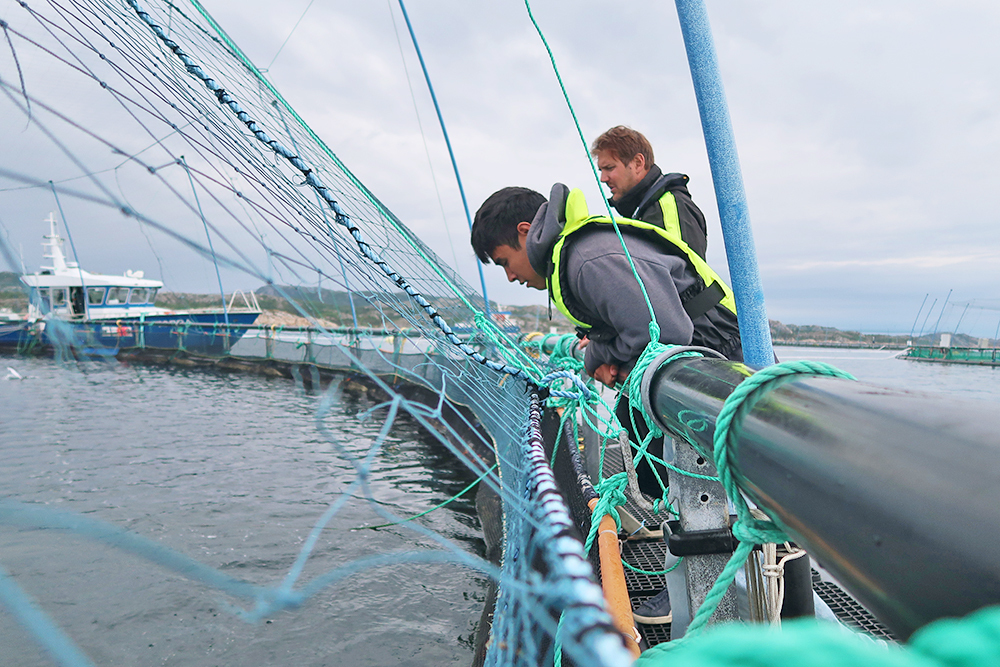
AquaCulture Shock program, in collaboration with MIT-Scandinavia MISTI, offers international internships for AI and autonomy in aquaculture Lily Keyes | MIT Sea Grant Publication Date : December 1, 2025 PRESS…
Sources
- MIT Sea Grant students explore the intersection of technology and offshore aquaculture in Norway
- MIT Sea Grant students explore the intersection of …
- MIT Sea Grant Students Lead Offshore Aquaculture …
- MIT Sea Grant students explore the intersection of technology …
Related posts
- MIT develops control framework to keep soft robots within safe force limits
- MIT engineers design microrobot that flies as fast as a bumblebee
- Warehouse Robots Take on Truck Unloading With AI and Heavy-Lift Arms