
TL;DR
Hundreds of researchers, industry leaders, and students gathered at MIT on Sept. 17 for the inaugural Generative AI Impact Consortium symposium to discuss technical advances and societal implications of generative AI. Speakers emphasized research directions such as 'world models' for embodied learning, applications in robotics and industry, and the need for guardrails and cross-sector collaboration.
What happened
MIT hosted the first symposium of the Generative AI Impact Consortium (MGAIC) on Sept. 17 at Kresge Auditorium, drawing hundreds of researchers, business leaders, educators, and students. The consortium, launched in February, is intended to bring together industry and MIT researchers to guide generative AI toward beneficial uses. MIT leaders framed the gathering as a call to address both technical progress and ethical challenges. Keynotes included Meta chief AI scientist Yann LeCun, who argued that future AI progress may hinge less on ever-larger language models and more on ‘world models’ that learn through sensory interaction, and Amazon Robotics chief technologist Tye Brady, who described current uses of generative AI to optimize warehouse robot behavior and the potential for collaborative robotics. Panels and faculty presentations covered topics from reducing noise in ecological image datasets and mitigating bias and hallucinations in AI systems to enabling language models to better incorporate visual information. MGAIC co-lead Vivek Farias said the event aimed to convert a sense of possibility into urgent action.
Why it matters
- Generative AI is already integrated across industry and research, so decisions made now will shape critical applications and standards.
- Shifting research toward embodied 'world models' could change how robots and AI systems learn and generalize, with broad implications for automation.
- Deployment in settings like warehouses highlights near-term operational benefits and the need to manage reliability and safety.
- Cross-sector collaboration — combining academic research with industry practice — is presented as essential to address ethical, technical, and societal challenges.
Key facts
- The MIT Generative AI Impact Consortium (MGAIC) launched in February and held its inaugural symposium on Sept. 17 at MIT’s Kresge Auditorium.
- Hundreds of attendees included researchers, business leaders, educators, and students.
- MIT Provost Anantha Chandrakasan and President Sally Kornbluth framed the event as addressing both technological advancement and ethical responsibilities.
- Yann LeCun (Meta) promoted the development of 'world models' that learn from sensory interaction rather than relying solely on massive language-model datasets.
- Tye Brady (Amazon Robotics) described current uses of generative AI to optimize robot movement in warehouses and discussed prospects for collaborative robotics.
- Presentations spanned industrial applications (Coca-Cola, Analog Devices), startups (Abridge), and MIT research on reducing noise in ecological image data, mitigating AI bias and hallucinations, and extending LLMs’ visual understanding.
- Speakers emphasized designing guardrails to keep future AI systems aligned with intended behavior; LeCun argued systems can be built to remain within those constraints.
What to watch next
- Progress on 'world models' that enable embodied learning and whether they lead to robots that can generalize new tasks (not confirmed in the source).
- Adoption of generative AI in collaborative robotics and broader industrial deployments beyond current warehouse optimizations (not confirmed in the source).
- Development of practical guardrails, governance frameworks, and engineering approaches to reduce hallucinations and bias in critical applications (not confirmed in the source).
Quick glossary
- Generative AI: A class of machine-learning systems that create new content — text, images, code, or other data — by learning patterns from large datasets.
- Large language model (LLM): A neural network trained on extensive text data to predict and generate human-like language across many contexts.
- World model: An approach to AI that seeks to learn representations of the physical world through sensory input and interaction, enabling more flexible and embodied learning.
- Hallucination (AI): When a model generates plausible-sounding but incorrect or fabricated information.
- Guardrails: Technical, policy, or design measures intended to keep AI systems' behavior aligned with human intentions and safety requirements.
Reader FAQ
What is the MIT Generative AI Impact Consortium (MGAIC)?
A consortium launched in February to bring together industry leaders and MIT researchers to explore and steer generative AI toward beneficial societal uses.
Who spoke at the inaugural MGAIC symposium?
Speakers included MIT leaders and key industry figures such as Yann LeCun (Meta) and Tye Brady (Amazon Robotics), along with faculty and company representatives.
Is generative AI already used in industry?
Yes; the symposium noted current uses such as generative AI optimizations in Amazon warehouses and discussions with companies including Coca-Cola, Analog Devices, and startups like Abridge.
Will robots soon be able to learn tasks on their own without training?
Not confirmed in the source.
Is MIT setting regulatory policy on generative AI?
Not confirmed in the source.
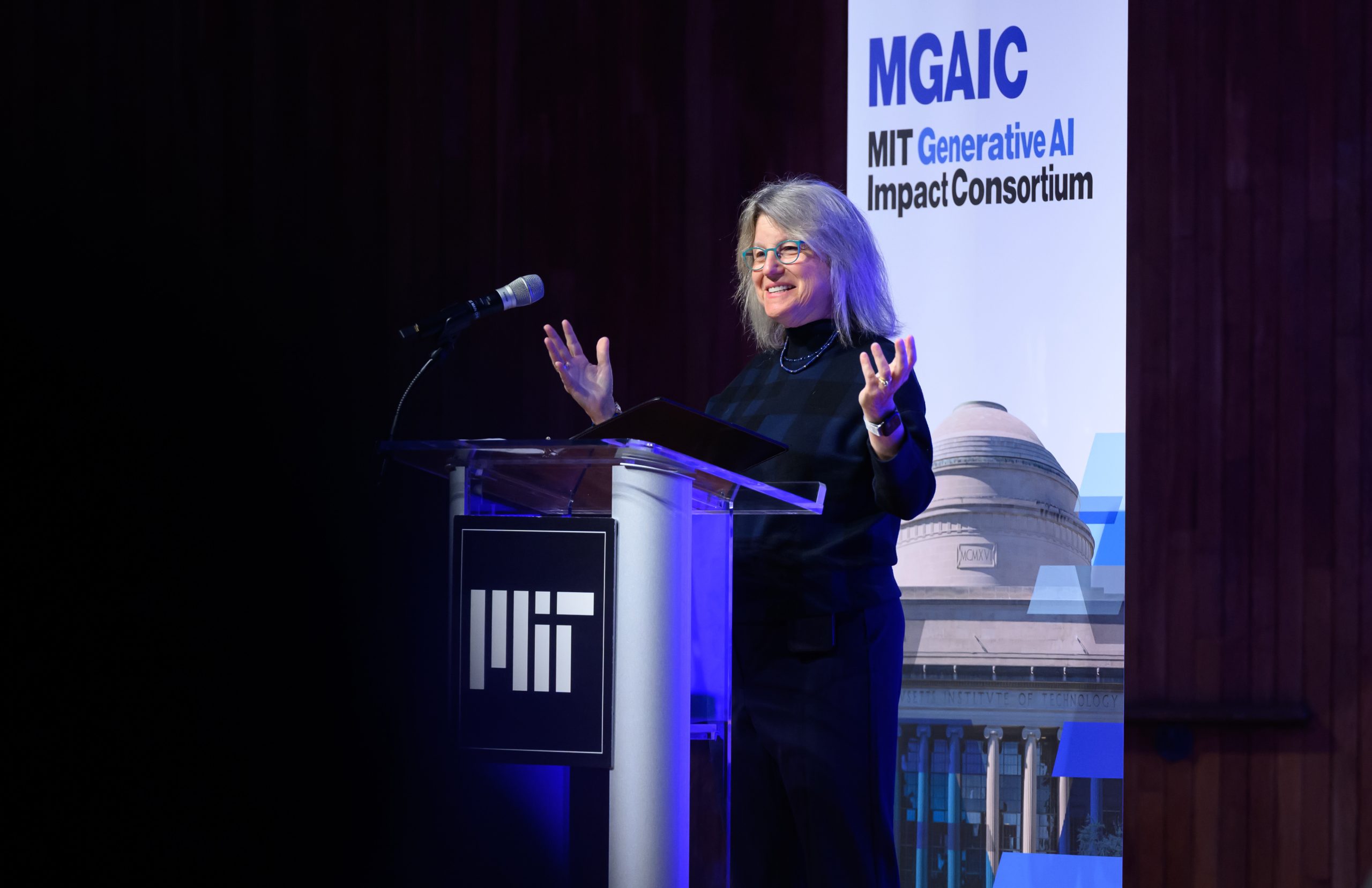
At the inaugural MIT Generative AI Impact Consortium Symposium, researchers and business leaders discussed potential advancements centered on this powerful technology. Adam Zewe | MIT News Publication Date : September…
Sources
- What does the future hold for generative AI?
- How MIT teaches and learns with AI
- MIT Generative AI Impact Consortium (MGAIC) Symposium
- Celebrating the advancement of technology leadership …
Related posts
- MIT’s generative AI diversifies virtual training grounds for robots
- MIT researchers develop speech-to-reality system that fabricates objects
- Italy Orders Meta to Pause WhatsApp Policy Blocking Rival AI Chatbots