
TL;DR
Researchers at MIT CSAIL and the Toyota Research Institute built a generative system that assembles realistic 3D indoor scenes to scale simulation data for robot training. The method steers a diffusion model with search and learning techniques to produce physically plausible environments and higher-quality, task-aligned scenes.
What happened
A team from MIT CSAIL working with the Toyota Research Institute introduced “steerable scene generation,” a pipeline that assembles lifelike 3D rooms for robot simulation. The system was trained on a library of over 44 million 3D rooms and places existing object assets into new layouts, then refines those scenes so they respect physical constraints (for example, avoiding object clipping). The approach steers a diffusion generator using strategies such as Monte Carlo tree search (MCTS) to explore alternative scene-building sequences and reinforcement learning to bias outputs toward specified objectives. In experiments the method produced more complex arrangements than its training distribution—for example filling a restaurant table with as many as 34 items when the training average was 17—and matched user prompts at high rates (98 percent for pantry shelves, 86 percent for messy breakfast tables). The paper was presented at the Conference on Robot Learning and the work is described as a proof of concept with planned future extensions.
Why it matters
- Generative assembly of realistic 3D scenes can produce far more diverse simulation data than manual creation, easing a major bottleneck for robot training.
- Physical plausibility (avoiding object clipping and respecting placement) makes simulated interactions more useful for teaching manipulation and arrangement tasks.
- Steering generation toward task-specific objectives could enable targeted datasets for dexterous or household robot behaviors, reducing the need for costly real-world data collection.
- Automated scene generation may accelerate research by allowing teams to sample many rare or complex scenarios that are hard to replicate in physical labs.
Key facts
- The system, called steerable scene generation, was developed at MIT CSAIL in collaboration with the Toyota Research Institute.
- Researchers trained on a dataset containing over 44 million 3D rooms populated with object models.
- Generation uses a diffusion model guided at runtime by search (Monte Carlo tree search) and optionally refined with reinforcement learning.
- In an experiment, MCTS expanded a restaurant table to as many as 34 items compared with a training average of 17 items per scene.
- Prompt-following performance reached 98% accuracy for pantry-shelf scenes and 86% for messy breakfast-table scenes, about 10+ percentage points above some prior methods cited.
- The tool can in-paint scenes (fill blanks while preserving existing elements) and enforces physical feasibility such as avoiding model clipping.
- Authors include Nicholas Pfaff and senior author Russ Tedrake; the paper was shown at the Conference on Robot Learning (CoRL).
- Support for the research came in part from Amazon and the Toyota Research Institute.
- Researchers describe the project as a proof of concept and plan further work to expand capabilities.
What to watch next
- Efforts to generate entirely new object geometries within scenes instead of relying on a fixed asset library (planned future work).
- Incorporation of articulated and interactive objects (cabinets, jars, etc.) so robots can practice opening and manipulating complex items.
- Integration with internet-derived object libraries and the team’s Scalable Real2Sim tools to bring more real-world variety into simulations.
Quick glossary
- Diffusion model: A type of generative AI that iteratively transforms random noise into coherent images or 3D content by learning a sequence of denoising steps.
- Monte Carlo tree search (MCTS): A search algorithm that explores possible sequences of decisions by sampling and evaluating many potential outcomes, often used to guide complex, sequential choices.
- Reinforcement learning: A machine-learning framework where an agent learns to make decisions by receiving rewards or penalties based on its actions, improving by trial and error.
- In-painting: A generative technique that fills missing or masked parts of an image or scene, producing plausible completions conditioned on surrounding content.
Reader FAQ
Does this system replace the need for real-world robot demonstrations?
Not confirmed in the source
Were the methods tested on physical robots in the paper?
Not confirmed in the source
What limitations do the researchers acknowledge?
The work is presented as a proof of concept and currently relies on a fixed library of object assets rather than generating novel object geometries or fully articulated items.
Who supported and where was the work presented?
The research was supported in part by Amazon and the Toyota Research Institute and was presented at the Conference on Robot Learning (CoRL).
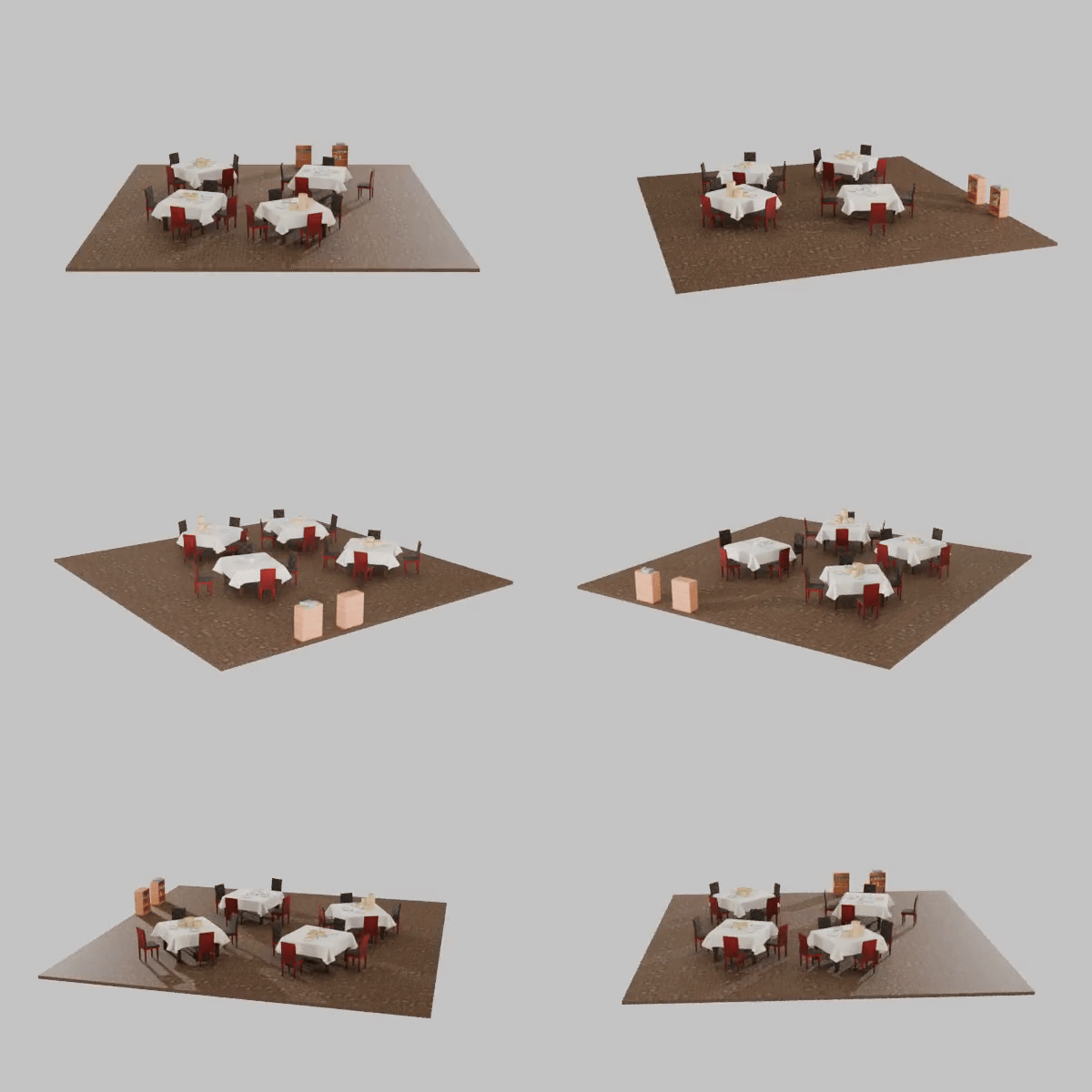
New tool from MIT CSAIL creates realistic virtual kitchens and living rooms where simulated robots can interact with models of real-world objects, scaling up training data for robot foundation models….
Sources
- Using generative AI to diversify virtual training grounds for robots
- MIT Releases Generative AI Tool for Virtual Robot Training
- How MIT Uses Generative AI to Build Smarter Non-Human …
- MIT Built a Virtual Playground Where Robots Learn to Think
Related posts
- MIT method stitches small submaps to build fast, accurate 3D maps
- MIT students study AI, autonomy and robotics for offshore aquaculture in Norway
- MIT develops control framework to keep soft robots within safe force limits