
TL;DR
At CES 2026 Nvidia unveiled a full robotics stack—foundation models, simulation tools, and on-device hardware—targeting generalist robots that can reason and act across tasks. The company published models on Hugging Face, released open-source simulation and orchestration tools, and introduced a Blackwell-powered Jetson T4000 card.
What happened
Nvidia used CES 2026 to roll out a comprehensive robotics ecosystem intended to support general-purpose physical AI. The company published several foundation models on Hugging Face, including Cosmos Transfer 2.5 and Cosmos Predict 2.5 for synthetic data and simulation-based policy evaluation; Cosmos Reason 2, a reasoning vision-language model; and Isaac GR00T N1.6, a vision-language-action model built for humanoid whole-body control that uses Cosmos Reason as its reasoning core. Nvidia also released Isaac Lab-Arena, an open-source simulation framework on GitHub that brings together training tools, task scenarios, and benchmarks such as Libero, RoboCasa, and RoboTwin. Supporting infrastructure includes Nvidia OSMO, an open-source command center to link data generation and training across desktop and cloud, and a new Blackwell-powered Jetson T4000 card—positioned as a power-efficient on-device compute option rated at roughly 1,200 teraflops with 64 GB of memory and operating between 40–70 watts. Nvidia said it is deepening a Hugging Face partnership to integrate its Isaac and GR00T work into the LeRobot framework, and noted growing adoption of its tooling among several robotics firms.
Why it matters
- A single, open stack could standardize development for generalist robots the way mobile OSes standardized phones, lowering integration friction.
- Combining simulation, models, and on-device compute aims to move more autonomous capabilities off the cloud and into robots, which can reduce latency and dependency on remote services.
- Open-source simulation and orchestration tools may cut the cost, time, and risk of validating complex robot behaviors before physical deployment.
- Stronger ties with Hugging Face and cross-compatible hardware could widen access to robotics development for non-specialist teams and hobbyists.
Key facts
- Announcement made at CES 2026.
- New models posted on Hugging Face: Cosmos Transfer 2.5, Cosmos Predict 2.5, Cosmos Reason 2, and Isaac GR00T N1.6.
- Isaac GR00T N1.6 is described as a next-generation vision-language-action model for humanoid whole-body control and uses Cosmos Reason as its reasoning component.
- Isaac Lab-Arena is an open-source simulation framework hosted on GitHub that consolidates training resources and benchmarks (Libero, RoboCasa, RoboTwin).
- Nvidia OSMO is an open-source command center intended to integrate workflows from synthetic data generation through model training across desktop and cloud.
- Blackwell-powered Jetson T4000 (part of the Thor family) is positioned as an on-device compute card offering about 1,200 teraflops and 64 GB of memory while consuming roughly 40–70 watts.
- Nvidia deepened collaboration with Hugging Face to integrate Isaac and GR00T into the LeRobot framework and connect developer communities.
- The Reachy 2 humanoid from Hugging Face’s developer platform now works with Nvidia’s Jetson Thor chip.
- Robotics has become the fastest-growing category on Hugging Face, with Nvidia’s models leading downloads.
- Several robotics companies, including Boston Dynamics, Caterpillar, Franka Robots, and NEURA Robotics, are reported to be using Nvidia’s technology.
What to watch next
- Timeline, pricing, and availability for the Jetson T4000 hardware — not confirmed in the source.
- How GR00T-powered humanoids perform in real-world deployments beyond simulations and demos — not confirmed in the source.
- Whether a broad set of robot makers and standards bodies adopt Nvidia’s stack as a de facto platform — not confirmed in the source.
Quick glossary
- Foundation model: A large AI model trained on broad data that can be adapted or fine-tuned for many downstream tasks.
- Simulation framework: Software that creates virtual environments to test and train robots safely before physical deployment.
- Vision-language model (VLM): A model that combines visual inputs and natural language to enable understanding and reasoning about scenes.
- On-device compute: Processing performed locally on a machine or robot rather than in a cloud server, reducing latency and network dependence.
- Open-source: Software whose source code is published and available for use, modification, and distribution by anyone under defined terms.
Reader FAQ
Which new models did Nvidia announce?
Cosmos Transfer 2.5, Cosmos Predict 2.5, Cosmos Reason 2, and Isaac GR00T N1.6 were announced and are available via Hugging Face.
Are the simulation and orchestration tools open-source?
Yes. Isaac Lab-Arena is on GitHub and Nvidia describes OSMO as open-source.
Is the Jetson T4000 available to buy now?
Not confirmed in the source.
Are other robotics companies using Nvidia’s stack?
The source names Boston Dynamics, Caterpillar, Franka Robots, and NEURA Robotics as using Nvidia technology.
Will Nvidia become the dominant robotics platform?
Not confirmed in the source.
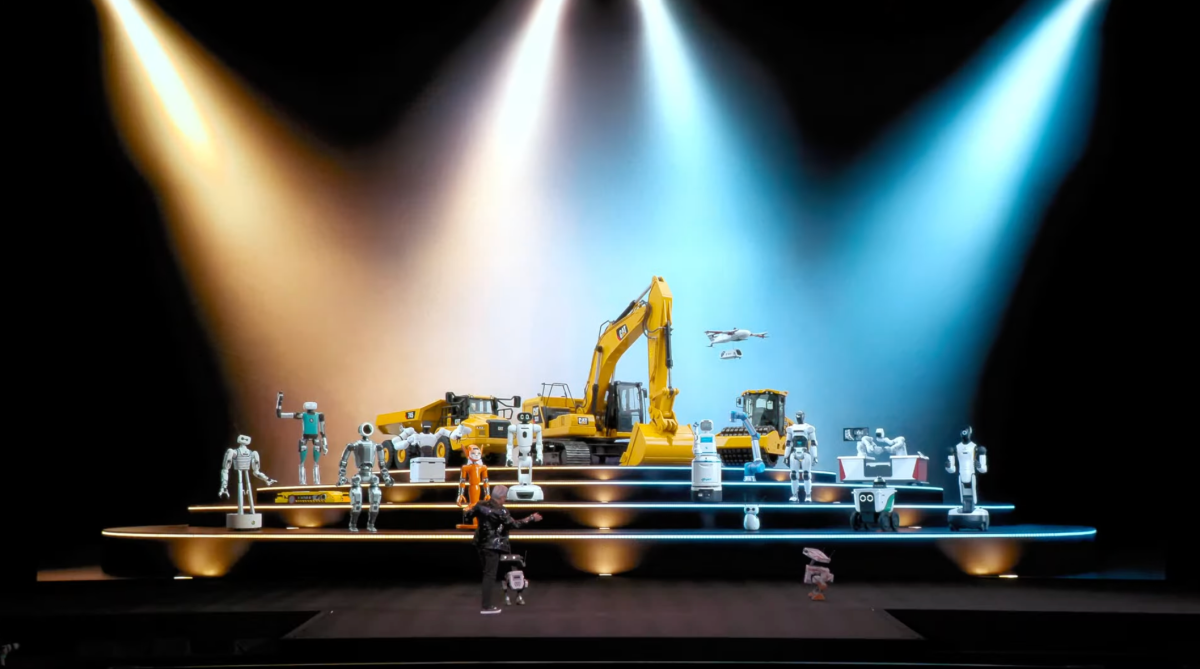
Nvidia released a new stack of robot foundation models, simulation tools, and edge hardware at CES 2026, moves that signal the company’s ambition to become the default platform for generalist…
Sources
- Nvidia wants to be the Android of generalist robotics
- AI for Robotics
- NVIDIA Announces Isaac GR00T N1 — the World's First …
- What Is NVIDIA's Three-Computer Solution for Robotics?
Related posts
- Uber, Lucid and Nuro unveil production-ready robotaxi at CES 2026
- Nvidia details Vera Rubin CPU and GPU architecture and NVL72 at CES
- Nvidia says DGX Spark performance has more than doubled since launch