
TL;DR
Nvidia has added an ambient light sensor to its latest G-Sync Pulsar monitors so displays can automatically change brightness and color temperature based on room lighting. The first models, 27-inch 1440p IPS panels up to 360Hz from Acer, AOC, Asus and MSI, arrive January 7 starting at $599.
What happened
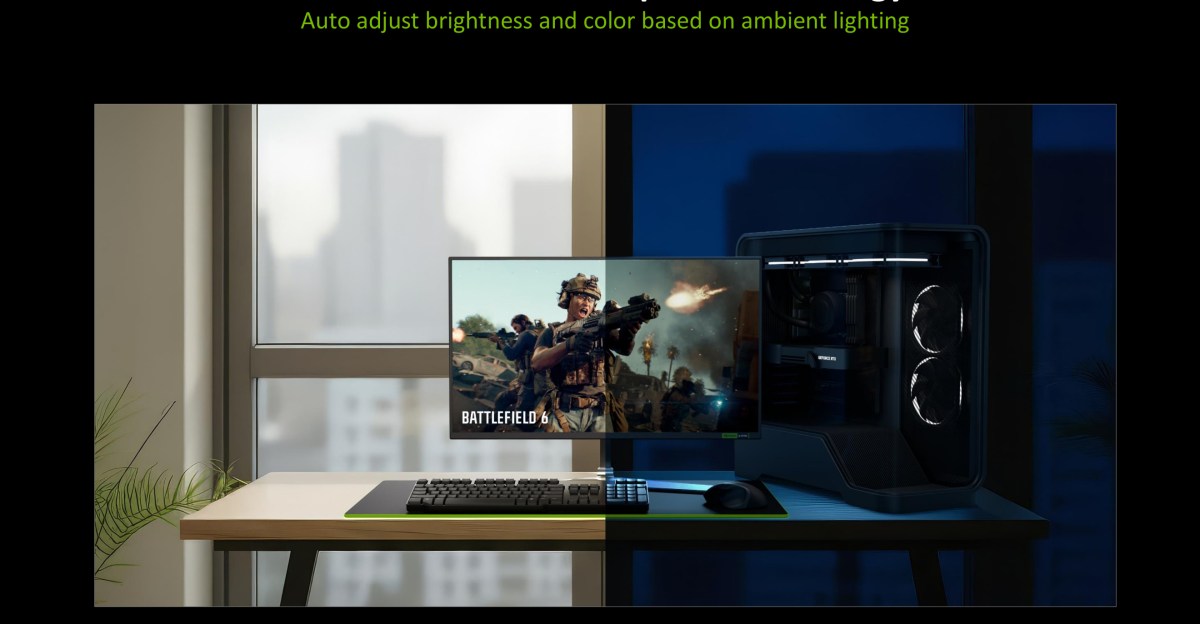
Nvidia introduced G-Sync Pulsar displays equipped with a built-in light sensor that monitors ambient brightness and color temperature and automatically adjusts screen brightness and color tone. The feature, billed as G-Sync Ambient Adaptive Technology, shifts displays toward cooler, brighter settings in daylight and reduces brightness with warmer tones in darker environments. Users retain control: the adaptive behavior can be tweaked or turned off through each monitor’s on‑screen display. The initial wave of monitors ships January 7, with partners Acer, AOC, Asus and MSI offering 27‑inch IPS models at 1440p and refresh rates up to 360Hz; pricing starts at $599. Nvidia first rolled out the G-Sync Pulsar family last year as part of a partnership with MediaTek to move key G-Sync functions into MediaTek scalers, removing the need for the dedicated G-Sync module that the technology required when it launched in 2013.
Why it matters
- Desktop monitors are gaining laptop-style automatic ambient adaptation, narrowing feature gaps between device classes.
- Automatic adjustment of brightness and color temperature can reduce glare and make screens easier to view in changing lighting conditions.
- Integration with MediaTek scalers continues Nvidia’s move away from dedicated G-Sync modules, simplifying hardware for manufacturers.
- Targeting esports-grade panels suggests the feature is being applied to high-refresh professional displays rather than general consumer models.
Key facts
- Feature name: G-Sync Ambient Adaptive Technology (as described in the source).
- Built-in light sensor measures ambient brightness and color temperature to drive automatic adjustments.
- Monitors can change to cooler, brighter tones in daylight and warmer, dimmer tones in darker rooms.
- User control is available via each monitor’s on-screen display to fine-tune or disable the feature.
- Available January 7, with starting price listed at $599.
- Initial partners: Acer, AOC, Asus and MSI.
- Hardware: 27-inch IPS panels, 1440p resolution, up to 360Hz refresh rate.
- G-Sync Pulsar branding follows Nvidia’s partnership with MediaTek to integrate G-Sync features into scalers and eliminate dedicated modules.
- Original G-Sync required a dedicated module at launch in 2013 to sync refresh rates, reduce tearing, and lower input lag and stutter.
What to watch next
- How much users rely on the automatic adjustments versus manual settings via each monitor’s on‑screen display (confirmed in the source).
- Whether the adaptive feature appears on other sizes, resolutions or non‑esports models beyond the initial 27‑inch offerings: not confirmed in the source.
- Any measurable impact on competitive gaming performance or latency from running the ambient adaptation: not confirmed in the source.
Quick glossary
- G-Sync: A variable refresh technology developed by Nvidia that synchronizes a display’s refresh rate with the GPU to reduce screen tearing and stutter.
- Ambient light sensor: A sensor that measures the brightness and sometimes the color temperature of surrounding light to allow displays to adjust accordingly.
- Color temperature: A numerical description of the color appearance of light, typically described as warm (reddish) or cool (bluish) tones.
- IPS: In‑plane switching, a type of LCD panel technology known for wider viewing angles and consistent color reproduction.
- Refresh rate: The number of times per second a display updates its image, measured in hertz (Hz); higher refresh rates can produce smoother motion.
Reader FAQ
When will these monitors be available?
The first G-Sync Pulsar models with the ambient adaptive feature will be available January 7.
How much do they cost?
Pricing starts at $599 for the initial models.
Which manufacturers are offering these monitors?
Acer, AOC, Asus and MSI are listed as partners for the initial displays.
Can I turn off the automatic brightness and color adjustments?
Yes. The monitors let users fine‑tune or disable the feature through the on‑screen display.
Will this feature appear on other monitor sizes or consumer lines?
not confirmed in the source
TECH GAMING CES Nvidia’s new G-Sync monitors automatically adjust brightness just like a laptop The latest G-Sync Pulsar monitors have a built-in light sensor so they can adjust brightness and…
Sources
- Nvidia’s new G-Sync monitors automatically adjust brightness just like a laptop
- g-sync-pulsar-gaming-monitor
- G-SYNC Pulsar tech debuts in the ROG Swift 360Hz … – ASUS
- Nvidia's G-Sync Pulsar is anti-blur monitor tech aimed …
Related posts
- Nvidia to Bring Native Linux and Fire TV Apps to GeForce Now
- AMD unveils new AI PC processors for general use and gaming at CES
- AMD’s CES CPU refresh raises clock speeds while leaving architecture intact