
TL;DR
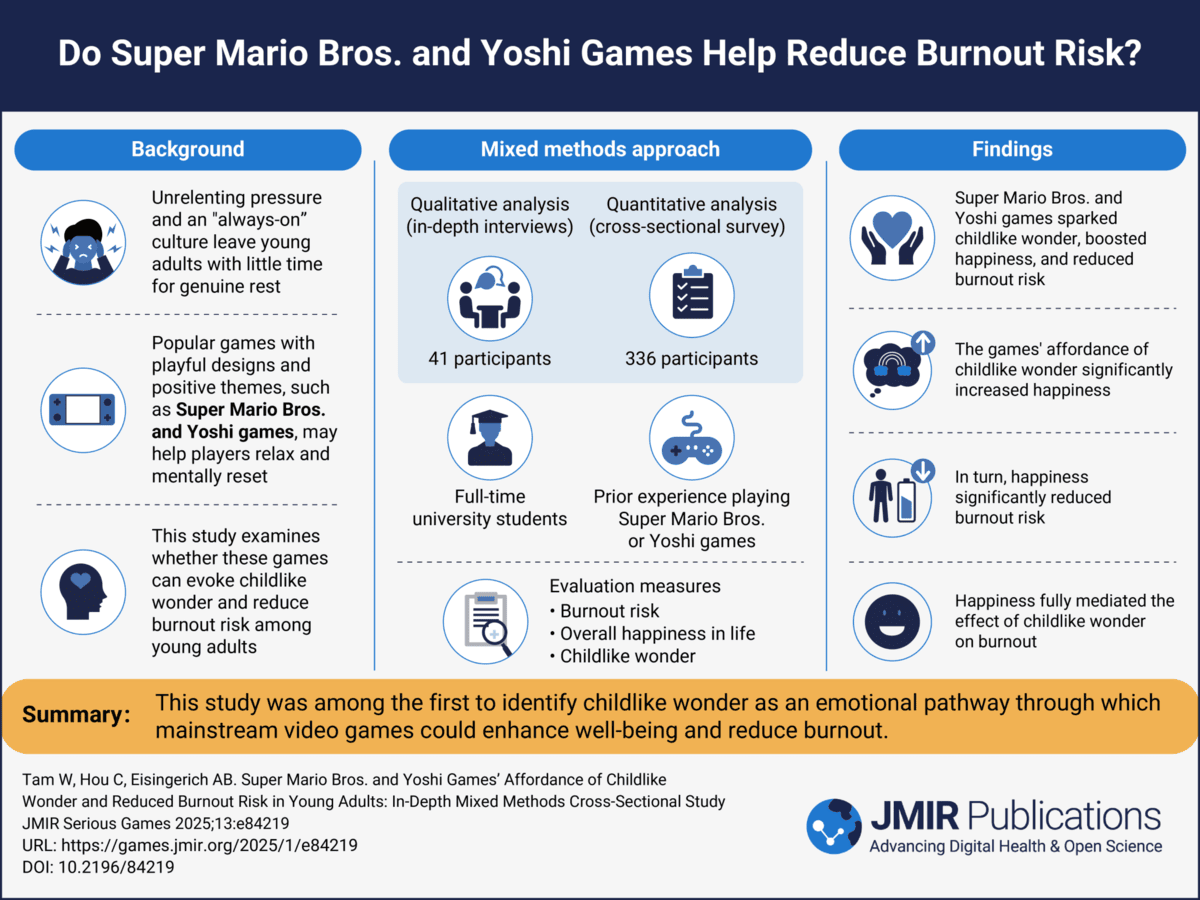
A mixed-methods study of Super Mario Bros. and Yoshi players found that these games are associated with increased feelings of childlike wonder and higher overall happiness, and that greater happiness was linked to lower burnout risk among young adults. Statistical analyses indicated happiness fully mediated the relationship between childlike wonder and burnout risk.
What happened
Researchers used a mixed-methods design to explore whether mainstream platformers like Super Mario Bros. and Yoshi can evoke childlike wonder and affect burnout risk in young adults. The qualitative component comprised 41 in-depth interviews with university students (mean age 22.51, SD 1.52; 19 women, 21 men, 1 prefer not to disclose). The quantitative arm surveyed 336 players of those franchises. Interview participants reported that playing these games evoked feelings associated with wonder, increased enjoyment, and offered respite from daily pressures. In the survey, measured affordance of childlike wonder predicted greater overall happiness (b=0.30, SE=0.04, P<.001). In turn, higher happiness predicted lower burnout risk (b=–0.48, SE=0.05, P<.001). Mediation analysis showed the effect of childlike wonder on burnout operated indirectly through happiness (indirect b=–0.14, bootstrapped SE=0.03), while the direct path to burnout was no longer statistically significant (b=–0.08, P=.06).
Why it matters
- Identifies an emotional pathway—feelings of childlike wonder—through which familiar games may relate to well-being.
- Suggests everyday, commercially available games could function as accessible microenvironments that help alleviate stress for young adults.
- Findings offer actionable insight for game designers, educators, and practitioners interested in nonclinical approaches to resilience-building.
- Highlights the potential value of studying positive emotional experiences in gaming beyond escapism or nostalgia.
Key facts
- Study published in JMIR Serious Games (2025) with DOI 10.2196/84219.
- Mixed-methods approach: 41 qualitative interviews and a cross-sectional survey of 336 players.
- Interview sample: mean age 22.51 years (SD 1.52); 19 women, 21 men, 1 prefer not to disclose.
- Games examined: Super Mario Bros. and Yoshi titles from the Mario franchise.
- Quantitative result: childlike wonder positively predicted happiness (b=0.30, SE=0.04, t=6.80, 95% CI 0.21–0.38; P<.001).
- Quantitative result: happiness negatively predicted burnout risk (b=–0.48, SE=0.05, t=–9.55, 95% CI –0.572 to –0.377).
- Mediation: happiness fully mediated the link between childlike wonder and burnout (indirect b=–0.14, bootstrapped SE=0.03; direct effect b=–0.08, P=.06).
- Background notes the Mario franchise has sold over 430 million copies worldwide, underscoring its broad cultural reach.
What to watch next
- Whether randomized or longitudinal studies confirm causal effects of gameplay on burnout and well-being — not confirmed in the source.
- Generalizability to other game genres and older or more diverse populations — not confirmed in the source.
- Long-term durability of reported effects (do short sessions produce lasting change?) — not confirmed in the source.
Quick glossary
- Childlike wonder: A sense of curiosity, awe, or delight that resembles emotional responses more common in childhood.
- Burnout: A state of chronic stress characterized by exhaustion, reduced efficacy, and feelings of overload; measurement approaches vary by study.
- Mediation: A statistical situation in which the effect of one variable on another operates through a third variable.
- Cross-sectional survey: A study design that collects data from participants at a single point in time to examine associations between variables.
Reader FAQ
Do Super Mario Bros. and Yoshi games reduce burnout?
The study found associations indicating these games are linked to greater happiness, and higher happiness was associated with lower burnout risk; this does not establish causation.
Who participated in the study?
Qualitative interviews involved 41 university students (mean age 22.51); the survey included 336 players.
Are the effects confirmed for other types of games?
Not confirmed in the source.
Can playing these games replace clinical treatment for burnout or mental health issues?
Not confirmed in the source.
Abstract Background: Unrelenting pressure and an “always-on” culture can leave no time for genuine rest among young adults. While playing video games has been noted to afford cognitive escapism and…
Sources
- Games’ affordance of childlike wonder and reduced burnout risk in young adults
- Super Mario Bros. and Yoshi Games' Affordance of Childlike …
- Playing Super Mario Bros. and Yoshi games may reduce …
- Study shows playing Super Mario Bros. and Yoshi games …
Related posts
- How AMD Broke Into CPUs 50 Years Ago With an Intel 8080 Clone
- My 2026 Open Social Web Predictions — Forecasts for Bluesky, Fediverse, Threads
- SPICE at 40: The open-source simulator that shaped modern IC design