
TL;DR
Researchers and industry partners are developing quantum inertial navigation for the London Underground using ultracold atom sensors that do not rely on satellites. MoniRail has received an additional £1.25 million from the UK government's quantum technology programme to advance the RQINS roadmap with several academic and industry collaborators.
What happened
Work is underway to adapt quantum accelerometers for railway use so trains can determine their position underground and where GPS is unavailable. The devices use clouds of atoms cooled close to absolute zero; at those temperatures atoms exhibit wave-like behaviour and their interference pattern shifts when accelerated. An optical measurement system reads those shifts to infer precise motion. MoniRail secured an extra £1.25 million from the UK government’s quantum technology programme to support the next phase of the Rail Quantum Inertial Navigation System (RQINS) roadmap, targeting the London Underground and possibly the wider national network. The approach is intended not only to improve onboard positioning—reducing uncertainty from metre-scale to centimetres—but also to enhance non-intrusive track monitoring by linking very precise location data to ride-quality sensors. The project involves Transport for London, QinetiQ, PA Consulting, Imperial College London and the University of Sussex.
Why it matters
- Provides precise positioning where satellite signals are blocked, such as deep tunnels and dense urban areas.
- Centimetre-level location could speed up fault finding and reduce time and cost for track maintenance.
- Offers a resilient navigation fallback independent of space-based systems, potentially mitigating economic impacts from GPS outages.
- Combines navigation and condition monitoring to deliver more actionable data from onboard sensors.
Key facts
- MoniRail received an additional £1.25 million from the UK government’s quantum technology programme to progress RQINS.
- RQINS is aimed at developing quantum navigation for the London Underground and potentially the national rail network.
- Quantum accelerometers use ultracold atom clouds; atoms act as waves and their interference reveals acceleration.
- Conventional train location in moving-block systems is accurate to metres; quantum navigation could reduce that to centimetres.
- Onboard sensors already collect ride-quality data; improved positioning can pinpoint defects more precisely.
- Project partners include Transport for London, QinetiQ, PA Consulting, Imperial College London and the University of Sussex.
- Once a vehicle has a known starting point, quantum accelerometers can keep tracking without satellite corrections.
- Estimates cited in the source suggest a single day of GPS disruption could cost the UK economy more than £1.4 billion.
What to watch next
- Schedule for laboratory validation and field trials: not confirmed in the source
- Plans for integration with existing signalling and train control systems: not confirmed in the source
- Timeline for any passenger-service deployment on the London Underground or national network: not confirmed in the source
Quick glossary
- Quantum accelerometer: A sensor that measures acceleration using quantum properties of particles, often employing ultracold atoms and matter-wave interference for high precision.
- Inertial navigation: A method of determining position by measuring motion (acceleration and rotation) from a known starting point, without relying on external signals.
- GPS (Global Positioning System): A satellite-based system that provides geolocation and time information to receivers on or near the Earth’s surface.
- Moving block: A train control approach where safe separation is calculated dynamically, giving location accuracy typically measured in metres rather than centimetres.
- Ultracold atoms: Atoms cooled to temperatures near absolute zero where quantum effects, such as wave-like behaviour, become measurable and exploitable for sensing.
Reader FAQ
How do quantum accelerometers determine a train’s position?
They use clouds of atoms cooled near absolute zero; the atoms’ wave-like interference shifts when accelerated and an optical system measures those shifts to infer motion from a known start point.
Will the system replace GPS entirely?
The source says quantum accelerometers do not require satellites once an initial position is known and could act as a resilient fallback, but whether they will replace GPS is not confirmed in the source.
Who is funding and building the project?
MoniRail received an extra £1.25 million from the UK government’s quantum technology programme; partners include Transport for London, QinetiQ, PA Consulting, Imperial College London and the University of Sussex.
When will passengers see this in service on the Underground?
Not confirmed in the source.
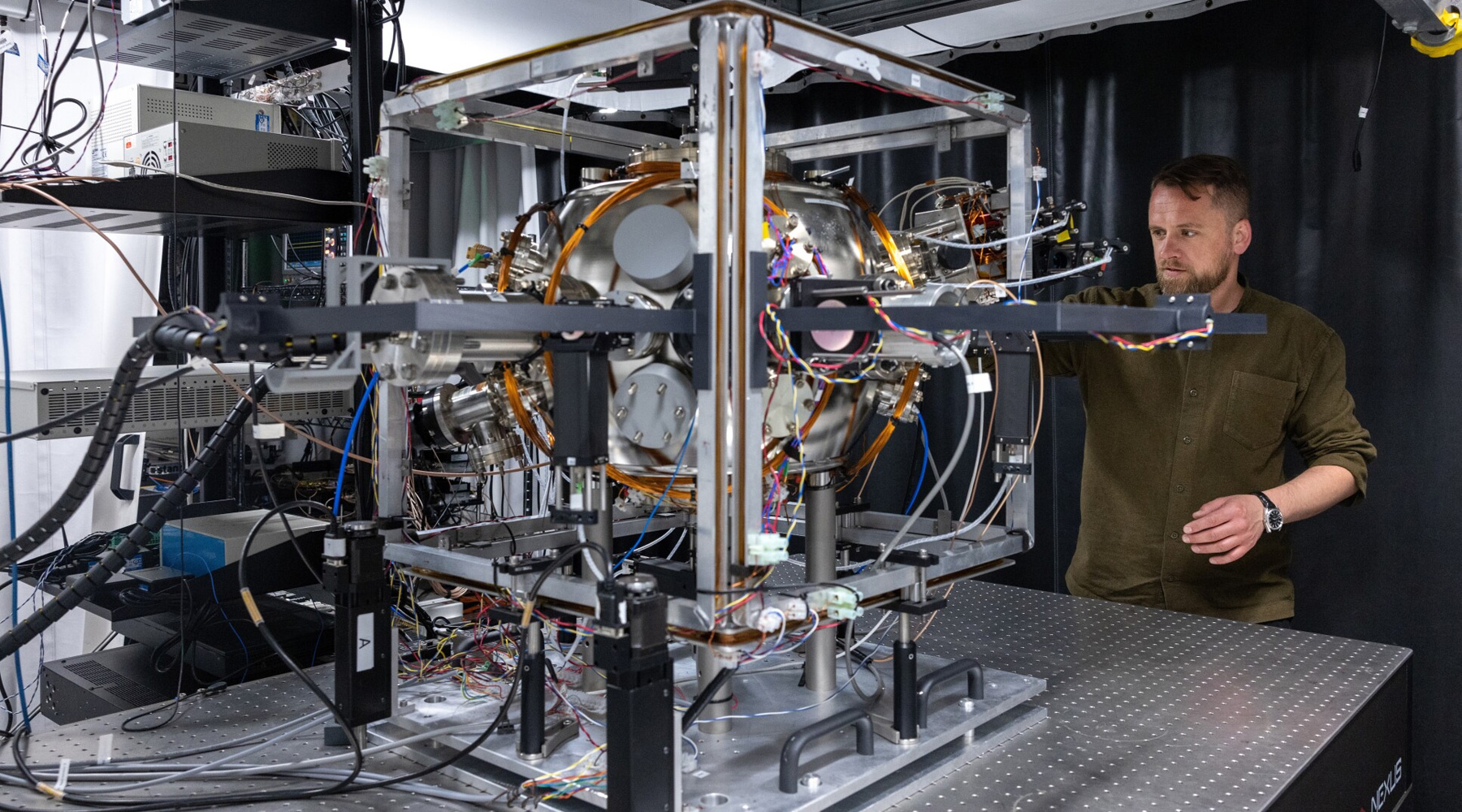
Tube trains could navigate the Underground using the weird rules of Quantum Physics Published on 6th January 2026 by Ian Mansfield in Science Tube trains of the future may soon…
Sources
- Tube trains could navigate the Underground using the rules of Quantum Physics
- First 3D quantum accelerometer could let ships navigate …
- No GPS, No Problem
- London Underground to be soon navigated by quantum …
Related posts
- Bosch adds free feature to make stolen e-bikes unusable and unsellable
- Mapping Protests in Iran: An Analytical Overview and Geographic Mapping
- DeskMate turns an iPhone into a panning AI companion and charging hub