
TL;DR
A recent talk by researcher h3artbl33d documents a reverse-engineering effort targeting Espressif’s proprietary Bluetooth subsystem on the ESP32. The presentation outlines techniques, discoveries about the Bluetooth peripheral, and the publication of tooling and SVD files intended to enable low-level access and independent auditing.
What happened
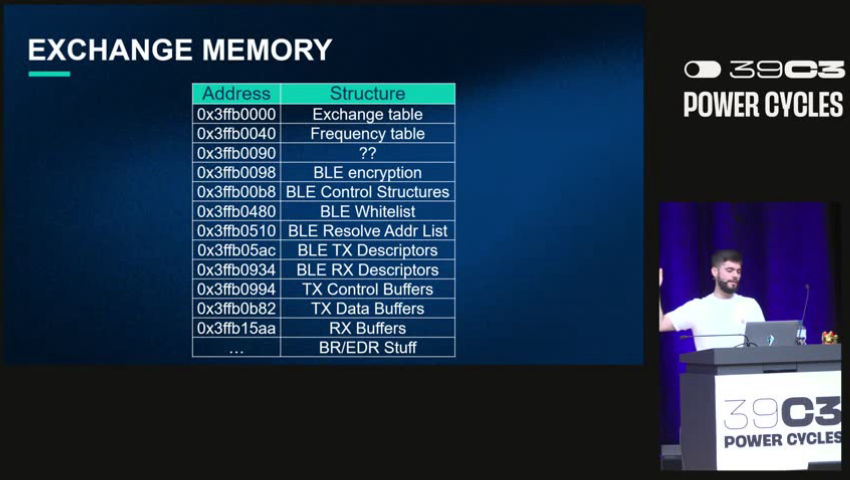
In a 34-minute presentation published recently, researcher h3artbl33d walked through a reverse-engineering project aimed at Espressif’s closed-source Bluetooth stack on the ESP32. The talk framed the work as a response to the lack of public documentation for a subsystem present in millions of devices, despite prior reverse engineering attention having focused on the ESP32 Wi‑Fi stack. The presenter described the methods used to map peripherals, recover symbol names, and work around broken memory references. The investigation revealed the Bluetooth peripheral’s architecture, its memory regions and associated interrupts, and surfaced some information about related on‑chip peripherals. As part of the effort, the speaker said they are publishing open tooling, SVD files and other documentation to help researchers, security analysts and developers gain low‑level access, audit implementations and experiment with custom Bluetooth stacks on the ESP32 platform.
Why it matters
- ESP32 devices with a proprietary Bluetooth stack are widely deployed, so improved transparency can affect many products.
- Open tooling and documentation can lower barriers for security research and independent auditing of Bluetooth implementations.
- Low‑level access makes it easier to prototype alternative or custom Bluetooth stacks and to repurpose hardware for novel use cases.
- Community‑shared resources may accelerate collaborative tooling and follow‑on research into undocumented peripherals.
Key facts
- The ESP32’s Bluetooth subsystem remains proprietary and largely undocumented according to the presenter.
- The talk was presented by h3artbl33d and runs about 33 minutes 53 seconds.
- The reverse‑engineering work covered peripheral mapping, navigating broken memory references and symbol name recovery.
- Investigators reported discovering the Bluetooth peripheral’s architecture, memory regions and interrupt structure.
- The presenter announced publication of open tooling, SVD files and additional documentation to support downstream work.
- The ESP32 is described in the talk as present in millions of devices and widely used by makers and hackers.
- Previous reverse engineering efforts have focused more on the ESP32 Wi‑Fi stack than on Bluetooth.
- The video was published on exquisite.tube and had 47 views at the time of capture.
What to watch next
- Where the published tooling, SVD files and documentation are hosted and how to access them — not confirmed in the source.
- Whether Espressif or device makers respond to the disclosures or provide official documentation — not confirmed in the source.
- If community contributors turn the published materials into production‑grade open Bluetooth stacks or audit reports — not confirmed in the source.
Quick glossary
- ESP32: A family of low‑cost, low‑power system‑on‑chip microcontrollers commonly used in hobbyist, industrial and IoT projects.
- Bluetooth stack: The software components that implement the Bluetooth protocol layers, from low‑level radio control to higher‑level profiles.
- Reverse engineering: The process of analyzing a system to discover its structure, function and operation, often without access to original design documents.
- SVD file: A device description format (usually CMSIS‑SVD) that lists a microcontroller’s peripherals, registers and bitfields to aid tooling and debugging.
Reader FAQ
Did the presenter release source code and files?
The talk states that open tooling, SVD files and documentation were published, but the hosting location and exact contents are not confirmed in the source.
Is the ESP32 Bluetooth stack now fully open source?
Not confirmed in the source.
Who gave the presentation and how long is it?
The presenter is h3artbl33d and the recorded talk is about 33 minutes 53 seconds long.
Did the research identify security vulnerabilities in the Bluetooth stack?
Not confirmed in the source.
Play Video Liberating Bluetooth on the ESP32 Published 6 hours ago • 47 views Hackers By h3artbl33d Subscribe Despite how widely used the ESP32 is, its Bluetooth stack remains closed…
Sources
- Liberating Bluetooth on the ESP32
- Liberating Bluetooth on the ESP32 – media.ccc.de
- Hacking Bluetooth the Easy way with ESP32 HCI …
- Reverse Engineering the ESP32-C3 Wi-Fi Drivers for Static …
Related posts
- Say No to Palantir in the NHS — Opposition Campaign and Call to Action
- How Expired SSL Certificates Can Halt Systems: Lessons from the Bazel Outage
- Rainbow Six Siege outages: accounts flooded with credits and random bans